Loading...
This comparison has not been analyzed yet.
One-time AI generation (~1 minute). Scores and timeline are already available below.
Aly Maher Pasha vs Su Tseng-chang
Aly Maher Pasha leads by 8.1 pts · 2 figures compared
…
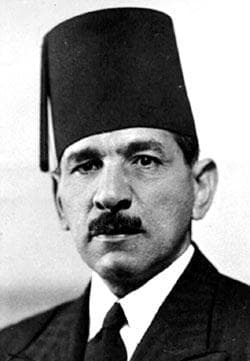
Aly Maher Pasha
Politician · Modern
51.9Total

Su Tseng-chang
Politician · Modern
43.8Total
Basic Information
Born
1882
1947
Died
1960
—
Era
Modern
Modern
Nationality
Egypt
China
Occupation
Politician
Politician
Civilization
Middle Eastern
Eastern
Score Comparison
Military (10%)
29.8
16.4
Political (20%)
68.0
68.0
Influence (20%)
51.0
49.4
Legacy (20%)
42.5
40.0
Leadership (15%)
74.0
40.0
Strategy (15%)
42.2
35.7
TOTAL
51.9
43.8
Aly Maher Pasha — Complete Timeline
1942 AD
Served as Prime Minister during the 1942 CrisisPolitical Action◆ Major
Aly Maher Pasha served as prime minister during the Abdeen Palace incident, when British forces surrounded the royal palace to force King Farouk to appoint a pro-Allied government. Maher resigned shortly after the crisis.
World War IIBritish InfluencePolitical Crisis
Impact: national
1952 AD
Appointed as Prime Minister after the 1952 RevolutionPolitical Action◆ Major
After the 1952 Egyptian Revolution, the Free Officers appointed Aly Maher Pasha as prime minister to manage the transition from monarchy to republic. He served briefly from July to September 1952 before being replaced.
RevolutionTransitionFree Officers
Impact: nationalconstructive
Resigned as Prime MinisterPolitical Action◆ Major
Maher resigned in September 1952 after disagreements with the Free Officers over land reform and the pace of political change. His resignation marked the end of civilian oversight and the consolidation of military rule.
ResignationFree OfficersPolitical Change
Impact: national
Su Tseng-chang — Complete Timeline
2006 AD
Premiership of the Republic of ChinaPolitical Action◆ Major
Su Tseng-chang served as Premier of the Republic of China from 2006 to 2007 under President Chen Shui-bian. He pursued anti-corruption measures and economic reforms, but resigned after a political scandal.
PremierROCChen Shui-bian
Impact: national
2007 AD
Resignation over Nuclear PolicyPolitical Action
Su Tseng-chang resigned as Premier in 2007 after a dispute with President Chen Shui-bian over the closure of the Fourth Nuclear Power Plant. His resignation highlighted divisions within the DPP over energy policy.
ResignationNuclear PowerDPP
Impact: national
2019 AD
Second PremiershipPolitical Action◆ Major
Su Tseng-chang returned as Premier in 2019 under President Tsai Ing-wen. He led the government's response to the COVID-19 pandemic, implementing border controls and economic stimulus measures.
PremierCOVID-19Tsai Ing-wen
Impact: nationalconstructive
This comparison has not been analyzed yet.
One-time AI generation (~1 minute). Scores and timeline are already available below.
Rankings
🥇
Aly Maher PashaLeader
Mil: 29.8Pol: 68.0Inf: 51.0
51.9
🥈
Su Tseng-chang
Mil: 16.4Pol: 68.0Inf: 49.4
43.8
+8.1 behind
How This Comparison Works
Algorithm
Each figure is scored on 6 dimensions (0—100 scale) based on structured historical data: Military (10%), Political (20%), Influence (20%), Legacy (20%), Leadership (15%), Strategy (15%). The weighted total produces the final ranking.
Data Sources
Scores are computed from structured sub-indicators in the database. Scale factors adjust for era (Ancient ×0.85, Modern ×1.0) and civilization size (Eastern ×1.05, Other ×0.80) to account for differences in population and military scale.
Maximum 3 Figures
Comparisons are limited to 2—3 figures to ensure readability and statistical meaningfulness.
Error Margins
±5 points per dimension — Sub-scores are derived from historical records with inherent uncertainty. Two figures within 5 points on a dimension should be considered roughly equivalent in that area.
Total Score Accuracy
±3 points overall — The weighted combination of 6 dimensions produces a total score with approximately ±3 points of uncertainty. Differences of less than 3 points are not statistically significant— the figures are effectively tied.
Known Limitations
- Historical records are incomplete and uneven across civilizations
- Figures from oral-tradition societies may be underrepresented
- Occupation labels can misclassify multi-role figures
- Scores measure capability and impact, not moral character
- Quantitative scoring is a comparison tool, not absolute truth
Capability Radar
Military (10%) — Battles & Warfare
Battles
24
13
Win Rate
22
17
Expansion
25
19
Political (20%) — Governance & Reform
Reform
40
40
Diplomacy
50
45
Economy
35
50
Influence (20%) — Cultural & Global Reach
Cultural
20
20
Global
15
15
Legacy (20%) — Historical Impact
Historical
25
25
Longevity
20
15
Leadership (15%) — Power & Stability
Tenure
55
55
Stability
30
40
Strategy (15%) — Tactics & Innovation
Strategy
33
24
Tactics
33
26
Reform
35
27
Similar Comparisons
Comments & Discussion
No comments yet. Be the first to share your thoughts!