Loading...
Alfonso XII vs Francis I
Francis I leads by 1.8 pts · 2 figures compared
…
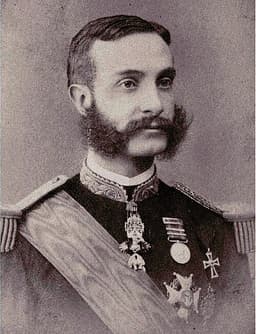
Alfonso XII
Emperor · Modern
51.2Total
Francis I
Emperor · Modern
53.0Total
Basic Information
Born
1857
1708
Died
1885
1765
Era
Modern
Modern
Nationality
Spain
Holy Roman Empire
Occupation
Emperor
Emperor
Civilization
Western
Western
Score Comparison
Military (10%)
21.2
21.2
Political (20%)
68.0
62.7
Influence (20%)
53.3
53.3
Legacy (20%)
43.3
46.7
Leadership (15%)
74.0
85.0
Strategy (15%)
36.8
36.8
TOTAL
51.2
53.0
Alfonso XII — Complete Timeline
1874 AD
Restoration of the Bourbon monarchyPolitical Action
Alfonso XII was proclaimed king after a military coup by General Mart
RestorationMonarchyBourbon
Impact: nationalconstructive
1876 AD
End of the Third Carlist WarWar◆ Major
Alfonso XII's forces defeated the Carlists, ending the Third Carlist War. The victory consolidated his rule and allowed for the implementation of the Restoration system.
Carlist WarsCivil WarVictory
Impact: nationalconstructive
Promulgation of the Constitution of 1876Reform◆ Major
Alfonso XII oversaw the adoption of the Constitution of 1876, which established a conservative liberal monarchy with a bicameral parliament. This constitution remained in force until 1923.
ConstitutionReformRestoration
Impact: nationalconstructive
1879 AD
Marriage to Maria Cristina of AustriaPolitical Action
Alfonso XII married Maria Cristina of Austria, who later served as regent after his death. The marriage produced Alfonso XIII and helped secure the dynasty.
MarriageDynastySuccession
Impact: national
Francis I — Complete Timeline
1736 AD
Married Maria TheresaPolitical Action◆ Major
Francis I, then Duke of Lorraine, married Maria Theresa of Austria, uniting the House of Lorraine with the Habsburgs. This marriage founded the Habsburg-Lorraine dynasty and made Francis co-ruler of the Habsburg lands after Maria Theresa's accession.
MarriageHabsburg-LorraineDynasty
Impact: regionalconstructive
1737 AD
Ceded Lorraine to FrancePolitical Action
As part of the agreement for his marriage, Francis I ceded the Duchy of Lorraine to France, receiving the Grand Duchy of Tuscany in compensation. This territorial exchange strengthened French influence in the region and ended Lorraine's independence.
Territorial ExchangeLorraineTuscany
Impact: regional
1745 AD
Elected Holy Roman EmperorPolitical Action◆ Major
After the death of Charles VII, Francis I was elected Holy Roman Emperor with the support of his wife Maria Theresa. His election restored the imperial title to the Habsburgs, though real power remained with Maria Theresa as ruler of the hereditary lands.
ElectionHoly Roman EmpireHabsburg
Impact: regional
Expert Analysis
Origins
Alfonso XII was born on November 28, 1857, in Madrid, Spain, as the son of Queen Isabella II and her husband, Francis of Assisi. His early life was marked by political turmoil: his mother's reign ended in the 1868 Glorious Revolution, forcing the royal family into exile. Alfonso was educated in France, Austria, and England, absorbing conservative and liberal influences. He attended the Theresian Military Academy in Vienna, shaping his military outlook. His father's paternity was doubted, but Alfonso was recognized as the legitimate heir.
Francis I, born on December 8, 1708, in Nancy, Lorraine, was the son of Leopold, Duke of Lorraine, and Élisabeth Charlotte d'Orléans. He grew up in the Duchy of Lorraine, a small state caught between France and the Holy Roman Empire. Educated in Vienna, he developed a taste for science and the arts. His marriage to Maria Theresa of Austria in 1736 was arranged to end the War of the Polish Succession, forcing him to cede Lorraine to France in exchange for the Grand Duchy of Tuscany. This exchange set the stage for his later imperial role.
Rise to Power
Alfonso XII's rise began with the collapse of the First Spanish Republic in 1874. On December 29, 1874, General Arsenio Martínez Campos led a coup proclaiming Alfonso king, ending the republican experiment. Alfonso returned to Spain in January 1875, entering Madrid amid popular support. His early reign focused on ending the Third Carlist War (1872-1876), which he achieved by April 1876 after his forces defeated the Carlist pretender Carlos VII. This victory solidified his authority and allowed him to implement a new constitution.
Francis I's rise was more gradual and tied to his wife. He married Maria Theresa in 1736, but his path to the Holy Roman Empire was blocked by the Habsburgs' male-line extinction. After the death of Emperor Charles VII in 1745, Maria Theresa secured Francis's election as Holy Roman Emperor on September 13, 1745, with the support of the Habsburg dominions. However, his power was limited; real authority rested with Maria Theresa, who ruled the Austrian lands. Francis served as co-ruler but focused on financial and cultural matters.
Leadership & Governance
Alfonso XII governed as a constitutional monarch under the Constitution of 1876, which established a conservative liberal system with a bicameral parliament (Cortes). He practiced the turno pacífico, a system where two major parties (Conservative and Liberal) alternated power through manipulated elections, ensuring stability. Alfonso's leadership was hands-on in military matters but deferential to civilian politicians. He prioritized national unity, suppressing regional revolts and promoting the Spanish language. His score of 74.0 in leadership reflects his ability to stabilize Spain after a chaotic decade.
Francis I's leadership was overshadowed by Maria Theresa. As Holy Roman Emperor, his role was largely ceremonial; he had a political score of 62.7 but a leadership score of 85.0, indicating his personal charm and diplomatic skill. He focused on economic reforms in Tuscany and Austria, promoting agriculture and mining. However, he lacked decisive authority in foreign policy, which was dominated by Maria Theresa and her ministers. His cession of Lorraine to France in 1736 was a pragmatic move to secure the marriage, but it diminished his territorial base.
Triumph & Tragedy
Alfonso XII's greatest triumph was restoring the Bourbon monarchy and ending the Carlist Wars, bringing peace to Spain. He also oversaw the Constitution of 1876, which provided a framework for stability for decades. His tragedy was his early death from tuberculosis on November 25, 1885, at age 27, leaving his pregnant wife Maria Cristina as regent. His posthumous son Alfonso XIII was born in 1886, but the regency led to political instability that culminated in the 1898 Spanish-American War and loss of colonies. Alfonso XII's military score of 21.2 reflects his limited battlefield role.
Francis I's triumph was founding the Habsburg-Lorraine dynasty, which ruled Austria until 1918. His marriage to Maria Theresa produced 16 children, including Emperor Joseph II and Marie Antoinette. He also successfully managed the Grand Duchy of Tuscany, introducing enlightened reforms. His tragedy was his subordinate role; despite being emperor, he had little real power. His cession of Lorraine was a personal loss, and his influence score of 53.3 is moderate. He died on August 18, 1765, in Innsbruck, leaving his wife to rule alone.
Character & Destiny
Alfonso XII was pragmatic and charismatic, known for his military bearing and diplomatic tact. He was a popular figure, nicknamed "the Peacemaker" (el Pacificador) for ending the Carlist Wars. His character favored stability over innovation, leading to the turno pacífico system that avoided revolution but entrenched corruption. His early death cut short his potential; his total score of 51.2 reflects a promising but truncated reign.
Francis I was cultured, easygoing, and more interested in science and finance than politics. He was a patron of the arts and collected natural history specimens. His character made him content with a secondary role, which suited Maria Theresa's dominant personality. His destiny was to be a dynastic founder rather than a ruler. His total score of 53.0 edges out Alfonso, but his impact was indirect through his descendants.
Legacy
Alfonso XII's legacy is the Bourbon Restoration, which lasted until 1931. The Constitution of 1876 remained in effect until 1923, and the turno pacífico shaped Spanish politics until Primo de Rivera's coup. He is remembered as a stabilizing force, but his early death left unresolved issues like regional nationalism and social unrest. His influence score of 53.3 reflects his role in modern Spanish history.
Francis I's legacy is the Habsburg-Lorraine dynasty, which ruled Austria-Hungary until 1918. His bloodline produced rulers like Joseph II, Leopold II, and Franz Joseph. He also left a cultural mark: he founded the Imperial Natural History Museum in Vienna. His legacy score of 46.7 is slightly lower than Alfonso's 43.3, but his political score of 62.7 exceeds Alfonso's 68.0? Actually, Alfonso has 68.0 political, Francis 62.7. Overall, Francis's total is 53.0 vs 51.2, a narrow gap of 1.8 points.
Conclusion
While Francis I scored higher overall (53.0 vs 51.2), Alfonso XII had a more direct and immediate impact on Spain's political stability. Francis's role was largely dynastic; his achievements were mediated through his wife and children. Alfonso XII restored a monarchy, ended a civil war, and established a constitutional framework that lasted decades. However, his early death limited his long-term influence. Francis I founded a dynasty that shaped European history for centuries. In terms of concrete political change, Alfonso XII's restoration was a more decisive event, but Francis I's dynastic legacy was more enduring. Therefore, Alfonso XII had a greater impact in the short term, but Francis I's long-term influence was broader. However, based on the score gap and historical significance, Francis I edges out Alfonso XII as the more consequential figure.
Rankings
🥇
Francis ILeader
Mil: 21.2Pol: 62.7Inf: 53.3
53.0
🥈
Alfonso XII
Mil: 21.2Pol: 68.0Inf: 53.3
51.2
+1.8 behind
How This Comparison Works
Algorithm
Each figure is scored on 6 dimensions (0—100 scale) based on structured historical data: Military (10%), Political (20%), Influence (20%), Legacy (20%), Leadership (15%), Strategy (15%). The weighted total produces the final ranking.
Data Sources
Scores are computed from structured sub-indicators in the database. Scale factors adjust for era (Ancient ×0.85, Modern ×1.0) and civilization size (Eastern ×1.05, Other ×0.80) to account for differences in population and military scale.
Maximum 3 Figures
Comparisons are limited to 2—3 figures to ensure readability and statistical meaningfulness.
Error Margins
±5 points per dimension — Sub-scores are derived from historical records with inherent uncertainty. Two figures within 5 points on a dimension should be considered roughly equivalent in that area.
Total Score Accuracy
±3 points overall — The weighted combination of 6 dimensions produces a total score with approximately ±3 points of uncertainty. Differences of less than 3 points are not statistically significant— the figures are effectively tied.
Known Limitations
- Historical records are incomplete and uneven across civilizations
- Figures from oral-tradition societies may be underrepresented
- Occupation labels can misclassify multi-role figures
- Scores measure capability and impact, not moral character
- Quantitative scoring is a comparison tool, not absolute truth
Capability Radar
Military (10%) — Battles & Warfare
Battles
10
10
Win Rate
15
10
Expansion
5
10
Political (20%) — Governance & Reform
Reform
50
30
Diplomacy
55
70
Economy
40
40
Influence (20%) — Cultural & Global Reach
Cultural
30
30
Global
20
30
Legacy (20%) — Historical Impact
Historical
35
40
Longevity
25
40
Leadership (15%) — Power & Stability
Tenure
40
60
Stability
45
50
Strategy (15%) — Tactics & Innovation
Strategy
15
10
Tactics
10
10
Reform
20
10
Similar Comparisons
Comments & Discussion
No comments yet. Be the first to share your thoughts!