Loading...
This comparison has not been analyzed yet.
One-time AI generation (~1 minute). Scores and timeline are already available below.
Alfonso XII of Spain vs Barghash bin Said
Barghash bin Said leads by 7.7 pts · 2 figures compared
…
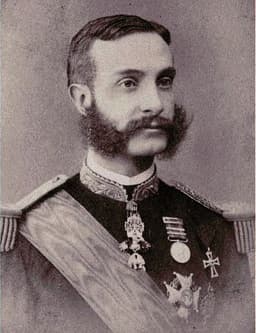
Alfonso XII of Spain
Emperor · Modern
49.2Total

Barghash bin Said
Emperor · Modern
56.9Total
Basic Information
Born
1857
1837
Died
1885
1888
Era
Modern
Modern
Nationality
Spain
Zanzibar
Occupation
Emperor
Emperor
Civilization
Western
Other
Score Comparison
Military (10%)
25.9
45.0
Political (20%)
60.0
65.0
Influence (20%)
53.3
60.0
Legacy (20%)
44.2
49.2
Leadership (15%)
68.0
66.0
Strategy (15%)
30.3
54.6
TOTAL
49.2
56.9
Alfonso XII of Spain — Complete Timeline
1874 AD
Restoration of the Bourbon monarchyPolitical Action
Alfonso XII was proclaimed king after a military coup led by General Mart
RestorationBourbonMonarchy
Impact: nationalconstructive
1876 AD
End of the Third Carlist WarWar◆ Major
Alfonso XII's forces defeated the Carlist rebels, ending the Third Carlist War. This victory consolidated his rule and eliminated the Carlist challenge to the Bourbon monarchy, bringing peace to Spain after years of civil conflict.
Carlist WarVictoryPeace
Impact: nationalconstructive
Signing of the Constitution of 1876Reform◆ Major
Alfonso XII oversaw the adoption of a new constitution that established a constitutional monarchy with a bicameral parliament. The constitution provided a framework for political stability and alternation between two main parties, the Conservatives and Liberals.
ConstitutionReformStability
Impact: nationalconstructive
1879 AD
Marriage to Maria Christina of AustriaPolitical Action
Alfonso XII married Maria Christina of Austria, his second wife. This marriage produced the future Alfonso XIII and helped secure the Bourbon succession, ensuring the dynasty's continuity after the king's early death.
MarriageSuccessionDynasty
Impact: national
1885 AD
Death of Alfonso XIIOther◆ Major
Alfonso XII died of tuberculosis at the age of 27, leaving his pregnant wife as regent. His death created a succession crisis, but his posthumous son Alfonso XIII was born later that year, ensuring the continuation of the Bourbon monarchy.
DeathSuccessionRegency
Impact: nationaltragic
Barghash bin Said — Complete Timeline
1870 AD
Accession as Sultan of ZanzibarPolitical Action◆ Major
Barghash bin Said became Sultan of Zanzibar after the death of his brother Majid. He inherited a prosperous but contested state, facing pressure from European powers and internal challenges to his authority.
SuccessionZanzibar
Impact: regional
Construction of Stone TownCultural◆ Major
Barghash bin Said oversaw the extensive building of Stone Town in Zanzibar City, constructing palaces, mosques, and public buildings using coral stone. This architectural project transformed the city into a major Swahili cultural and commercial center.
ArchitectureUrban DevelopmentZanzibar
Impact: regionalconstructive
Resisted British demands for abolitionPolitical Action
Barghash bin Said initially resisted British demands to end the slave trade, seeking to preserve Zanzibar's economic base. He delayed negotiations and sought support from other powers, but ultimately capitulated under threat of naval blockade.
ResistanceDiplomacySlavery
Impact: regional
1873 AD
Abolished the slave trade in ZanzibarReform
Under British pressure, Barghash bin Said signed a treaty abolishing the slave trade in Zanzibar. This ended the island's role as a major slave market, though slavery itself continued for decades. The move reduced British interference temporarily.
AbolitionSlaveryReform
Impact: regionalprogressive
This comparison has not been analyzed yet.
One-time AI generation (~1 minute). Scores and timeline are already available below.
Rankings
🥇
Barghash bin SaidLeader
Mil: 45.0Pol: 65.0Inf: 60.0
56.9
🥈
Alfonso XII of Spain
Mil: 25.9Pol: 60.0Inf: 53.3
49.2
+7.7 behind
How This Comparison Works
Algorithm
Each figure is scored on 6 dimensions (0—100 scale) based on structured historical data: Military (10%), Political (20%), Influence (20%), Legacy (20%), Leadership (15%), Strategy (15%). The weighted total produces the final ranking.
Data Sources
Scores are computed from structured sub-indicators in the database. Scale factors adjust for era (Ancient ×0.85, Modern ×1.0) and civilization size (Eastern ×1.05, Other ×0.80) to account for differences in population and military scale.
Maximum 3 Figures
Comparisons are limited to 2—3 figures to ensure readability and statistical meaningfulness.
Error Margins
±5 points per dimension — Sub-scores are derived from historical records with inherent uncertainty. Two figures within 5 points on a dimension should be considered roughly equivalent in that area.
Total Score Accuracy
±3 points overall — The weighted combination of 6 dimensions produces a total score with approximately ±3 points of uncertainty. Differences of less than 3 points are not statistically significant— the figures are effectively tied.
Known Limitations
- Historical records are incomplete and uneven across civilizations
- Figures from oral-tradition societies may be underrepresented
- Occupation labels can misclassify multi-role figures
- Scores measure capability and impact, not moral character
- Quantitative scoring is a comparison tool, not absolute truth
Capability Radar
Military (10%) — Battles & Warfare
Battles
15
5
Win Rate
20
5
Expansion
5
10
Political (20%) — Governance & Reform
Reform
60
70
Diplomacy
70
65
Economy
50
70
Influence (20%) — Cultural & Global Reach
Cultural
30
60
Global
30
40
Legacy (20%) — Historical Impact
Historical
40
55
Longevity
35
50
Leadership (15%) — Power & Stability
Tenure
40
60
Stability
65
55
Strategy (15%) — Tactics & Innovation
Strategy
15
5
Tactics
10
5
Reform
30
10
Similar Comparisons
Comments & Discussion
No comments yet. Be the first to share your thoughts!