Loading...
Alfonso XII of Spain vs Napoleon Bonaparte
Napoleon Bonaparte leads by 21.7 pts · 2 figures compared
…
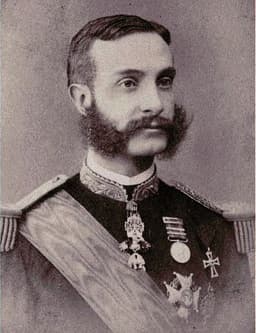
Alfonso XII of Spain
Emperor · Modern
49.2Total

Napoleon Bonaparte
General · Modern
70.9Total
Basic Information
Born
1857
1769
Died
1885
1821
Era
Modern
Modern
Nationality
Spain
France
Occupation
Emperor
General
Civilization
Western
Western
Score Comparison
Military (10%)
25.9
94.0
Political (20%)
60.0
72.0
Influence (20%)
53.3
40.0
Legacy (20%)
44.2
80.0
Leadership (15%)
68.0
78.0
Strategy (15%)
30.3
90.0
TOTAL
49.2
70.9
Alfonso XII of Spain — Complete Timeline
1874 AD
Restoration of the Bourbon monarchyPolitical Action
Alfonso XII was proclaimed king after a military coup led by General Mart
RestorationBourbonMonarchy
Impact: nationalconstructive
1876 AD
End of the Third Carlist WarWar◆ Major
Alfonso XII's forces defeated the Carlist rebels, ending the Third Carlist War. This victory consolidated his rule and eliminated the Carlist challenge to the Bourbon monarchy, bringing peace to Spain after years of civil conflict.
Carlist WarVictoryPeace
Impact: nationalconstructive
Signing of the Constitution of 1876Reform◆ Major
Alfonso XII oversaw the adoption of a new constitution that established a constitutional monarchy with a bicameral parliament. The constitution provided a framework for political stability and alternation between two main parties, the Conservatives and Liberals.
ConstitutionReformStability
Impact: nationalconstructive
1879 AD
Marriage to Maria Christina of AustriaPolitical Action
Alfonso XII married Maria Christina of Austria, his second wife. This marriage produced the future Alfonso XIII and helped secure the Bourbon succession, ensuring the dynasty's continuity after the king's early death.
MarriageSuccessionDynasty
Impact: national
1885 AD
Death of Alfonso XIIOther◆ Major
Alfonso XII died of tuberculosis at the age of 27, leaving his pregnant wife as regent. His death created a succession crisis, but his posthumous son Alfonso XIII was born later that year, ensuring the continuation of the Bourbon monarchy.
DeathSuccessionRegency
Impact: nationaltragic
Napoleon Bonaparte — Complete Timeline
1799 AD
Coup of 18 BrumaireOther◆ Major
Napoleon Bonaparte, with support from his brother Lucien and key political figures, overthrew the Directory in a bloodless coup. He established the Consulate with himself as First Consul, effectively becoming the ruler of France. This event ended the French Revolution's most unstable period.
French RevolutionCoupRise to Power
Impact: regional
1804 AD
Promulgation of the Napoleonic CodeOther◆ Major
Napoleon enacted the Civil Code of the French, known as the Napoleonic Code, a comprehensive set of laws that replaced the fragmented feudal legal systems. The code established legal equality, protected property rights, and secularized law. It became the basis for legal systems in many European and world countries.
Legal ReformNapoleonic CodeCivil Law
Impact: globalconstructive
1805 AD
Battle of AusterlitzWar◆ Major
Napoleon's Grande Arm
Napoleonic WarsBattleDecisive Victory
Impact: global
1812 AD
Invasion of RussiaWar◆ Major
Napoleon led the Grande Arm
Napoleonic WarsInvasionDisaster
Impact: globaldestructive
1815 AD
Battle of WaterlooWar◆ Major
Napoleon's French army was defeated by the combined forces of the Duke of Wellington's Anglo-Allied army and Gebhard Leberecht von Bl
Napoleonic WarsBattleFinal Defeat
Impact: globaldestructive
Expert Analysis
alfonso-xii-of-spain-vs-napoleon-bonaparte
# The Conqueror and the Peacemaker
On a cold December morning in 1885, a young king lay dying in the Royal Palace of El Pardo, his body ravaged by tuberculosis at just twenty-seven years of age. Across the English Channel, in a grand tomb at Les Invalides, the remains of another monarch had already rested for six decades—a man who had once bestrode Europe like a colossus before dying in lonely exile on a remote Atlantic island. Between these two fates lies one of history’s most instructive contrasts: Napoleon Bonaparte, the Corsican artilleryman who conquered a continent and built an empire that collapsed under its own ambition, and Alfonso XII of Spain, the peacemaker king who restored a dynasty and gave his war-torn nation a generation of stability. What drove these two men to such different outcomes?
Origins
Napoleon was born in 1769 on Corsica, a Mediterranean island that had only recently become French territory. His family were minor nobility with Italian roots, speaking Corsican dialect rather than proper French. This outsider status forged in him a ferocious drive to prove himself. When revolution swept France in 1789, the young artillery officer saw opportunity in chaos—the old aristocracy was crumbling, and talent, not birth, would now determine advancement. The French Revolution had opened a door, and Napoleon charged through it.
Alfonso XII, born in 1857, inherited a very different Spain. His mother, Queen Isabella II, had been driven into exile by revolution in 1868, and the boy prince grew up in Parisian hotels and Austrian palaces, learning the bitter lessons of dynastic fragility. While Napoleon learned warfare at military academies in Brienne and Paris, Alfonso studied diplomacy and statecraft in exile, watching his mother’s mistakes from a distance. One man was shaped by revolution’s promise; the other by monarchy’s precariousness.
Rise to Power
Napoleon’s ascent was a military rocket. At twenty-four, he captured Toulon from British forces; at twenty-six, he crushed a royalist uprising in Paris with a “whiff of grapeshot”; at twenty-seven, he led a brilliant campaign in Italy that made him a national hero. By 1799, at just thirty, he staged a coup and became First Consul. The speed was breathtaking—he seemed to will his own destiny into existence.
Alfonso’s path was slower and more patient. In 1874, a military coup led by General Martínez Campos proclaimed him king, ending the chaotic First Spanish Republic. But Alfonso did not seize power; he was invited back. He understood that Spain had exhausted itself with civil wars, military coups, and ideological extremism. Unlike Napoleon, who saw power as something to be taken, Alfonso saw it as something to be earned through service.
Leadership & Governance
Their ruling styles could not have been more different. Napoleon governed through sheer force of personality and military genius. He reformed France’s legal system with the Napoleonic Code, centralized education, and built roads and canals. His military campaigns—Austerlitz in 1805, Jena in 1806, Wagram in 1809—were masterpieces of strategy that earned him a military score of 94 and a strategy score of 93. Yet his political score of 75 reveals the flaw: he could conquer but could not consolidate. He placed his brothers on European thrones, but these puppet kingdoms never won loyalty.
Alfonso, by contrast, governed through reconciliation. His 1876 constitution established a stable constitutional monarchy with a bicameral parliament. He ended the Third Carlist War in 1876, not by annihilating his enemies but by integrating them into a national settlement. Where Napoleon demanded submission, Alfonso offered compromise. His political score of 70.4 and leadership score of 75.4 reflect a man who understood that in Spain, exhausted by decades of conflict, the greatest victory was peace itself.
Triumph & Tragedy
Napoleon’s greatest triumph was Austerlitz in 1805, where he destroyed a combined Russian and Austrian army and crowned himself master of Europe. But his tragedy was equally monumental: the disastrous 1812 invasion of Russia, where 600,000 men marched east and only 100,000 returned. He never recovered. Exiled to Elba in 1814, he escaped and ruled for a Hundred Days before Waterloo in 1815 ended everything. He died in 1821 on Saint Helena, a prisoner of the British.
Alfonso’s triumph was quieter but more lasting. By ending the Third Carlist War in 1876 and signing a constitution that balanced power between crown and parliament, he gave Spain the stability it had lacked for generations. His tragedy was his early death—he died of tuberculosis in 1885 at twenty-seven, leaving his pregnant wife Maria Christina as regent. The succession crisis he feared would eventually come, but not through his own failures.
Character & Destiny
Napoleon’s character was volcanic ambition tempered by cold calculation. He once said, “Impossible is a word to be found only in the dictionary of fools.” This relentless drive made him great but also doomed him. He could not stop conquering because he could not imagine any other way of being. His personality demanded that the world bend to his will.
Alfonso’s character was the opposite: pragmatic, conciliatory, and deeply aware of limits. He knew that Spain’s wounds needed healing, not further wounding. Where Napoleon saw every problem as a target to be destroyed, Alfonso saw every conflict as a negotiation to be resolved. History records the conquerors, but it is often the peacemakers who endure.
Legacy
Napoleon’s legacy is colossal and contradictory. He spread revolutionary ideals of meritocracy and legal equality across Europe, yet he also revived monarchy and crowned himself emperor. The Napoleonic Code influences legal systems worldwide, and his military tactics are still studied. But his legacy score of 78 reflects the tragedy: he is remembered as much for his fall as for his rise.
Alfonso XII’s legacy is more modest but more positive. He is remembered as “the Peacemaker”—the king who restored the Bourbon dynasty and gave Spain a generation of stability. His constitution lasted until 1923, and his reign marked the end of Spain’s nineteenth-century civil wars. His legacy score of 60.6 reflects his limited ambitions, but within those limits, he succeeded completely.
Conclusion
Standing before Napoleon’s massive tomb in Les Invalides, one feels the weight of ambition—the sense that greatness, however flawed, still demands awe. Walking through the quiet chambers of the Royal Palace of Madrid, one feels something different: the calm of a king who understood that sometimes the greatest victory is not conquering your enemies but reconciling with them. Napoleon and Alfonso XII were both products of their eras—one of revolution’s boundless promise, the other of war’s terrible exhaustion. Their different outcomes remind us that history judges not by the scale of ambition but by the wisdom of its exercise.
Rankings
🥇
Napoleon BonaparteLeader
Mil: 94.0Pol: 72.0Inf: 40.0
70.9
🥈
Alfonso XII of Spain
Mil: 25.9Pol: 60.0Inf: 53.3
49.2
+21.7 behind
How This Comparison Works
Algorithm
Each figure is scored on 6 dimensions (0—100 scale) based on structured historical data: Military (10%), Political (20%), Influence (20%), Legacy (20%), Leadership (15%), Strategy (15%). The weighted total produces the final ranking.
Data Sources
Scores are computed from structured sub-indicators in the database. Scale factors adjust for era (Ancient ×0.85, Modern ×1.0) and civilization size (Eastern ×1.05, Other ×0.80) to account for differences in population and military scale.
Maximum 3 Figures
Comparisons are limited to 2—3 figures to ensure readability and statistical meaningfulness.
Error Margins
±5 points per dimension — Sub-scores are derived from historical records with inherent uncertainty. Two figures within 5 points on a dimension should be considered roughly equivalent in that area.
Total Score Accuracy
±3 points overall — The weighted combination of 6 dimensions produces a total score with approximately ±3 points of uncertainty. Differences of less than 3 points are not statistically significant— the figures are effectively tied.
Known Limitations
- Historical records are incomplete and uneven across civilizations
- Figures from oral-tradition societies may be underrepresented
- Occupation labels can misclassify multi-role figures
- Scores measure capability and impact, not moral character
- Quantitative scoring is a comparison tool, not absolute truth
Capability Radar
Military (10%) — Battles & Warfare
Battles
15
95
Win Rate
20
90
Expansion
5
95
Political (20%) — Governance & Reform
Reform
60
95
Diplomacy
70
80
Economy
50
85
Influence (20%) — Cultural & Global Reach
Cultural
30
85
Global
30
90
Legacy (20%) — Historical Impact
Historical
40
95
Longevity
35
90
Leadership (15%) — Power & Stability
Tenure
40
85
Stability
65
70
Strategy (15%) — Tactics & Innovation
Strategy
15
95
Tactics
10
98
Reform
30
92
Similar Comparisons
Comments & Discussion
The Bust-Smasher of Systems6/17/2026
You can't compare a cannonball to a bandage. Napoleon didn't just conquer armies; he annihilated the Holy Roman Empire and codified modern law with the Code Napoleon. Alfonso XII was a talented diplomat who patched together a fractured Spain, but he *inherited* a monarchy his mother had burnt to the ground. One man remade the world; the other swept up the pieces. Let's be real—Napoleon is history's tectonic plate, Alfonso is the decorative ivy.
铁骑上的法学家6/17/2026
别拿拿破仑的军靴去踩阿方索的丝绒拖鞋。拿破仑不仅打碎了欧洲的封建棋盘,还用《民法典》给现代文明筑了地基——离婚权、财产平等,全是他的遗产。阿方索十二世?他确实是“和平家”(Pacificador),但西班牙那会儿刚从卡洛斯战争的血坑里爬出来,他做的不过是给伤员喂参汤。拿破仑是时代的炸药包,阿方索是药箱里的绷带。两回事。
The Great Leveler6/17/2026
Napoleon was a meritocratic battering ram. He took a Corsican accent and a grudge and turned it into the Empire's top job, proving that talent could shatter birthrights. Alfonso XII played the game the old way: he married an Austrian princess, mended royal fences, and kept the throne warm for his son. One man was a revolution in epaulettes; the other was a restoration in a suit. I know who I'd rather grab a drink with.
镜影双生6/17/2026
这才是最妙的讽刺:一个靠革命上位,一个靠革命丧权。拿破仑踩着革命者的尸体登顶,阿方索则拼命扑灭母亲留下的革命火种。拿破仑说“不可能是个法文词”,阿方索却用四年时间把头埋进西班牙的烂摊子里修修补补。一个在冰天雪地的莫斯科栽了跟头,一个在床榻上被结核菌掏空。一个死在英伦看守的孤岛上,一个死在王宫床单里。对比的不是大小,是时代。
The Pragmatist's Ghost6/17/2026
Let's skip the romanticism. Napoleon lost 400,000 men in Russia alone for a delusion of grandeur. Alfonso XII, given a bankrupt, bellicose mess of a country, actually *stabilized* it for a decade—a feat Napoleon never attempted because Napoleon was a barn-burner, not a builder. The "peacemaker" tag isn't weak; it's rare. History loves conquerors, but it forgets that most conquerors leave ashes behind.