Loading...
Alfonso X of Castile vs Yusuf ibn Tashfin
Yusuf ibn Tashfin leads by 8.6 pts · 2 figures compared
…
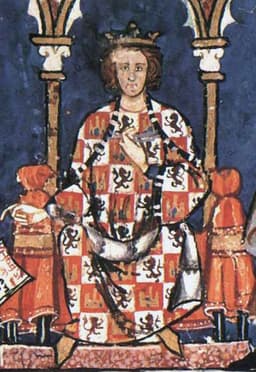
Alfonso X of Castile
Emperor · Medieval
54.6Total
Yusuf ibn Tashfin
Emperor · Medieval
63.2Total
Basic Information
Born
1221
1061
Died
1284
1106
Era
Medieval
Medieval
Nationality
Holy Roman Empire
Almoravid Empire
Occupation
Emperor
Emperor
Civilization
Western
Middle Eastern
Score Comparison
Military (10%)
45.0
77.2
Political (20%)
53.8
60.0
Influence (20%)
65.0
57.7
Legacy (20%)
40.0
55.0
Leadership (15%)
65.0
78.0
Strategy (15%)
60.0
65.9
TOTAL
54.6
63.2
Alfonso X of Castile — Complete Timeline
1252 AD
Commissioned the Alfonsine TablesCultural◆ Major
Alfonso X commissioned the Alfonsine Tables, a set of astronomical tables based on Ptolemaic models. These tables were used by European astronomers for centuries and became a standard reference in medieval science.
AstronomyScienceCultural Patronage
Impact: globalconstructive
1257 AD
Elected King of GermanyPolitical Action◆ Major
Alfonso X of Castile was elected King of Germany by a faction of prince-electors, opposing Richard of Cornwall. This election was part of the Great Interregnum, with Alfonso receiving support from the Hohenstaufen loyalists and the Papacy.
ElectionGreat InterregnumCastilian Claim
Impact: regional
Never Visited GermanyPolitical Action◆ Major
Alfonso X never traveled to Germany to assert his claim to the throne. His absence weakened his authority, and he was unable to secure effective control over the German kingdom, leaving the title contested.
AbsenceGreat InterregnumRival Claimant
Impact: regional
1275 AD
Renounced Claim to German ThronePolitical Action◆ Major
Alfonso X formally renounced his claim to the German throne in favor of Rudolf of Habsburg. This renunciation ended the Great Interregnum and allowed Rudolf to be recognized as the legitimate king of Germany.
RenunciationGreat InterregnumRudolf of Habsburg
Impact: regional
Yusuf ibn Tashfin — Complete Timeline
1070 AD
Unification of the MaghrebWar◆ Major
Yusuf ibn Tashfin conquered the remaining Berber kingdoms in the Maghreb, including the Zenata and the Barghawata. He unified the region under Almoravid rule, creating a vast empire stretching from Senegal to Algeria.
Almoravid EmpireMaghrebUnification
Impact: regionalconstructive
Foundation of MarrakechCultural◆ Major
Yusuf ibn Tashfin founded the city of Marrakech, which became the capital of the Almoravid Empire. The city grew into a major cultural and commercial center, serving as a hub for trans-Saharan trade.
Almoravid EmpireMarrakechFoundation
Impact: regionalconstructive
1080 AD
Reform of Islamic LawReform◆ Major
Yusuf ibn Tashfin enforced a strict Maliki interpretation of Islamic law across his empire. He suppressed non-orthodox practices and promoted religious scholars, strengthening the role of Islam in governance and society.
Almoravid EmpireIslamic LawReform
Impact: regional
1086 AD
Battle of Sagrajas (Zallaqa)War
Yusuf ibn Tashfin led the Almoravid army to victory over the Christian forces of King Alfonso VI of Le
Almoravid EmpireReconquistaBattle
Impact: regional
1090 AD
Annexation of Al-AndalusPolitical Action◆ Major
Yusuf ibn Tashfin annexed the Taifa kingdoms of Al-Andalus, incorporating them into the Almoravid Empire. He deposed the Muslim rulers who had failed to resist the Christian advance, establishing direct Almoravid control over the Iberian Peninsula.
Almoravid EmpireAl-AndalusAnnexation
Impact: regional
Expert Analysis
Origins
Alfonso X of Castile was born in 1221 in Toledo, the eldest son of Ferdinand III of Castile and Elisabeth of Swabia. He was educated in the courts of Castile and exposed to the multicultural environment of the Reconquista, learning from Christian, Muslim, and Jewish scholars. His father's conquests expanded Castile's territory, setting the stage for Alfonso's later intellectual pursuits.
Yusuf ibn Tashfin was born around 1009 in the Sahara, likely among the Lamtuna Berber tribe. He rose under the guidance of his cousin Abu Bakr ibn Umar, leader of the Almoravids. Yusuf was deeply influenced by the strict Maliki interpretation of Islam and the desert traditions of the Sanhaja Berbers, which emphasized religious purity and military discipline.
Rise to Power
Alfonso X became king of Castile and León in 1252 after his father's death. He immediately pursued a claim to the Holy Roman Empire, being elected King of Germany in 1257 by a faction of prince-electors opposing Richard of Cornwall. However, Alfonso never visited Germany, and his absence weakened his claim. He formally renounced it in 1275 in favor of Rudolf of Habsburg, ending the Great Interregnum.
Yusuf ibn Tashfin emerged as a military leader in the 1060s, leading Almoravid forces against rebel Berber tribes. He succeeded Abu Bakr as leader in 1072 after Abu Bakr returned to the Sahara. Under Yusuf, the Almoravids conquered the remaining Berber kingdoms, including the Zenata and Barghawata, unifying the Maghreb by 1082. His reputation as a devout and effective ruler grew, and he was called upon by the Taifa kings of Al-Andalus to defend against Christian advances.
Leadership & Governance
Alfonso X was a patron of learning, commissioning the Alfonsine Tables in 1272, a set of astronomical tables based on Ptolemaic models that remained in use by European astronomers for centuries. He also oversaw the compilation of legal codes, including the Siete Partidas, a comprehensive legal code that influenced later Spanish law. However, his governance was marked by financial strain from his imperial ambitions and conflicts with the nobility, leading to revolts by his son Sancho.
Yusuf ibn Tashfin ruled with a firm hand, enforcing strict Maliki law across his empire. He suppressed non-orthodox practices and promoted religious uniformity. He centralized administration, appointed loyal governors, and maintained a disciplined army. His annexation of Al-Andalus in 1090 deposed the ineffective Taifa rulers, but his rigid rule alienated some local Muslims. His leadership scored 78.0 in military and 60.0 in political, compared to Alfonso's 45.0 and 53.8.
Triumph & Tragedy
Alfonso X's greatest triumph was his cultural legacy: the Alfonsine Tables and Siete Partidas solidified his reputation as a wise ruler. His court in Toledo became a center of translation and scholarship, preserving and transmitting knowledge. His tragedy was his failure to secure the German throne and the resulting financial waste. His later years were marred by civil war with his son Sancho, who usurped power in 1282.
Yusuf ibn Tashfin's greatest victory was the Battle of Sagrajas (Zallaqa) in 1086, where he decisively defeated King Alfonso VI of León and Castile, halting the Reconquista for decades. He unified the Maghreb and Al-Andalus under one rule, creating a powerful empire. His tragedy was the eventual decline of the Almoravids under his successors, partly due to the rigid religious policies he instituted. His military score of 77.2 reflects his battlefield success.
Character & Destiny
Alfonso X was intellectually curious but politically impractical. His pursuit of the German throne and neglect of Castile's internal affairs led to instability. He was known as "the Wise" for his learning, but his decision-making was often indecisive, and he failed to secure his legacy against his rebellious son. His character shaped his downfall: a ruler more interested in ideas than power.
Yusuf ibn Tashfin was a pious and determined leader, embodying the ascetic ideals of the Almoravids. He was a skilled strategist and administrator, but his rigid adherence to Maliki law limited cultural diversity. His destiny was to build an empire that would last only a century after his death, but his military achievements preserved Muslim rule in Iberia for another 400 years.
Legacy
Alfonso X's legacy is intellectual: the Alfonsine Tables advanced astronomy, and the Siete Partidas influenced legal systems in Spain and Latin America. His patronage of translation preserved Arabic and Greek works. However, his political legacy is weak; he failed to expand Castile's territory or secure its throne. His influence score of 65.0 is higher than his political or military scores.
Yusuf ibn Tashfin's legacy is both political and religious. He unified the Maghreb and Al-Andalus, creating the Almoravid Empire that lasted until 1147. He stopped the Christian advance for a generation, and his reforms established Maliki dominance in North Africa. His legacy score of 55.0 reflects his lasting impact on the region's religious and political landscape.
Conclusion
While Alfonso X contributed to European learning, his practical failures in governance and military affairs limit his impact. Yusuf ibn Tashfin, with a total score of 63.2 to Alfonso's 54.6, achieved more tangible results: he unified territories, won decisive battles, and shaped the course of Iberian history for centuries. Alfonso's cultural contributions are notable, but Yusuf's leadership and military success had a greater direct impact on the medieval world. Yusuf ibn Tashfin had the greater impact.
Rankings
🥇
Yusuf ibn TashfinLeader
Mil: 77.2Pol: 60.0Inf: 57.7
63.2
🥈
Alfonso X of Castile
Mil: 45.0Pol: 53.8Inf: 65.0
54.6
+8.6 behind
How This Comparison Works
Algorithm
Each figure is scored on 6 dimensions (0—100 scale) based on structured historical data: Military (10%), Political (20%), Influence (20%), Legacy (20%), Leadership (15%), Strategy (15%). The weighted total produces the final ranking.
Data Sources
Scores are computed from structured sub-indicators in the database. Scale factors adjust for era (Ancient ×0.85, Modern ×1.0) and civilization size (Eastern ×1.05, Other ×0.80) to account for differences in population and military scale.
Maximum 3 Figures
Comparisons are limited to 2—3 figures to ensure readability and statistical meaningfulness.
Error Margins
±5 points per dimension — Sub-scores are derived from historical records with inherent uncertainty. Two figures within 5 points on a dimension should be considered roughly equivalent in that area.
Total Score Accuracy
±3 points overall — The weighted combination of 6 dimensions produces a total score with approximately ±3 points of uncertainty. Differences of less than 3 points are not statistically significant— the figures are effectively tied.
Known Limitations
- Historical records are incomplete and uneven across civilizations
- Figures from oral-tradition societies may be underrepresented
- Occupation labels can misclassify multi-role figures
- Scores measure capability and impact, not moral character
- Quantitative scoring is a comparison tool, not absolute truth
Capability Radar
Military (10%) — Battles & Warfare
Battles
30
75
Win Rate
25
80
Expansion
30
82
Political (20%) — Governance & Reform
Reform
70
70
Diplomacy
55
72
Economy
65
68
Influence (20%) — Cultural & Global Reach
Cultural
85
60
Global
60
62
Legacy (20%) — Historical Impact
Historical
80
72
Longevity
75
65
Leadership (15%) — Power & Stability
Tenure
60
85
Stability
40
74
Strategy (15%) — Tactics & Innovation
Strategy
40
78
Tactics
35
70
Reform
45
65
Similar Comparisons
Comments & Discussion
No comments yet. Be the first to share your thoughts!