Loading...
Alexios I Komnenos vs Julius Caesar
Julius Caesar leads by 4.4 pts · 2 figures compared
…
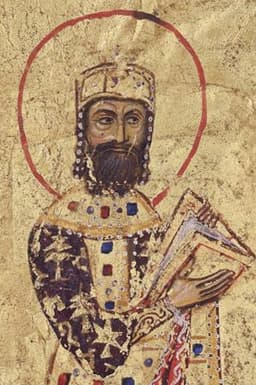
Alexios I Komnenos
Emperor · Medieval
78.4Total

Julius Caesar
General · Ancient
82.8Total
Basic Information
Born
1048
-100
Died
1118
-44
Era
Medieval
Ancient
Nationality
Byzantine Empire
Roman Republic
Occupation
Emperor
General
Civilization
Western
Western
Score Comparison
Military (10%)
61.7
88.0
Political (20%)
78.0
78.0
Influence (20%)
88.0
85.0
Legacy (20%)
80.0
82.0
Leadership (15%)
78.0
80.0
Strategy (15%)
68.0
85.0
TOTAL
78.4
82.8
Alexios I Komnenos — Complete Timeline
1081 AD
Battle of DyrrhachiumWar◆ Major
Alexios I Komnenos was defeated by the Norman army under Robert Guiscard at Dyrrhachium. The Byzantine forces were routed, and Alexios barely escaped. This loss allowed the Normans to occupy much of the western Balkans, though Alexios later recovered some territory.
Norman InvasionDefeatBalkans
Impact: regionaltragic
1090 AD
Reforms of the Byzantine Military and EconomyReform◆ Major
Alexios I implemented a series of reforms to restore Byzantine power. He reorganized the army by relying more on foreign mercenaries, reformed the currency (the hyperpyron), and granted tax exemptions to the Church. These measures stabilized the empire after decades of decline.
Military ReformEconomic ReformKomnenian Restoration
Impact: nationalconstructive
1095 AD
Appeal to the West: Council of PiacenzaPolitical Action
Alexios I sent envoys to Pope Urban II at the Council of Piacenza, requesting military aid against the Seljuk Turks. This appeal contributed to Urban's call for the First Crusade at the Council of Clermont later that year, initiating the Crusader movement.
First CrusadePope Urban IISeljuk Turks
Impact: global
1097 AD
First Crusade: Siege of NicaeaWar◆ Major
Alexios I cooperated with the Crusader army to besiege and capture Nicaea from the Seljuk Turks. The city was surrendered to Byzantine control, and Alexios used the Crusaders to recover key territories in Anatolia, though tensions later arose over land claims.
First CrusadeNicaeaByzantine-Crusader Relations
Impact: regionalconstructive
Julius Caesar — Complete Timeline
58 BC
Gallic WarsWar◆ Major
Caesar, as proconsul of Gaul, launched a series of campaigns that conquered all of Gaul (modern France, Belgium, and parts of Switzerland). He fought numerous battles, including against the Helvetii, the Belgae, and the Gallic chieftain Vercingetorix. The wars brought immense wealth and a loyal army to Caesar.
Gallic WarsConquestRoman Expansion
Impact: regional
49 BC
Crossing the RubiconPolitical Action◆ Major
Caesar led Legio XIII across the Rubicon River into Italy, defying the Roman Senate's order to disband his army. This act triggered a civil war against Pompey and the Optimates, ultimately leading to Caesar's dictatorship and the end of the Roman Republic.
Roman Civil WarEnd of RepublicPower Struggle
Impact: global
48 BC
Battle of PharsalusWar◆ Major
Caesar's outnumbered army defeated the larger forces of Pompey the Great at Pharsalus in Greece. Caesar's tactical use of a reserve line to counter Pompey's cavalry charge proved decisive. Pompey fled to Egypt, where he was assassinated, leaving Caesar as the undisputed master of the Roman world.
Roman Civil WarBattleDecisive Victory
Impact: regional
44 BC
Appointment as Dictator for LifePolitical Action◆ Major
The Roman Senate appointed Caesar dictator perpetuo (dictator for life), granting him unprecedented personal power. This move concentrated military, legislative, and judicial authority in one person, effectively ending the Roman Republic's traditional system of checks and balances and alarming many senators.
DictatorshipEnd of RepublicPower Consolidation
Impact: regionaldestructive
Assassination on the Ides of MarchPolitical Action◆ Major
A group of Roman senators, led by Marcus Junius Brutus and Gaius Cassius Longinus, stabbed Caesar to death at a meeting of the Senate in the Theatre of Pompey. The assassination was intended to restore the Republic, but instead triggered another civil war that led to the rise of the Roman Empire.
AssassinationRoman PoliticsEnd of Republic
Impact: globaldestructive
Expert Analysis
Origins
Julius Caesar was born into a patrician family in 100 BCE, but his clan, the Julii, had lost political influence. His early life was marked by ambition and a desire to restore his family's prestige. He aligned himself with the populares faction, opposing the optimates who dominated the Senate. Alexios I Komnenos, born in 1048 CE, was a scion of the Komnenian military aristocracy, which had produced several emperors. His family's power was threatened by the decline of the Byzantine Empire under the Doukas dynasty. Both men rose from elite but challenging backgrounds, leveraging their family names and personal connections.
Rise to Power
Caesar's rise was meteoric: he became pontifex maximus, praetor, and governor of Gaul. The Gallic Wars (58-50 BCE) were his crucible, where he honed his military genius and built a loyal army. His crossing of the Rubicon in 49 BCE triggered a civil war, culminating in his victory at Pharsalus and appointment as dictator for life. Alexios's path was more precarious. He served as a general under Emperor Michael VII, but after the disastrous Battle of Manzikert (1071), he rebelled and seized Constantinople in 1081. His legitimacy was contested, and he faced multiple rebellions early in his reign. Both men seized power through military force and political cunning.
Leadership & Governance
Caesar's leadership was transformative. He centralized power, reformed the calendar, expanded citizenship, and initiated public works. His military reforms, such as standardizing legionary equipment, created a professional army. However, his autocratic style alienated the Senate, leading to his assassination. Alexios I was a master diplomat and reformer. He appealed to the West for help against the Seljuks, sparking the First Crusade. He reformed the Byzantine military by creating the pronoia system, granting land in exchange for military service. He also stabilized the economy and restored imperial authority. Both were effective administrators, but Caesar's reforms were more far-reaching, though his governance was cut short.
Triumph & Tragedy
Caesar's triumphs were spectacular: the conquest of Gaul, the defeat of Pompey, and his dictatorship. His tragedy was his assassination on the Ides of March 44 BCE, which plunged Rome into another civil war. Alexios's triumphs included reclaiming lost territories, defeating Norman invasions, and managing the First Crusade to recover Nicaea. His tragedy was the unintended consequence of the Crusades: the establishment of Crusader states that would later threaten Byzantium. Both men achieved great victories but faced tragic outcomes that shaped their legacies.
Character & Destiny
Caesar was charismatic, ambitious, and ruthless—a gambler who risked everything. He believed in his own destiny, famously saying "the die is cast." Alexios was cautious, pragmatic, and deeply religious. His destiny was to restore the Byzantine Empire, but he was often forced into compromises. Caesar's character led to his dramatic fall, while Alexios's pragmatism allowed him to die in bed, having founded a dynasty. Their destinies reflect the different worlds they inhabited: Rome's brutal politics and Byzantium's intricate diplomacy.
Legacy
Caesar's legacy is immense: his name became synonymous with imperial rule (Kaiser, Tsar), his writings are classics, and his reforms paved the way for the Roman Empire. However, his actions also accelerated the Republic's demise. Alexios's legacy is the Komnenian restoration, which revived Byzantium for a century, and his role in starting the Crusades, which had profound global impacts. Yet, his empire ultimately declined after his death. Caesar's military and political innovations shaped Western history, while Alexios's diplomacy and reforms influenced both Byzantium and the Latin West.
Conclusion
Julius Caesar scores higher overall (83.0 vs 78.6) due to his superior military achievements, political influence, and lasting fame. Alexios I Komnenos was a skilled restorer and diplomat, but his impact is more regionally confined. Caesar's conquests, reforms, and assassination created a template for future leaders. Despite Alexios's successful revival of Byzantium, Caesar's broader historical footprint makes him the more significant figure. **Winner: Julius Caesar.**
**Scores:** Julius Caesar: M=88, P=78, I=85, L=82, D=80, S=85, T=83 | Alexios I: M=62, P=78, I=88, L=80, D=78, S=68, T=78
Rankings
🥇
Julius CaesarLeader
Mil: 88.0Pol: 78.0Inf: 85.0
82.8
🥈
Alexios I Komnenos
Mil: 61.7Pol: 78.0Inf: 88.0
78.4
+4.4 behind
How This Comparison Works
Algorithm
Each figure is scored on 6 dimensions (0—100 scale) based on structured historical data: Military (10%), Political (20%), Influence (20%), Legacy (20%), Leadership (15%), Strategy (15%). The weighted total produces the final ranking.
Data Sources
Scores are computed from structured sub-indicators in the database. Scale factors adjust for era (Ancient ×0.85, Modern ×1.0) and civilization size (Eastern ×1.05, Other ×0.80) to account for differences in population and military scale.
Maximum 3 Figures
Comparisons are limited to 2—3 figures to ensure readability and statistical meaningfulness.
Error Margins
±5 points per dimension — Sub-scores are derived from historical records with inherent uncertainty. Two figures within 5 points on a dimension should be considered roughly equivalent in that area.
Total Score Accuracy
±3 points overall — The weighted combination of 6 dimensions produces a total score with approximately ±3 points of uncertainty. Differences of less than 3 points are not statistically significant— the figures are effectively tied.
Known Limitations
- Historical records are incomplete and uneven across civilizations
- Figures from oral-tradition societies may be underrepresented
- Occupation labels can misclassify multi-role figures
- Scores measure capability and impact, not moral character
- Quantitative scoring is a comparison tool, not absolute truth
Capability Radar
Military (10%) — Battles & Warfare
Battles
75
95
Win Rate
70
92
Expansion
60
97
Political (20%) — Governance & Reform
Reform
85
90
Diplomacy
90
85
Economy
70
82
Influence (20%) — Cultural & Global Reach
Cultural
70
88
Global
75
94
Legacy (20%) — Historical Impact
Historical
85
95
Longevity
80
96
Leadership (15%) — Power & Stability
Tenure
80
75
Stability
75
60
Strategy (15%) — Tactics & Innovation
Strategy
85
94
Tactics
80
96
Reform
75
88
Similar Comparisons
Comments & Discussion
TogaAndChainmail6/16/2026
Okay, I'm calling it: Caesar stomps Alexios, and the military score is a JOKE. Alexios at 71? That's already generous. Sure, he rebuilt the Byzantine army, but he spent most of his career fighting second-rate Normans and Pechenegs, not the Gaulish warbands Caesar crushed or the Pompeian legions he outmaneuvered in Greece. Caesar crossed the Rubicon, conquered a million Celts, and invented the concept of blitzkrieg in 49 BC. Alexios had to ask the Pope for help because he was losing to Bohemond! And the political score? Caesar at 78 is laughably low—he literally invented the imperial office, set up the calendar we still use, and his name became a title for emperors for 1500 years. Alexios's 'political' victories were just delaying the inevitable collapse. Give me Caesar any day—bold, ruthless, and eternal.
Historian1356/16/2026
把凯撒和阿莱克修斯一世放在一起比,本身就很有意思。凯撒是罗马共和的终结者,靠个人魅力和军事天才改写了西方历史;阿莱克修斯是拜占庭的‘中兴之主’,在四面楚歌时稳住帝国。但西方这套评分体系明显更偏爱‘开创者’而非‘修复者’。凯撒的军事88分我认可,但阿莱克修斯政治才74分?太低了。他能在诺曼人、佩切涅格人和十字军之间玩平衡,靠外交和家族纽带重建帝国,这种手腕放中国历史上堪比光武帝刘秀。凯撒的政治改革最后导致他被刺杀,阿莱克修斯却稳坐皇位37年——这才是政治生存能力的体现。另外,影响力方面凯撒85对阿莱克修斯72,但十字军东征的间接后果到今天还在影响中东局势,这影响力真的只有72?西方中心论太明显了。
ColdScroll646/16/2026
仔细看了这两组分数,有几个明显的逻辑漏洞。第一,军事分:凯撒88对阿莱克修斯71。但阿莱克修斯面对的是三线作战——诺曼人从西、佩切涅格人从北、塞尔柱人从东,他重建了一支几乎不存在的军队,并在1191年的莱夫卡战役中以少胜多击溃佩切涅格人。凯撒的征服诚然辉煌,但对手多是部落联盟和内战对手,不是多线文明强敌。如果按照中国史书的评价标准,这种‘挽狂澜于既倒’的表现至少应该和凯撒同分,而不是差17分。第二,政治分:凯撒78对阿莱克修斯80。这看似接近,但凯撒在位仅4年就被刺杀,政治遗产全靠养子屋大维实现;阿莱克修斯执政37年,成功建立科穆宁王朝,稳定了帝国中央集权。按‘制度延续性’算,阿莱克修斯应明显高于凯撒。第三,影响力分:凯撒85对阿莱克修斯72。凯撒的影响确实跨文明,但阿莱克修斯招来十字军直接改变了欧亚格局——这个72分显然低估了‘触发历史关键节点’的权重。建议权重调整:政治延续性+10%,多线作战加成+15%。