Loading...
Alexios I Komnenos vs Alp Tigin
Alexios I Komnenos leads by 27.9 pts · 2 figures compared
…
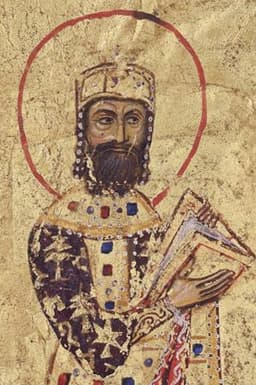
Alexios I Komnenos
Emperor · Medieval
78.4Total
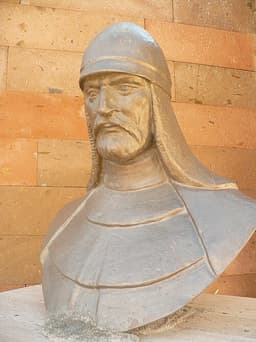
Alp Tigin
Emperor · Medieval
50.5Total
Basic Information
Born
1048
911
Died
1118
963
Era
Medieval
Medieval
Nationality
Byzantine Empire
Ghaznavid Empire
Occupation
Emperor
Emperor
Civilization
Western
Middle Eastern
Score Comparison
Military (10%)
61.7
55.0
Political (20%)
78.0
33.6
Influence (20%)
88.0
56.4
Legacy (20%)
80.0
49.2
Leadership (15%)
78.0
50.7
Strategy (15%)
68.0
60.0
TOTAL
78.4
50.5
Alexios I Komnenos — Complete Timeline
1081 AD
Battle of DyrrhachiumWar◆ Major
Alexios I Komnenos was defeated by the Norman army under Robert Guiscard at Dyrrhachium. The Byzantine forces were routed, and Alexios barely escaped. This loss allowed the Normans to occupy much of the western Balkans, though Alexios later recovered some territory.
Norman InvasionDefeatBalkans
Impact: regionaltragic
1090 AD
Reforms of the Byzantine Military and EconomyReform◆ Major
Alexios I implemented a series of reforms to restore Byzantine power. He reorganized the army by relying more on foreign mercenaries, reformed the currency (the hyperpyron), and granted tax exemptions to the Church. These measures stabilized the empire after decades of decline.
Military ReformEconomic ReformKomnenian Restoration
Impact: nationalconstructive
1095 AD
Appeal to the West: Council of PiacenzaPolitical Action
Alexios I sent envoys to Pope Urban II at the Council of Piacenza, requesting military aid against the Seljuk Turks. This appeal contributed to Urban's call for the First Crusade at the Council of Clermont later that year, initiating the Crusader movement.
First CrusadePope Urban IISeljuk Turks
Impact: global
1097 AD
First Crusade: Siege of NicaeaWar◆ Major
Alexios I cooperated with the Crusader army to besiege and capture Nicaea from the Seljuk Turks. The city was surrendered to Byzantine control, and Alexios used the Crusaders to recover key territories in Anatolia, though tensions later arose over land claims.
First CrusadeNicaeaByzantine-Crusader Relations
Impact: regionalconstructive
Alp Tigin — Complete Timeline
961 AD
Rebellion against the SamanidsPolitical Action◆ Major
Alp Tigin rebelled against the Samanid ruler Mansur I after being passed over for a governorship. He marched from Nishapur to Ghazni, defeating Samanid forces along the way, and established his own rule in eastern Afghanistan.
Impact: regional
963 AD
Consolidation of GhazniPolitical Action
Alp Tigin fortified Ghazni and organized a military state based on slave soldiers (ghilman). He established a stable administration that attracted scholars and merchants, turning Ghazni into a major regional power center.
Impact: regionalconstructive
Expert Analysis
Alexios I Komnenos vs Alp Tigin
# The Emperor and the Slave: Two Paths to Power in the Medieval World
In the autumn of 1081, a Byzantine emperor fled his own battlefield, his purple robes stained with dust and blood as Norman knights cut down his Varangian guard at Dyrrhachium. A century earlier and a thousand miles east, a Turkic slave commander named Alp Tigin had seized a mountain fortress in what is now Afghanistan, his hands clean of imperial purple but his eyes fixed on a throne he would never sit upon. Both men sought to build dynasties from the wreckage of old orders. One succeeded beyond measure; the other barely registered in history’s ledger. The question is not merely who was greater, but why their fates diverged so dramatically.
Origins
Alexios Komnenos was born into the Byzantine aristocracy at a time when the empire was bleeding from every frontier. His family had produced emperors before, but the throne had become a revolving door for generals who could seize it. The young Alexios grew up in a world where loyalty was a currency and betrayal a survival skill. He learned to read men the way sailors read storms—by watching the clouds gather.
Alp Tigin’s origins were far humbler. A Turkic slave purchased by the Samanid court in Persia, he rose through the ranks of the *ghilman*—military slaves who could, paradoxically, wield immense power. In the Islamic world of the 10th century, a slave could become a general, and a general could become a king. But Alp Tigin began with nothing but his sword and his wits. Where Alexios inherited a name, Alp Tigin had to forge one.
Rise to Power
Alexios came to power through a coup in 1081, but it was a coup born of desperation. The Byzantine Empire had lost Anatolia to the Seljuk Turks after the disaster at Manzikert a decade earlier. Normans were invading from the west, Pechenegs from the north. When Alexios seized the throne, he inherited not a kingdom but a crisis. His path was clear: survive, stabilize, rebuild.
Alp Tigin’s rise was more personal and more precarious. In 961, after being passed over for the governorship of Khorasan, he rebelled against his Samanid overlord Mansur I. Marching from Nishapur with a band of loyal slave soldiers, he carved out a territory around the city of Ghazni. He did not claim the title of sultan or emir—he was too shrewd for that. Instead, he fortified Ghazni and organized a military state based on the *ghilman* system he knew so well. He was a king in all but name, ruling from a mountain citadel that would become the seed of the Ghaznavid Empire.
The difference in their rises is instructive. Alexios seized an empire; Alp Tigin built one from scratch. But Alexios’s empire came with expectations and obligations. Alp Tigin’s came with none.
Leadership & Governance
Alexios I Komnenos was a political genius who understood that survival required reinvention. His reforms of the Byzantine military and economy after 1090 were masterstrokes of necessity. He reorganized the army by relying more on foreign mercenaries and feudal-like grants of land called *pronoia*, binding the aristocracy to the throne through mutual self-interest. He debased the currency, then stabilized it. He made deals with the Venetians that cost his empire dearly but bought him the naval support he needed to survive.
His greatest gamble, however, was his appeal to the West. At the Council of Piacenza in 1095, Alexios sent envoys to Pope Urban II requesting military aid against the Seljuk Turks. This single act triggered the First Crusade—a decision that would reshape the medieval world. Alexios had hoped for a few thousand mercenaries. He got an army of tens of thousands, led by nobles who had their own ambitions. His genius lay in managing this unwieldy force, cooperating with the crusaders to recapture Nicaea in 1097 while ensuring the city returned to Byzantine control.
Alp Tigin’s governance was simpler and more brutal. He consolidated Ghazni as a military stronghold, relying on his *ghilman* as both soldiers and administrators. He had no empire to reform, no ancient bureaucracy to manage. His state was a war machine, and he ran it like a camp. There were no crusades, no diplomatic appeals to distant powers—just the steady accumulation of power through force and patronage.
Triumph & Tragedy
Alexios’s greatest triumph was the restoration of Byzantine power after decades of collapse. By the time of his death in 1118, the empire had recovered much of Anatolia, the Normans had been pushed back, and the Komnenian dynasty was secure. His greatest tragedy was the Crusade itself—a monster he had summoned but could not control. The crusaders would go on to carve out kingdoms in the Holy Land, creating a new set of problems for Byzantium that would haunt it for centuries.
Alp Tigin’s triumph was smaller but more personal. He died in 963, having established a dynasty that would rule for nearly two centuries. His tragedy was that he never lived to see it. He died in his mountain fortress, a rebel who had become a founder, but whose name would be overshadowed by his more famous successors—especially Mahmud of Ghazni, who turned Alp Tigin’s modest state into an empire stretching from Persia to India.
Character & Destiny
Alexios was a survivor. His every decision was calculated, every alliance weighed. He could be ruthless—he blinded his rivals, broke promises when necessary, and married his daughter Anna to a man he did not trust. But he was also capable of deep pragmatism. He knew when to fight and when to flee, when to beg and when to command.
Alp Tigin was a gambler. He staked everything on a rebellion against his masters, then on a fortress in the mountains. He had no empire to inherit, no legacy to protect. He was a slave who became a king by refusing to accept his place. His character was defined by ambition, not calculation.
Legacy
Alexios I Komnenos is remembered as the founder of the Komnenian restoration, the emperor who saved Byzantium from collapse and launched the Crusades. His legacy is complex—part savior, part enabler of future disasters. He is the subject of his daughter Anna Komnene’s famous history, the *Alexiad*, which immortalized him as both a warrior and a statesman.
Alp Tigin is barely remembered outside of specialist histories. His dynasty overshadowed him; his empire was built by others. He was a seed, not a tree. Yet without him, there would have been no Ghaznavid Empire, no Mahmud of Ghazni, no great campaigns into India. He was a necessary beginning.
Conclusion
The difference between these two men is not one of ability but of opportunity. Alexios inherited an empire and saved it. Alp Tigin created a kingdom and died before it could become an empire. One entered history with a name; the other had to invent one. In the end, Alexios is remembered because he wrote his story in the annals of Europe and the Crusades. Alp Tigin wrote his in the dust of Afghanistan, where empires rise and fall like the wind. Both were founders. But only one founded a world that would remember him.
Rankings
🥇
Alexios I KomnenosLeader
Mil: 61.7Pol: 78.0Inf: 88.0
78.4
🥈
Alp Tigin
Mil: 55.0Pol: 33.6Inf: 56.4
50.5
+27.9 behind
How This Comparison Works
Algorithm
Each figure is scored on 6 dimensions (0—100 scale) based on structured historical data: Military (10%), Political (20%), Influence (20%), Legacy (20%), Leadership (15%), Strategy (15%). The weighted total produces the final ranking.
Data Sources
Scores are computed from structured sub-indicators in the database. Scale factors adjust for era (Ancient ×0.85, Modern ×1.0) and civilization size (Eastern ×1.05, Other ×0.80) to account for differences in population and military scale.
Maximum 3 Figures
Comparisons are limited to 2—3 figures to ensure readability and statistical meaningfulness.
Error Margins
±5 points per dimension — Sub-scores are derived from historical records with inherent uncertainty. Two figures within 5 points on a dimension should be considered roughly equivalent in that area.
Total Score Accuracy
±3 points overall — The weighted combination of 6 dimensions produces a total score with approximately ±3 points of uncertainty. Differences of less than 3 points are not statistically significant— the figures are effectively tied.
Known Limitations
- Historical records are incomplete and uneven across civilizations
- Figures from oral-tradition societies may be underrepresented
- Occupation labels can misclassify multi-role figures
- Scores measure capability and impact, not moral character
- Quantitative scoring is a comparison tool, not absolute truth
Capability Radar
Military (10%) — Battles & Warfare
Battles
75
45
Win Rate
70
50
Expansion
60
50
Political (20%) — Governance & Reform
Reform
85
20
Diplomacy
90
30
Economy
70
20
Influence (20%) — Cultural & Global Reach
Cultural
70
30
Global
75
30
Legacy (20%) — Historical Impact
Historical
85
45
Longevity
80
40
Leadership (15%) — Power & Stability
Tenure
80
25
Stability
75
25
Strategy (15%) — Tactics & Innovation
Strategy
85
45
Tactics
80
40
Reform
75
30
Similar Comparisons
Comments & Discussion
DyrrhachiumDenier6/16/2026
You revisionists can't see the forest for the trees. Alexios lost at Dyrrhachium because he was outnumbered and outflanked by Bohemond's Normans—but he rebuilt the Komnenian army from scratch by 1091 to crush the Pechenegs at Levounion. That's Byzantine grit. Alp Tigin seized Ghazni on a gamble, then died before founding anything stable. Alexios held the empire together for 37 years. Case closed.
沙漠之狐6/16/2026
少拿“奴隶崛起”那套浪漫叙事骗人。阿尔普特勤从一个突厥奴隶爬到萨曼王朝的将军,最后占了加兹尼当小军阀,听起来很屌,但你看他死后呢?他的地盘差点散架,还是他儿子赛布克特勤收拾残局。阿莱克修斯呢?1081年登基时帝国四面起火,他在多里莱乌姆用计谋打退突厥人,还搞了普洛诺亚制度养兵。一个靠演技,一个靠制度,高下立判。
GhostOfNikephoros6/16/2026
Amateurs focus on battles; I focus on letters. Alexios wrote to Robert of Flanders begging for Western mercenaries in 1090, practically admitting the empire couldn't defend itself. That letter is pathetic—it's a begging bowl, not a strategy. Alp Tigin never groveled to foreigners. He took Ghazni by force and held it with Turkic slave soldiers who owed him everything. Alexios preserved a corpse; Alp Tigin built a dynasty that spawned Mahmud of Ghazni. Who's the real founder?
铁血史官6/16/2026
别争了,本质是资源差距。阿莱克修斯继承的是罗马帝国的残余,官僚体系、国库、还有近东的情报网——虽然千疮百孔,但骨架还在。阿尔普特勤呢?他只是个奴隶,在呼罗珊的混乱中靠剑和运气抢了个山头。阿莱克修斯能打翻身仗,是因为有君士坦丁堡的底子。阿尔普特勤能崛起,纯粹是个人能力逆天。比“成就”没有意义,比“起点”才能看出谁是真狠人。
PapyrusPuncher6/16/2026
Basil II rolled in his grave every time Alexios debased the hyperpyron coinage after 1092. Sure, he stabilized the economy short-term, but slashing gold content destroyed centuries of Byzantine monetary prestige. Alp Tigin never had a coin minted in his name—he knew his job was to win wars, not play banker. Alexios the Reformer is a myth; he was a pragmatist who mortgaged the empire's soul to stay afloat. Alp Tigin kept it simple: conquer or die.