Loading...
This comparison has not been analyzed yet.
One-time AI generation (~1 minute). Scores and timeline are already available below.
Alexander III of Russia vs Griffith Lerotholi
Alexander III of Russia leads by 7.7 pts · 2 figures compared
…
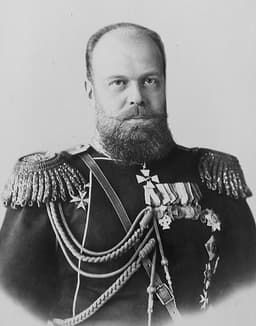
Alexander III of Russia
Emperor · Modern
49.3Total

Griffith Lerotholi
Emperor · Modern
41.6Total
Basic Information
Born
1845
1873
Died
1894
1939
Era
Modern
Modern
Nationality
Russia
Lesotho
Occupation
Emperor
Emperor
Civilization
Western
Other
Score Comparison
Military (10%)
21.2
20.0
Political (20%)
53.8
35.1
Influence (20%)
53.3
48.6
Legacy (20%)
43.3
37.5
Leadership (15%)
79.8
55.3
Strategy (15%)
30.3
45.0
TOTAL
49.3
41.6
Alexander III of Russia — Complete Timeline
1881 AD
Reversal of Alexander II's ReformsReform
Upon ascending the throne, Alexander III issued the Manifesto on Unshakeable Autocracy, rejecting his father's reformist policies. He strengthened the power of the nobility, increased censorship, and expanded the powers of the secret police, reversing many liberalizing measures.
Counter-ReformsAutocracyReaction
Impact: nationaldestructive
1882 AD
May Laws of 1882Political Action◆ Major
Alexander III approved the May Laws, which imposed severe restrictions on Jewish residence, property ownership, and education. These laws confined Jews to the Pale of Settlement, limited their access to higher education, and fueled anti-Semitic discrimination.
Anti-SemitismMay LawsPale of Settlement
Impact: nationaldestructive
1891 AD
Construction of the Trans-Siberian RailwayInvention◆ Major
Alexander III initiated the construction of the Trans-Siberian Railway, linking European Russia to the Pacific port of Vladivostok. The project aimed to develop Siberia and strengthen Russian control over the Far East. It became the longest railway in the world.
Trans-Siberian RailwayInfrastructureSiberia
Impact: globalconstructive
1894 AD
Franco-Russian AlliancePolitical Action◆ Major
Alexander III finalized a military alliance with France, ending Russia's diplomatic isolation. The alliance committed both powers to mutual defense against the Triple Alliance of Germany, Austria-Hungary, and Italy. This pact shaped European alliances leading to World War I.
Franco-Russian AllianceDiplomacyTriple Alliance
Impact: global
Griffith Lerotholi — Complete Timeline
1905 AD
Succession as Paramount ChiefPolitical Action◆ Major
Griffith Lerotholi succeeded his father Lerotholi as paramount chief of the Basotho. His rule was marked by growing pressure from the Union of South Africa to incorporate Basutoland.
SuccessionBasothoParamount Chief
Impact: regional
1910 AD
Opposition to South African IncorporationPolitical Action◆ Major
Griffith Lerotholi led Basotho opposition to proposals to incorporate Basutoland into the Union of South Africa. He petitioned the British government to maintain Basutoland's status as a protectorate.
South AfricaIncorporationBasutoland
Impact: regionalconstructive
1920 AD
Conflict with Lekhotla la BafoPolitical Action
Griffith Lerotholi faced opposition from the Lekhotla la Bafo (Council of Commoners), a political organization demanding more democratic governance. The conflict highlighted tensions between traditional authority and modern political movements.
Political OppositionBasothoDemocracy
Impact: regional
This comparison has not been analyzed yet.
One-time AI generation (~1 minute). Scores and timeline are already available below.
Rankings
🥇
Alexander III of RussiaLeader
Mil: 21.2Pol: 53.8Inf: 53.3
49.3
🥈
Griffith Lerotholi
Mil: 20.0Pol: 35.1Inf: 48.6
41.6
+7.7 behind
How This Comparison Works
Algorithm
Each figure is scored on 6 dimensions (0—100 scale) based on structured historical data: Military (10%), Political (20%), Influence (20%), Legacy (20%), Leadership (15%), Strategy (15%). The weighted total produces the final ranking.
Data Sources
Scores are computed from structured sub-indicators in the database. Scale factors adjust for era (Ancient ×0.85, Modern ×1.0) and civilization size (Eastern ×1.05, Other ×0.80) to account for differences in population and military scale.
Maximum 3 Figures
Comparisons are limited to 2—3 figures to ensure readability and statistical meaningfulness.
Error Margins
±5 points per dimension — Sub-scores are derived from historical records with inherent uncertainty. Two figures within 5 points on a dimension should be considered roughly equivalent in that area.
Total Score Accuracy
±3 points overall — The weighted combination of 6 dimensions produces a total score with approximately ±3 points of uncertainty. Differences of less than 3 points are not statistically significant— the figures are effectively tied.
Known Limitations
- Historical records are incomplete and uneven across civilizations
- Figures from oral-tradition societies may be underrepresented
- Occupation labels can misclassify multi-role figures
- Scores measure capability and impact, not moral character
- Quantitative scoring is a comparison tool, not absolute truth
Capability Radar
Military (10%) — Battles & Warfare
Battles
10
5
Win Rate
10
5
Expansion
10
5
Political (20%) — Governance & Reform
Reform
40
20
Diplomacy
70
25
Economy
50
15
Influence (20%) — Cultural & Global Reach
Cultural
30
15
Global
30
5
Legacy (20%) — Historical Impact
Historical
40
15
Longevity
30
10
Leadership (15%) — Power & Stability
Tenure
60
30
Stability
70
20
Strategy (15%) — Tactics & Innovation
Strategy
10
5
Tactics
10
5
Reform
20
5
Similar Comparisons
Comments & Discussion
No comments yet. Be the first to share your thoughts!