Loading...
Aleksander Kwasniewski vs Michelle Bachelet
Aleksander Kwasniewski leads by 4.7 pts · 2 figures compared
…

Aleksander Kwasniewski
Politician · Modern
58.7Total
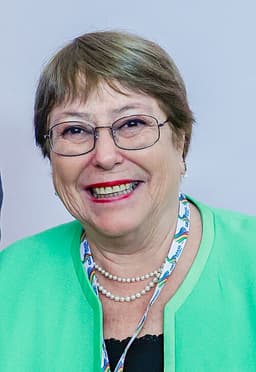
Michelle Bachelet
Politician · Modern
54.0Total
Basic Information
Born
1954
1951
Died
—
—
Era
Modern
Modern
Nationality
Poland
Chile
Occupation
Politician
Politician
Civilization
Western
Western
Score Comparison
Military (10%)
49.1
12.2
Political (20%)
70.0
65.0
Influence (20%)
59.0
55.0
Legacy (20%)
49.2
52.0
Leadership (15%)
80.0
79.8
Strategy (15%)
42.5
43.2
TOTAL
58.7
54.0
Aleksander Kwasniewski — Complete Timeline
1995 AD
President of PolandPolitical Action◆ Major
Kwasniewski won the 1995 presidential election, defeating Lech Walesa, and became President of Poland on December 23. He was a former communist official who led the Democratic Left Alliance.
PresidencyElection
Impact: national
1997 AD
Constitution of 1997Reform◆ Major
Kwasniewski signed Poland's new constitution on April 2, 1997, which replaced the communist-era document. It established a parliamentary system, strengthened civil rights, and defined the role of the president.
ConstitutionReform
Impact: nationalconstructive
1999 AD
NATO Accession of PolandPolitical Action◆ Major
Kwasniewski oversaw Poland's accession to NATO on March 12, 1999, a major shift in foreign policy. This integration into Western security structures was a key goal of his presidency.
NATOForeign Policy
Impact: globalconstructive
2004 AD
European Union Accession of PolandPolitical Action◆ Major
Kwasniewski led Poland's successful negotiations for EU membership, which was achieved on May 1, 2004. This marked a historic integration of Poland into the European community and boosted economic development.
European UnionIntegration
Impact: globalconstructive
Michelle Bachelet — Complete Timeline
2000 AD
Appointed as Minister of HealthPolitical Action
Bachelet served as Minister of Health under President Ricardo Lagos from 2000 to 2002. She implemented reforms to improve the public health system, including the expansion of primary care and the reduction of waiting times.
HealthMinistryChile
Impact: nationalconstructive
2002 AD
Appointed as Minister of DefensePolitical Action◆ Major
Bachelet was appointed Minister of Defense by President Ricardo Lagos in 2002, becoming the first woman to hold that position in Chile and in Latin America. She oversaw the modernization of the armed forces and promoted gender equality within the military.
DefenseGender EqualityChile
Impact: nationalconstructive
2006 AD
Implemented the Chile Crece Contigo Social Protection SystemReform◆ Major
Bachelet launched the Chile Crece Contigo (Chile Grows with You) system in 2006, a comprehensive social protection program for children from gestation to age four. The program provided healthcare, education, and social support to reduce inequality.
Social PolicyChild WelfareChile
Impact: nationalprogressive
Elected First Female President of ChilePolitical Action
Michelle Bachelet won the 2005-2006 presidential election as the candidate of the Concertaci
Chilean PresidencyWomen in PoliticsFirst
Impact: nationalprogressive
2014 AD
Re-elected President of ChilePolitical Action◆ Major
Bachelet won the 2013 presidential election, returning to office for a second term from 2014 to 2018. She campaigned on a platform of educational reform, tax reform, and a new constitution.
Chilean PresidencyRe-electionDemocracy
Impact: nationalconstructive
2015 AD
Proposed a New Constitution for ChilePolitical Action◆ Major
Bachelet announced a process to draft a new constitution for Chile in 2015, aiming to replace the 1980 constitution inherited from the Pinochet dictatorship. The process stalled due to political opposition and was not completed during her term.
Constitutional ReformChilePolitical Process
Impact: nationalprogressive
Expert Analysis
Origins
Aleksander Kwasniewski was born on November 15, 1954, in Bialogard, Poland. He studied transport economics at the University of Gdansk, graduating in 1977. He joined the Polish United Workers' Party (communist) in 1977, rising through its ranks. Michelle Bachelet was born on September 29, 1951, in Santiago, Chile. Her father, Alberto Bachelet, was an air force general who died after torture under Pinochet. She studied medicine at the University of Chile, becoming a pediatrician. Exiled in Australia and East Germany, she returned to Chile in 1979.
Rise to Power
Kwasniewski served as Minister for Sport in the communist government (1985-1987) and later as a member of the Sejm. After the fall of communism, he co-founded the Social Democracy of the Republic of Poland (SDRP) in 1990. He won the 1995 presidential election with 51.7% of the vote against Lech Walesa, becoming president on December 23, 1995. Bachelet entered politics after Chile's return to democracy, joining the Socialist Party. She served as Health Minister (2000-2002) and Defense Minister (2002-2004) under President Ricardo Lagos. She won the 2005-2006 presidential election with 53.5% in the runoff against Sebastian Pinera, becoming Chile's first female president on March 11, 2006.
Leadership & Governance
Kwasniewski's leadership focused on integrating Poland into Western institutions. He oversaw NATO accession in 1999 and EU membership in 2004, requiring tough negotiations and domestic reforms. He signed the 1997 constitution, establishing a parliamentary system. His political score of 70.0 reflects his ability to navigate post-communist politics. Bachelet's governance emphasized social welfare and gender equality. She implemented the Chile Crece Contigo social protection system (2006), expanded healthcare, and introduced educational reforms. Her leadership score of 79.8 is higher than Kwasniewski's 80.0, but she faced criticism for not fully transforming Chile's neoliberal model. Bachelet's strategy score of 43.2 is similar to Kwasniewski's 42.5, indicating comparable tactical approaches.
Triumph & Tragedy
Kwasniewski's greatest success was securing Poland's NATO and EU memberships, which locked in democratic and economic integration. His tragedy was his communist past; he was criticized for not fully breaking with the old system. He also faced accusations of corruption, though never convicted. Bachelet's triumph was becoming Chile's first female president and advancing social protections. Her tragedy was her inability to pass a new constitution during her second term (2014-2018), as the process stalled. She also struggled with low approval ratings in her second term due to economic slowdown and corruption scandals.
Character & Destiny
Kwasniewski was pragmatic and skilled at building coalitions, able to work with both former communists and pro-democracy forces. His character allowed him to achieve major foreign policy goals but also left him vulnerable to accusations of opportunism. Bachelet was resilient and principled, shaped by her family's suffering under dictatorship. She championed human rights and gender equality, but her consensus-driven style sometimes led to incremental changes rather than transformative reforms. Historical assessments note her moral authority but limited structural impact.
Legacy
Kwasniewski's legacy is tied to Poland's successful integration into NATO and the EU, which brought economic growth and security. He is remembered as a key figure in Poland's post-communist transition, with a legacy score of 49.2. Bachelet's legacy includes breaking gender barriers in Chilean politics and establishing social programs like Chile Crece Contigo. She later served as UN High Commissioner for Human Rights (2018-2022), enhancing her global influence score of 55.0. Her constitutional reform effort, though incomplete, set a precedent for future changes.
Conclusion
Kwasniewski had a greater impact on his nation's trajectory. His total score of 58.7 versus Bachelet's 54.0 reflects his role in securing Poland's place in Western alliances, which fundamentally altered the country's geopolitical position. Bachelet's social reforms were significant but did not change Chile's core economic structure. While both were effective leaders, Kwasniewski's achievements in foreign policy and institutional reform had more enduring effects.
Rankings
🥇
Aleksander KwasniewskiLeader
Mil: 49.1Pol: 70.0Inf: 59.0
58.7
🥈
Michelle Bachelet
Mil: 12.2Pol: 65.0Inf: 55.0
54.0
+4.7 behind
How This Comparison Works
Algorithm
Each figure is scored on 6 dimensions (0—100 scale) based on structured historical data: Military (10%), Political (20%), Influence (20%), Legacy (20%), Leadership (15%), Strategy (15%). The weighted total produces the final ranking.
Data Sources
Scores are computed from structured sub-indicators in the database. Scale factors adjust for era (Ancient ×0.85, Modern ×1.0) and civilization size (Eastern ×1.05, Other ×0.80) to account for differences in population and military scale.
Maximum 3 Figures
Comparisons are limited to 2—3 figures to ensure readability and statistical meaningfulness.
Error Margins
±5 points per dimension — Sub-scores are derived from historical records with inherent uncertainty. Two figures within 5 points on a dimension should be considered roughly equivalent in that area.
Total Score Accuracy
±3 points overall — The weighted combination of 6 dimensions produces a total score with approximately ±3 points of uncertainty. Differences of less than 3 points are not statistically significant— the figures are effectively tied.
Known Limitations
- Historical records are incomplete and uneven across civilizations
- Figures from oral-tradition societies may be underrepresented
- Occupation labels can misclassify multi-role figures
- Scores measure capability and impact, not moral character
- Quantitative scoring is a comparison tool, not absolute truth
Capability Radar
Military (10%) — Battles & Warfare
Battles
30
22
Win Rate
31
25
Expansion
36
25
Political (20%) — Governance & Reform
Reform
70
70
Diplomacy
80
75
Economy
65
60
Influence (20%) — Cultural & Global Reach
Cultural
40
55
Global
55
60
Legacy (20%) — Historical Impact
Historical
55
60
Longevity
40
50
Leadership (15%) — Power & Stability
Tenure
65
65
Stability
70
65
Strategy (15%) — Tactics & Innovation
Strategy
36
32
Tactics
41
31
Reform
47
38
Similar Comparisons
Comments & Discussion
No comments yet. Be the first to share your thoughts!