Loading...
Albert Alcibiades vs Julius Caesar
Julius Caesar leads by 43.6 pts · 2 figures compared
…
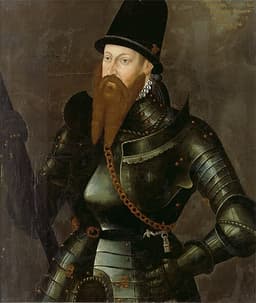
Albert Alcibiades
General · Modern
39.2Total

Julius Caesar
General · Ancient
82.8Total
Basic Information
Born
1522
-100
Died
1557
-44
Era
Modern
Ancient
Nationality
Brandenburg-Kulmbach
Roman Republic
Occupation
General
General
Civilization
Western
Western
Score Comparison
Military (10%)
20.0
88.0
Political (20%)
27.9
78.0
Influence (20%)
50.2
85.0
Legacy (20%)
41.7
82.0
Leadership (15%)
38.1
80.0
Strategy (15%)
43.3
85.0
TOTAL
39.2
82.8
Albert Alcibiades — Complete Timeline
1527 AD
Became Margrave of Brandenburg-KulmbachPolitical Action◆ Major
Albert Alcibiades inherited the Margraviate of Brandenburg-Kulmbach, a small principality in Franconia. He became known for his aggressive military policies and expansionist ambitions, earning the nickname 'Alcibiades' for his warlike nature.
InheritanceMargrave
Impact: regional
1546 AD
Fought in the Schmalkaldic WarWar◆ Major
Albert Alcibiades fought on the side of Emperor Charles V in the Schmalkaldic War against the Protestant princes. He commanded troops in several battles, including the decisive Battle of M
Schmalkaldic WarImperial Service
Impact: regional
1552 AD
Raided and Plundered Franconian TerritoriesWar◆ Major
After the Treaty of Passau, Albert Alcibiades launched a series of raids and plundering campaigns across Franconia, attacking both Catholic and Protestant territories. His actions caused widespread destruction and destabilized the region, leading to his condemnation.
RaidingDestruction
Impact: regionaldestructive
1553 AD
Defeated at the Battle of SievershausenWar◆ Major
Albert Alcibiades was defeated by a coalition of princes led by Maurice of Saxony at the Battle of Sievershausen. Though he escaped, his forces were shattered, and he was forced to flee, ending his military ambitions.
BattleDefeat
Impact: regionaltragic
Placed under Imperial BanPolitical Action◆ Major
Albert Alcibiades was placed under the Imperial ban by Emperor Charles V for his violent raids and refusal to obey imperial authority. The ban declared him an outlaw, allowing any prince to attack him without legal consequences.
Imperial BanOutlaw
Impact: regionaldestructive
1557 AD
Died in ExileOther
Albert Alcibiades died in exile in France, having been driven from his lands after the Imperial ban. His death marked the end of the Brandenburg-Kulmbach line, and his territories were divided among neighboring princes.
ExileDeath
tragic
Julius Caesar — Complete Timeline
58 BC
Gallic WarsWar◆ Major
Caesar, as proconsul of Gaul, launched a series of campaigns that conquered all of Gaul (modern France, Belgium, and parts of Switzerland). He fought numerous battles, including against the Helvetii, the Belgae, and the Gallic chieftain Vercingetorix. The wars brought immense wealth and a loyal army to Caesar.
Gallic WarsConquestRoman Expansion
Impact: regional
49 BC
Crossing the RubiconPolitical Action◆ Major
Caesar led Legio XIII across the Rubicon River into Italy, defying the Roman Senate's order to disband his army. This act triggered a civil war against Pompey and the Optimates, ultimately leading to Caesar's dictatorship and the end of the Roman Republic.
Roman Civil WarEnd of RepublicPower Struggle
Impact: global
48 BC
Battle of PharsalusWar◆ Major
Caesar's outnumbered army defeated the larger forces of Pompey the Great at Pharsalus in Greece. Caesar's tactical use of a reserve line to counter Pompey's cavalry charge proved decisive. Pompey fled to Egypt, where he was assassinated, leaving Caesar as the undisputed master of the Roman world.
Roman Civil WarBattleDecisive Victory
Impact: regional
44 BC
Appointment as Dictator for LifePolitical Action◆ Major
The Roman Senate appointed Caesar dictator perpetuo (dictator for life), granting him unprecedented personal power. This move concentrated military, legislative, and judicial authority in one person, effectively ending the Roman Republic's traditional system of checks and balances and alarming many senators.
DictatorshipEnd of RepublicPower Consolidation
Impact: regionaldestructive
Assassination on the Ides of MarchPolitical Action◆ Major
A group of Roman senators, led by Marcus Junius Brutus and Gaius Cassius Longinus, stabbed Caesar to death at a meeting of the Senate in the Theatre of Pompey. The assassination was intended to restore the Republic, but instead triggered another civil war that led to the rise of the Roman Empire.
AssassinationRoman PoliticsEnd of Republic
Impact: globaldestructive
Expert Analysis
albert-alcibiades-vs-julius-caesar
# The Conqueror and the Condottiere
On a January morning in 49 BCE, Julius Caesar stood at the banks of the Rubicon River in northern Italy, contemplating an act that would shatter centuries of republican tradition. Across the water lay not just Roman territory, but the abyss of civil war. "The die is cast," he reportedly declared, and marched his legion across. Fourteen hundred years later, another German warlord—Albert Alcibiades, Margrave of Brandenburg-Kulmbach—would also defy imperial authority, but with neither Caesar’s vision nor his restraint. Where Caesar crossed a river and remade the world, Albert crossed into infamy and oblivion. Why did one become the father of an empire, while the other became a footnote in German chronicles? The answer lies not merely in talent, but in the stark difference between genius and ambition unmoored from wisdom.
Origins
Caesar was born into the patrician Julian clan in 100 BCE, a family claiming descent from the goddess Venus. Yet his Rome was a republic tearing itself apart—senatorial corruption, street violence, and the looming shadow of military strongmen like Marius and Sulla. Young Caesar learned early that in such a world, survival demanded both charm and steel. He fled Sulla’s proscriptions, served with distinction in Asia Minor, and was captured by pirates—whom he calmly told he would crucify, then did, after they failed to take him seriously.
Albert Alcibiades, born in 1522, inherited a very different stage: the Margraviate of Brandenburg-Kulmbach, a scrap of Franconian territory in the chaotic Holy Roman Empire. The Reformation had split Germany into warring Catholic and Protestant camps. Albert’s father died when he was five, and the boy grew up in a world where power was measured in cavalry and castles, not senatorial votes. His nickname, "Alcibiades," was telling—borrowed from the brilliant but treacherous Athenian general who switched sides in the Peloponnesian War. It suggested a man who admired cunning over principle.
Rise to Power
Caesar’s ascent was a masterclass in patience and calculation. He climbed the *cursus honorum*—quaestor, aedile, praetor—borrowing fortunes to fund games and win the mob’s love. In 60 BCE, he forged the First Triumvirate with Pompey and Crassus, an alliance that gave him command of Gaul. Over eight years, he conquered a territory larger than Italy, wrote commentaries that became classics, and built an army loyal to him alone. When the Senate ordered him to disband, he chose war.
Albert’s path was steeper and narrower. He inherited his margraviate at five, but real power came only in 1546, when he fought for Emperor Charles V in the Schmalkaldic War against Protestant princes. He was competent, not brilliant—his military score of 38.1 reflects a man who could lead a charge but not a campaign. The war ended in 1547, but Albert kept fighting. By 1552, after the Peace of Passau, he turned predator, raiding and plundering Franconian territories with a fury that shocked even hardened contemporaries.
Leadership & Governance
Caesar governed with a fusion of ruthlessness and magnanimity. He pardoned former enemies, extended citizenship to Gauls, reformed the calendar, and launched public works that employed the poor. As dictator, he centralized power but maintained republican forms—until he accepted dictatorship for life. His military genius (score 88) was inseparable from his political instinct: he knew when to fight and when to forgive. At the Battle of Alesia, he besieged the Gallic chieftain Vercingetorix while simultaneously repelling a massive relief army—a feat of tactical brilliance that ended Celtic resistance.
Albert governed like a wolf in a henhouse. His political score of 42.3 and leadership of 36.8 suggest a man who could terrorize but not administer. He extracted tribute, burned towns, and alienated allies. The Imperial ban of 1553 was inevitable: Emperor Charles V, weary of his rampage, declared him an outlaw. At the Battle of Sievershausen that same year, Albert was defeated by a coalition led by Maurice of Saxony. Though Maurice died in the battle, Albert’s cause was finished.
Triumph & Tragedy
Caesar’s greatest triumph was the conquest of Gaul, a campaign that made him the richest man in Rome and gave him a veteran army. His greatest tragedy was the Ides of March, 44 BCE, when sixty senators stabbed him to death in the Pompeian Theater. He fell at the feet of Pompey’s statue—the very man he had defeated. Yet his assassination backfired: it sparked civil wars that ended the Republic and gave birth to the Empire under his adopted heir, Octavian.
Albert’s triumph was fleeting: his raids in 1552 made him feared across Franconia, but they also made him friendless. His tragedy was total: defeated, exiled, and dying in France in 1557 at age thirty-five. His lands were carved up, his name a warning. He had no heir to continue his line.
Character & Destiny
Caesar was a man of immense charm, intellect, and ambition—but also of discipline. He slept little, dictated letters while riding, and forgave enemies who later killed him. His flaw was hubris: he believed his genius made him indispensable, and he ignored warnings of conspiracy. Yet his destiny was to be a pivot of history—the man who ended one era and began another.
Albert’s character was all ambition and no anchor. He fought for no cause but his own, switching sides in the religious wars with an opportunism that earned universal distrust. His destiny was to be a cautionary tale: a man of energy and courage who lacked the wisdom to build anything lasting. Where Caesar’s name became synonymous with empire, Albert’s became a synonym for brigandage.
Legacy
Caesar’s legacy is immeasurable. His name became a title—Caesar, Kaiser, Tsar. His reforms shaped Europe for centuries, and his writings are still studied. He scored 82 in legacy, but that number feels cold next to the reality: every Roman emperor after him claimed his mantle, and every European conqueror from Charlemagne to Napoleon measured himself against Caesar.
Albert Alcibiades left no legacy but a footnote. His legacy score of 57.1 is generous; he is remembered only by specialists of the Reformation era, and then as a failure. His lands were absorbed, his line extinct, his story a moral lesson about the limits of naked force.
Conclusion
History is not a meritocracy. Caesar and Albert both broke laws, both fought wars, both defied authority. But Caesar broke the Republic to build something greater; Albert broke the peace to fill his own pockets. Caesar understood that power must be legitimized—through institutions, through generosity, through the appearance of legality. Albert understood only that power was its own justification. The difference between the two is the difference between a founder and a predator. One crossed the Rubicon and changed the world. The other crossed into exile and was forgotten. The die is cast, indeed—but it is character that decides how it falls.
Rankings
🥇
Julius CaesarLeader
Mil: 88.0Pol: 78.0Inf: 85.0
82.8
🥈
Albert Alcibiades
Mil: 20.0Pol: 27.9Inf: 50.2
39.2
+43.6 behind
How This Comparison Works
Algorithm
Each figure is scored on 6 dimensions (0—100 scale) based on structured historical data: Military (10%), Political (20%), Influence (20%), Legacy (20%), Leadership (15%), Strategy (15%). The weighted total produces the final ranking.
Data Sources
Scores are computed from structured sub-indicators in the database. Scale factors adjust for era (Ancient ×0.85, Modern ×1.0) and civilization size (Eastern ×1.05, Other ×0.80) to account for differences in population and military scale.
Maximum 3 Figures
Comparisons are limited to 2—3 figures to ensure readability and statistical meaningfulness.
Error Margins
±5 points per dimension — Sub-scores are derived from historical records with inherent uncertainty. Two figures within 5 points on a dimension should be considered roughly equivalent in that area.
Total Score Accuracy
±3 points overall — The weighted combination of 6 dimensions produces a total score with approximately ±3 points of uncertainty. Differences of less than 3 points are not statistically significant— the figures are effectively tied.
Known Limitations
- Historical records are incomplete and uneven across civilizations
- Figures from oral-tradition societies may be underrepresented
- Occupation labels can misclassify multi-role figures
- Scores measure capability and impact, not moral character
- Quantitative scoring is a comparison tool, not absolute truth
Capability Radar
Military (10%) — Battles & Warfare
Battles
45
95
Win Rate
40
92
Expansion
30
97
Political (20%) — Governance & Reform
Reform
10
90
Diplomacy
15
85
Economy
10
82
Influence (20%) — Cultural & Global Reach
Cultural
20
88
Global
10
94
Legacy (20%) — Historical Impact
Historical
25
95
Longevity
15
96
Leadership (15%) — Power & Stability
Tenure
20
75
Stability
5
60
Strategy (15%) — Tactics & Innovation
Strategy
45
94
Tactics
50
96
Reform
10
88
Similar Comparisons
Comments & Discussion
CROSSING VENGEANCE6/17/2026
Caesar at the Rubicon was a masterclass in knowing when hesitation kills, while Albert at the Siege of Hof was just setting fire to his own credibility. Caesar calculated every move, even in civil war; Albert looted and burned on impulse, making enemies of both Catholics and Lutherans. One built a legacy that lasted millennia—the other got himself banned by the Holy Roman Empire and died a lonely fugitive at twenty-nine. Some men gamble on history; others just gamble.
苏拉门生6/17/2026
阿尔喀比亚德就是个德意志的痞子版凯撒,可惜脑子差太远了。凯撒在法萨卢斯战役以劣势兵力大败庞培,靠的是战术纪律和士兵忠诚;而这位勃兰登堡侯爵在松德斯豪森战役只会烧杀抢掠,结果盟友全跑了,敌人全围上来。同样的野心,不同的下限,一个带军团征服高卢,一个带佣兵祸害法兰肯。不是所有叛逆都能封神,有些人就是当炮灰的命。
DATA DICE6/17/2026
Ah, the "great man" theory strikes again. You're comparing a man who controlled Gaul's tax base and had three veteran legions against a minor prince who couldn't even hold his own castle. Caesar had institutional momentum—he was consul, governor, and had Senates bribes ready. Albert had a few hundred mercenaries and bad credit. The gap isn't "genius vs. folly" but "resources vs. bankruptcy." Put either man in the other's shoes, and both drown.
帝国残影6/17/2026
别把帝国缔造者和地方军阀混为一谈。凯撒跨过卢比孔河时清楚自己赌的是整个罗马的命运,他赢了就是独裁官,输了就死全家;阿尔伯特在1525年攻打维尔茨堡时只是想抢主教的银盘子。结果呢?凯撒的遗产是奥古斯都的帝国,阿尔伯特的遗产是被查理五世宣布为帝国公敌,土地全被没收。这不是才能差距,是格局的鸿沟。一个想着治国,一个只晓得劫道。