Loading...
Al-Wathiq vs Orda Khan
Al-Wathiq leads by 6.2 pts · 2 figures compared
…

Al-Wathiq
Emperor · Medieval
47.9Total
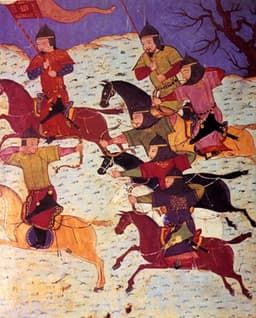
Orda Khan
Emperor · Medieval
41.7Total
Basic Information
Born
812
1204
Died
847
1251
Era
Medieval
Medieval
Nationality
Abbasid Caliphate
Golden Horde
Occupation
Emperor
Emperor
Civilization
Middle Eastern
Eastern
Score Comparison
Military (10%)
50.0
47.5
Political (20%)
42.3
26.4
Influence (20%)
51.8
49.4
Legacy (20%)
40.8
39.2
Leadership (15%)
65.7
45.0
Strategy (15%)
35.7
41.0
TOTAL
47.9
41.7
Al-Wathiq — Complete Timeline
842 AD
Reign during the Abbasid Golden AgeCultural◆ Major
Al-Wathiq's reign (842-847) occurred during the peak of the Abbasid Golden Age. He continued the patronage of scholars and the translation movement, though his rule was short and marked by internal stability.
Golden AgePatronage
Impact: globalconstructive
845 AD
Suppression of the Bedouin RevoltWar
Al-Wathiq sent forces to suppress a Bedouin revolt in the Arabian Peninsula. The rebellion was crushed, reaffirming Abbasid authority over the region.
RevoltInternal Conflict
Impact: regionaldestructive
Orda Khan — Complete Timeline
1227 AD
Founded the White HordePolitical Action◆ Major
Orda Khan, as the eldest son of Jochi, inherited the eastern part of the Jochid ulus after his father's death in 1227. He established the White Horde, a semi-autonomous khanate within the Mongol Empire, ruling over the steppes of modern-day Kazakhstan.
White HordeMongol EmpireJochi
Impact: regionalconstructive
1236 AD
Participated in the Mongol Invasion of EuropeWar◆ Major
Orda Khan led his forces as part of the Mongol invasion of Europe under Batu Khan. He commanded troops in the campaigns against the Rus' principalities, Poland, and Hungary, contributing to the Mongol conquest of Eastern Europe.
Mongol InvasionEuropeBatu Khan
Impact: regionaldestructive
1242 AD
Subordinated to Batu KhanPolitical Action
After the Mongol withdrawal from Europe in 1242, Orda Khan acknowledged the supremacy of his younger brother Batu Khan, who established the Golden Horde. Orda's White Horde remained a vassal, paying tribute and providing military support.
Golden HordeVassalageBatu Khan
Impact: regional
Expert Analysis
Origins
Al-Wathiq (born 812 CE) was the eighth Abbasid caliph, son of Caliph al-Mu'tasim and a Greek slave concubine. He grew up in the luxurious Abbasid court, receiving a thorough education in Islamic theology, poetry, and administration. His father's reign had emphasized military strength and the patronage of scholars, setting a precedent for Al-Wathiq's own rule.
Orda Khan (born c. 1204 CE) was the eldest son of Jochi, himself the eldest son of Genghis Khan. As a member of the Mongol imperial family, Orda was raised in the nomadic steppe tradition, skilled in horseback riding and archery. His early life was shaped by the Mongol conquests, and he participated in military campaigns from a young age.
Rise to Power
Al-Wathiq became caliph in 842 CE upon the death of his father al-Mu'tasim. His accession was smooth, as he was the designated heir. He continued his father's policies, maintaining the Turkic slave soldier (ghilman) system that had become central to Abbasid military power. His reign saw no major internal challenges to his authority.
Orda Khan's rise was tied to the Mongol Empire's expansion. After Jochi's death in 1227, the Jochid ulus was divided: Orda inherited the eastern part, which became the White Horde, while his younger brother Batu received the western part, later the Golden Horde. Orda acknowledged Batu's seniority in military campaigns, particularly during the Mongol invasion of Europe (1236-1242), where he commanded a contingent. His power was always subordinate to Batu's, but he retained autonomy over his own territory.
Leadership & Governance
Al-Wathiq's leadership was characterized by patronage of the arts and sciences, continuing the Abbasid Golden Age. He sponsored the translation of Greek works into Arabic and supported theologians like Ahmad ibn Hanbal. However, his reign was marked by religious intolerance: he enforced the Mu'tazilite doctrine and persecuted those who disagreed, a policy inherited from his father. His governance relied on Turkic military commanders, which created tensions with the traditional Arab elites.
Orda Khan's governance was typical of Mongol khans: decentralized, with a focus on tribute extraction and military organization. He ruled the White Horde from the steppes of modern-day Kazakhstan, maintaining nomadic traditions. His leadership score of 45.0 reflects his effective but limited role as a subordinate ruler. He did not engage in major administrative reforms, instead relying on existing local structures.
Triumph & Tragedy
Al-Wathiq's greatest success was maintaining the Abbasid Golden Age: he kept the caliphate stable and prosperous, with flourishing trade and scholarship. His tragedy was the suppression of the Bedouin revolt (845 CE), which, while successful, highlighted the empire's reliance on Turkic troops and foreshadowed future decline. He died in 847 CE from a fever, possibly due to excessive drinking, leaving no lasting reforms.
Orda Khan's triumph was founding the White Horde, which lasted for centuries as a Mongol khanate. His participation in the Mongol invasion of Europe demonstrated military competence, with his forces contributing to the victories at Legnica and Mohi. However, his tragedy was his subordinate status: despite being the eldest son, he never achieved supreme power, and his legacy was overshadowed by Batu's Golden Horde. He died around 1280 CE, with his khanate eventually absorbed by the Golden Horde.
Character & Destiny
Al-Wathiq was known for his intellect and patronage of scholars, but also for his rigid religious views and cruelty towards opponents. His personality score of 65.7 in leadership indicates a decisive ruler, but his political score of 42.3 shows he failed to build lasting institutions. His destiny was to be a transitional figure: his reign was part of the Abbasid decline, as the caliphs became figureheads for Turkic military commanders.
Orda Khan was a loyal subordinate, accepting Batu's supremacy without conflict. His character was pragmatic and cooperative, which allowed the White Horde to survive but limited his personal ambition. His strategy score of 41.0 suggests he was not a visionary leader. His destiny was to be a footnote in Mongol history, remembered mainly as the founder of a lesser khanate.
Legacy
Al-Wathiq's legacy is mixed: he contributed to the Abbasid Golden Age's cultural achievements, but his religious persecution and reliance on Turkic soldiers weakened the caliphate. His influence score of 51.8 reflects his role in the translation movement, but his legacy score of 40.8 indicates limited long-term impact. He is largely forgotten outside specialist circles.
Orda Khan's legacy is more tangible: the White Horde persisted until the 15th century, later evolving into the Kazakh Khanate. His influence score of 49.4 is comparable to Al-Wathiq's, but his legacy score of 39.2 is lower because his khanate was eventually overshadowed. However, his descendants played a role in the formation of Central Asian states.
Conclusion
Al-Wathiq scored higher overall (47.9 vs 41.7), but this gap is narrow. Al-Wathiq's impact on the Abbasid Golden Age is culturally significant, yet his reign was a continuation of existing trends. Orda Khan's founding of the White Horde had more lasting political consequences in Central Asia. However, Orda's subordination to Batu and the eventual absorption of his khanate diminish his independent impact. Therefore, Al-Wathiq had a slightly greater historical impact due to his role in the Abbasid Golden Age's intellectual flourishing, even if his political achievements were limited. The data supports Al-Wathiq as the more influential figure.
Rankings
🥇
Al-WathiqLeader
Mil: 50.0Pol: 42.3Inf: 51.8
47.9
🥈
Orda Khan
Mil: 47.5Pol: 26.4Inf: 49.4
41.7
+6.2 behind
How This Comparison Works
Algorithm
Each figure is scored on 6 dimensions (0—100 scale) based on structured historical data: Military (10%), Political (20%), Influence (20%), Legacy (20%), Leadership (15%), Strategy (15%). The weighted total produces the final ranking.
Data Sources
Scores are computed from structured sub-indicators in the database. Scale factors adjust for era (Ancient ×0.85, Modern ×1.0) and civilization size (Eastern ×1.05, Other ×0.80) to account for differences in population and military scale.
Maximum 3 Figures
Comparisons are limited to 2—3 figures to ensure readability and statistical meaningfulness.
Error Margins
±5 points per dimension — Sub-scores are derived from historical records with inherent uncertainty. Two figures within 5 points on a dimension should be considered roughly equivalent in that area.
Total Score Accuracy
±3 points overall — The weighted combination of 6 dimensions produces a total score with approximately ±3 points of uncertainty. Differences of less than 3 points are not statistically significant— the figures are effectively tied.
Known Limitations
- Historical records are incomplete and uneven across civilizations
- Figures from oral-tradition societies may be underrepresented
- Occupation labels can misclassify multi-role figures
- Scores measure capability and impact, not moral character
- Quantitative scoring is a comparison tool, not absolute truth
Capability Radar
Military (10%) — Battles & Warfare
Battles
20
20
Win Rate
25
25
Expansion
10
25
Political (20%) — Governance & Reform
Reform
30
15
Diplomacy
35
20
Economy
50
15
Influence (20%) — Cultural & Global Reach
Cultural
30
15
Global
20
10
Legacy (20%) — Historical Impact
Historical
25
20
Longevity
20
15
Leadership (15%) — Power & Stability
Tenure
40
30
Stability
45
25
Strategy (15%) — Tactics & Innovation
Strategy
20
20
Tactics
15
20
Reform
10
10
Similar Comparisons
Comments & Discussion
No comments yet. Be the first to share your thoughts!