Loading...
Ahmed Hassan al-Bakr vs Shang Kexi
Shang Kexi leads by 7.4 pts · 2 figures compared
…

Ahmed Hassan al-Bakr
General · Modern
47.3Total
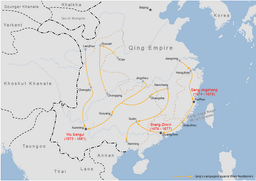
Shang Kexi
General · Modern
54.7Total
Basic Information
Born
1914
1604
Died
1982
1676
Era
Modern
Modern
Nationality
Iraq
China
Occupation
General
General
Civilization
Middle Eastern
Eastern
Score Comparison
Military (10%)
25.9
47.5
Political (20%)
46.6
68.0
Influence (20%)
54.9
56.4
Legacy (20%)
45.0
49.2
Leadership (15%)
65.0
48.8
Strategy (15%)
30.3
60.0
TOTAL
47.3
54.7
Ahmed Hassan al-Bakr — Complete Timeline
1963 AD
Role in the 1963 coupPolitical Action◆ Major
Al-Bakr, a senior Ba'athist officer, helped plan and execute the coup that overthrew Qasim. He became Prime Minister briefly but was forced out by President Arif later that year, marking an early setback for the Ba'ath Party.
CoupBa'ath PartyPower Struggle
Impact: national
1968 AD
Ba'athist return to power (17 July Revolution)Political Action
Al-Bakr led a bloodless coup that brought the Ba'ath Party back to power. He became President and Chairman of the Revolutionary Command Council, establishing a regime that would rule Iraq for decades. Saddam Hussein was his deputy.
CoupBa'ath PartyRegime Change
Impact: national
1972 AD
Nationalization of the Iraq Petroleum CompanyPolitical Action◆ Major
Al-Bakr's government fully nationalized the Iraq Petroleum Company, ending foreign control of the country's oil industry. This move dramatically increased state revenue and funded development projects, but also led to Western sanctions.
OilNationalizationEconomic Policy
Impact: nationalconstructive
1979 AD
Forced resignation and succession by Saddam HusseinPolitical Action
Al-Bakr was forced to resign as President, ostensibly for health reasons, and was succeeded by Saddam Hussein. He was placed under house arrest until his death in 1982. The transition consolidated Saddam's absolute power.
SuccessionSaddam HusseinPower Shift
Impact: nationaldestructive
Shang Kexi — Complete Timeline
1634 AD
Defection to the Qing DynastyPolitical Action◆ Major
Shang Kexi, a Ming general stationed in Liaodong, surrendered to the Qing dynasty after a series of defeats. His defection provided the Qing with experienced Han Chinese troops and knowledge of Ming defenses.
DefectionMing-Qing WarQing Dynasty
Impact: nationaldestructive
1644 AD
Service in the Qing Conquest of ChinaWar◆ Major
Shang Kexi led his Han Chinese forces in the Qing invasion of China proper, participating in the capture of Beijing and subsequent campaigns against Ming loyalists in the south. His troops were instrumental in the Qing victory.
Military CampaignQing ConquestHan Chinese Forces
Impact: nationaldestructive
1649 AD
Enfeoffment as Prince of PingnanPolitical Action◆ Major
The Qing court enfeoffed Shang Kexi as the Prince of Pingnan (Pacifier of the South), granting him hereditary rule over Guangdong province. This made him one of the Three Feudatories, semi-autonomous vassals in southern China.
Three FeudatoriesQing DynastyFeudal Title
Impact: regionalconstructive
1673 AD
Rebellion of the Three FeudatoriesWar◆ Major
Shang Kexi initially remained loyal to the Qing when Wu Sangui launched the Rebellion of the Three Feudatories. However, his son Shang Zhixin joined the rebels, and Shang Kexi was caught in the conflict, dying before its resolution.
RebellionThree FeudatoriesQing Dynasty
Impact: nationaldestructive
1676 AD
Death and Succession CrisisOther◆ Major
Shang Kexi died during the Rebellion of the Three Feudatories, with his son Shang Zhixin having defected to the rebels. His death marked the end of his personal rule, and the Qing later suppressed the rebellion, abolishing the feudatory system.
DeathRebellionThree Feudatories
Impact: regionaltragic
Expert Analysis
Origins
Ahmed Hassan al-Bakr was born in 1914 in Tikrit, Iraq, into a Sunni Arab family. He graduated from the Iraqi Military Academy in 1938 and joined the Ba'ath Party in the 1950s, participating in the 1958 revolution that overthrew the monarchy. Shang Kexi was born in 1604 in Liaodong, Ming China, into a military family. He rose through Ming ranks but surrendered to the Qing after defeats, becoming a key defector.
Rise to Power
Al-Bakr's rise began with the 1963 Ramadan Revolution, a coup that overthrew Qasim; he became Prime Minister briefly. After internal Ba'athist splits, he was sidelined but returned in the 1968 17 July Revolution, a bloodless coup that made him President. Shang Kexi's defection to the Qing in 1634 provided the Qing with experienced Han troops. He led campaigns in the conquest of China, including the capture of Beijing in 1644, and was enfeoffed as Prince of Pingnan, ruling Guangdong.
Leadership & Governance
Al-Bakr centralized power as Chairman of the Revolutionary Command Council, promoting Ba'athist socialism and Arab nationalism. His major achievement was nationalizing the Iraq Petroleum Company in 1972, ending foreign control and increasing state revenue. However, he relied heavily on his relative Saddam Hussein, who gradually accumulated power. Shang Kexi governed Guangdong as a semi-autonomous fief, collecting taxes and maintaining his own army. His rule was pragmatic, balancing Qing loyalty with local interests. His military score of 47.5 reflects his battlefield competence, while al-Bakr's 25.9 indicates less direct command.
Triumph & Tragedy
Al-Bakr's triumph was the oil nationalization, which boosted Iraq's economy and sovereignty. His tragedy was losing power to Saddam; forced to resign in 1979 under pressure, he died under house arrest in 1982. Shang Kexi's triumph was his successful defection and service to the Qing, earning the title Prince of Pingnan. His tragedy was the Rebellion of the Three Feudatories: his son Shang Zhixin joined Wu Sangui's revolt, and Shang Kexi died in 1676 during the conflict, his legacy tarnished. He scored 68.0 in political skill, higher than al-Bakr's 46.6, but al-Bakr's influence score of 54.9 is close to Shang's 56.4.
Character & Destiny
Al-Bakr was cautious and a consensus-builder, but his delegation to Saddam proved fatal. He lacked the ruthlessness to purge rivals, leading to his ouster. Shang Kexi was a pragmatic survivor, switching sides when necessary, but his family's rebellion undid his work. Both were shaped by their environments: al-Bakr by Ba'athist intrigue, Shang by Ming-Qing transition. Their total scores differ: Shang 54.7 vs al-Bakr 47.3, with Shang leading in military and political categories.
Legacy
Al-Bakr's legacy is overshadowed by Saddam Hussein, but his oil nationalization set a precedent for resource sovereignty in the Middle East. He is remembered as a transitional figure who empowered the Ba'ath Party. Shang Kexi is remembered as one of the Three Feudatories, a symbol of Ming loyalist resistance, despite his initial defection. His rule in Guangdong established a pattern of local autonomy that persisted. Both have mixed legacies: al-Bakr's influence score of 54.9 and legacy score of 45.0; Shang's influence 56.4 and legacy 49.2.
Conclusion
Shang Kexi had greater total impact based on his higher scores (54.7 vs 47.3) and his role in shaping Qing China's consolidation. His military and political actions directly influenced the Rebellion of the Three Feudatories, a major event. Al-Bakr's impact was more fleeting, as his policies were quickly overturned by Saddam. While al-Bakr's oil nationalization was significant, it was part of a broader trend; Shang's defection and feudal rule were pivotal in Chinese history. Therefore, Shang Kexi is the more impactful figure.
Rankings
🥇
Shang KexiLeader
Mil: 47.5Pol: 68.0Inf: 56.4
54.7
🥈
Ahmed Hassan al-Bakr
Mil: 25.9Pol: 46.6Inf: 54.9
47.3
+7.4 behind
How This Comparison Works
Algorithm
Each figure is scored on 6 dimensions (0—100 scale) based on structured historical data: Military (10%), Political (20%), Influence (20%), Legacy (20%), Leadership (15%), Strategy (15%). The weighted total produces the final ranking.
Data Sources
Scores are computed from structured sub-indicators in the database. Scale factors adjust for era (Ancient ×0.85, Modern ×1.0) and civilization size (Eastern ×1.05, Other ×0.80) to account for differences in population and military scale.
Maximum 3 Figures
Comparisons are limited to 2—3 figures to ensure readability and statistical meaningfulness.
Error Margins
±5 points per dimension — Sub-scores are derived from historical records with inherent uncertainty. Two figures within 5 points on a dimension should be considered roughly equivalent in that area.
Total Score Accuracy
±3 points overall — The weighted combination of 6 dimensions produces a total score with approximately ±3 points of uncertainty. Differences of less than 3 points are not statistically significant— the figures are effectively tied.
Known Limitations
- Historical records are incomplete and uneven across civilizations
- Figures from oral-tradition societies may be underrepresented
- Occupation labels can misclassify multi-role figures
- Scores measure capability and impact, not moral character
- Quantitative scoring is a comparison tool, not absolute truth
Capability Radar
Military (10%) — Battles & Warfare
Battles
10
55
Win Rate
10
50
Expansion
10
40
Political (20%) — Governance & Reform
Reform
40
35
Diplomacy
30
55
Economy
30
40
Influence (20%) — Cultural & Global Reach
Cultural
20
30
Global
20
30
Legacy (20%) — Historical Impact
Historical
40
45
Longevity
20
40
Leadership (15%) — Power & Stability
Tenure
60
60
Stability
20
45
Strategy (15%) — Tactics & Innovation
Strategy
10
50
Tactics
10
45
Reform
20
30
Similar Comparisons
Comments & Discussion
No comments yet. Be the first to share your thoughts!