Loading...
Ahmed Hassan al-Bakr vs Hasso von Manteuffel
Hasso von Manteuffel leads by 1.4 pts · 2 figures compared
…

Ahmed Hassan al-Bakr
General · Modern
47.3Total
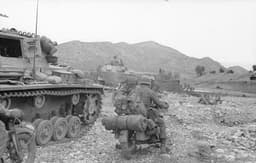
Hasso von Manteuffel
General · Modern
48.7Total
Basic Information
Born
1914
1897
Died
1982
1978
Era
Modern
Modern
Nationality
Iraq
Germany
Occupation
General
General
Civilization
Middle Eastern
Western
Score Comparison
Military (10%)
25.9
61.7
Political (20%)
46.6
32.2
Influence (20%)
54.9
54.9
Legacy (20%)
45.0
46.7
Leadership (15%)
65.0
36.9
Strategy (15%)
30.3
67.2
TOTAL
47.3
48.7
Ahmed Hassan al-Bakr — Complete Timeline
1963 AD
Role in the 1963 coupPolitical Action◆ Major
Al-Bakr, a senior Ba'athist officer, helped plan and execute the coup that overthrew Qasim. He became Prime Minister briefly but was forced out by President Arif later that year, marking an early setback for the Ba'ath Party.
CoupBa'ath PartyPower Struggle
Impact: national
1968 AD
Ba'athist return to power (17 July Revolution)Political Action
Al-Bakr led a bloodless coup that brought the Ba'ath Party back to power. He became President and Chairman of the Revolutionary Command Council, establishing a regime that would rule Iraq for decades. Saddam Hussein was his deputy.
CoupBa'ath PartyRegime Change
Impact: national
1972 AD
Nationalization of the Iraq Petroleum CompanyPolitical Action◆ Major
Al-Bakr's government fully nationalized the Iraq Petroleum Company, ending foreign control of the country's oil industry. This move dramatically increased state revenue and funded development projects, but also led to Western sanctions.
OilNationalizationEconomic Policy
Impact: nationalconstructive
1979 AD
Forced resignation and succession by Saddam HusseinPolitical Action
Al-Bakr was forced to resign as President, ostensibly for health reasons, and was succeeded by Saddam Hussein. He was placed under house arrest until his death in 1982. The transition consolidated Saddam's absolute power.
SuccessionSaddam HusseinPower Shift
Impact: nationaldestructive
Hasso von Manteuffel — Complete Timeline
1943 AD
Battle of the Kasserine PassWar◆ Major
Manteuffel commanded a battle group in the German offensive at the Kasserine Pass in Tunisia. His forces advanced against inexperienced US troops, achieving a tactical victory before being halted by Allied reinforcements.
World War IINorth AfricaKasserine
Impact: regional
1944 AD
Command of 7th Panzer DivisionWar◆ Major
Manteuffel was appointed commander of the 7th Panzer Division on the Eastern Front. He led the division in defensive battles in Romania and Hungary, including the retreat through the Carpathian Mountains.
World War IIEastern FrontPanzer Division
Impact: regional
Command of 5th Panzer ArmyWar◆ Major
Manteuffel commanded the 5th Panzer Army during the Battle of the Bulge. His army led the main offensive in the Ardennes, achieving initial breakthroughs before being halted by Allied resistance and supply shortages.
World War IIWestern FrontArdennes
Impact: regional
1945 AD
Command of 3rd Panzer ArmyWar◆ Major
Manteuffel was appointed commander of the 3rd Panzer Army on the Eastern Front. He led the army in the defense of Pomerania and the Oder River line against the Soviet Vistula-Oder Offensive, eventually surrendering to British forces.
World War IIEastern FrontCommand
Impact: regional
Expert Analysis
Origins
Ahmed Hassan al-Bakr was born in 1914 in Tikrit, Iraq, into a Sunni Arab family. He trained as a teacher before joining the Iraqi military in 1938, graduating from the Military College in Baghdad. His early career was shaped by the anti-British sentiment of the 1940s and 1950s, and he joined the Ba'ath Party in the early 1950s, rising through its ranks due to his military connections.
Hasso von Manteuffel was born in 1897 in Potsdam, Germany, into a Prussian aristocratic family with a long military tradition. He joined the Imperial German Army in 1916, serving in World War I. After the war, he remained in the Reichswehr, and by the 1930s, he was a cavalry officer. His early experiences in the Great War and the interwar period shaped his tactical thinking, emphasizing mobility and combined arms.
Rise to Power
Al-Bakr's political rise began with the 1963 coup, which overthrew Prime Minister Abd al-Karim Qasim. As a senior Ba'athist officer, he played a key role in the planning and execution, becoming Prime Minister briefly. However, internal party conflicts led to his ouster later that year. He rebuilt his influence within the Ba'ath Party, and on July 17, 1968, he led a bloodless coup (the 17 July Revolution) that brought the party back to power. He became President and Chairman of the Revolutionary Command Council.
Manteuffel rose through the ranks of the Wehrmacht, commanding a battalion during the 1940 invasion of France. His breakthrough came in North Africa, where he commanded a battle group at the Kasserine Pass in February 1943, achieving a tactical victory against inexperienced US forces. His performance earned him the Knight's Cross, and he was later given command of the 7th Panzer Division on the Eastern Front in 1944, where he conducted defensive battles in Romania and Hungary. In December 1944, he commanded the 5th Panzer Army in the Battle of the Bulge, leading the main offensive that initially broke through US lines.
Leadership & Governance
Al-Bakr's leadership was characterized by his role as a consensus-builder within the Ba'ath Party, balancing factions. He focused on consolidating power through the security apparatus and the party structure. His governance included nationalizing the Iraq Petroleum Company in 1972, which increased state revenue from oil, and implementing socialist economic policies. He also pursued a foreign policy aligned with the Soviet Union and supported the Palestinian cause. However, he delegated increasing authority to his deputy, Saddam Hussein, who built a parallel power structure through the security services.
Manteuffel's leadership on the battlefield was marked by aggressive, mobile tactics. He emphasized speed and surprise, often leading from the front. At the Battle of the Bulge, he advocated for a narrower, faster advance rather than the broad front plan, but was overruled. His command style was professional and respected by his troops, but he operated within a rigid Nazi hierarchy that limited strategic autonomy. Unlike al-Bakr, Manteuffel had no role in governance, focusing solely on military operations.
Triumph & Tragedy
Al-Bakr's greatest triumph was the nationalization of the Iraq Petroleum Company, which ended foreign control and dramatically increased oil revenues, funding infrastructure and social programs. His 1968 coup also stabilized Ba'athist rule for decades. However, his greatest failure was his inability to prevent Saddam Hussein from accumulating power, leading to his forced resignation in 1979 under pressure, ostensibly for health reasons. He was placed under house arrest until his death in 1982, effectively a prisoner in his own country.
Manteuffel's triumphs include his tactical successes at Kasserine Pass and his leadership of the 5th Panzer Army during the initial phases of the Battle of the Bulge, where his forces advanced 60 miles. He also successfully commanded the 3rd Panzer Army in the defense of Pomerania in 1945, delaying the Soviet advance. However, his tragedy was fighting for a regime that committed atrocities, and his strategic efforts could not prevent Germany's defeat. After the war, he was convicted of war crimes for allowing forced labor and sentenced to 18 months in prison.
Character & Destiny
Al-Bakr was cautious and methodical, preferring to work behind the scenes. He was a party man, not a charismatic dictator. His tendency to delegate allowed Saddam to build a rival power base, leading to his downfall. Historians note that al-Bakr lacked the ruthlessness to purge rivals, scoring 46.6 in political acumen compared to Saddam's higher score.
Manteuffel was a daring, professional soldier who adhered to the Prussian military ethos. He was politically naive, never questioning the Nazi regime's legitimacy. His character led him to follow orders effectively, but his destiny was tied to a losing cause. Military historians rate his strategic ability at 67.2, but his political score of 32.2 reflects his lack of broader influence.
Legacy
Al-Bakr's legacy is overshadowed by Saddam Hussein, but his nationalization of Iraq's oil set a precedent for resource control in the region. His Ba'athist structure enabled Saddam's later consolidation. In Iraq, he is remembered as a founder of the modern state, but also as a transitional figure. His influence score of 54.9 reflects this mixed legacy.
Manteuffel's legacy is that of a skilled panzer commander, studied in military academies for his tactical prowess. However, his involvement in a criminal regime limits his legacy. He scored 46.7 in legacy, lower than other German generals due to his war crimes conviction.
Conclusion
Hasso von Manteuffel had a greater impact in his domain, achieving notable tactical victories and commanding armies in key battles, with a total score of 48.7 vs al-Bakr's 47.3. While al-Bakr's nationalization policy had long-term economic effects, his political weakness allowed Saddam to hijack the state. Manteuffel's military achievements, though ultimately on the losing side, were more decisive in the short term. However, if we consider long-term global influence, al-Bakr's oil nationalization reshaped Iraq's economy for decades. Still, the score gap of 1.4 points favors Manteuffel, whose tactical legacy in armored warfare remains relevant.
Rankings
🥇
Hasso von ManteuffelLeader
Mil: 61.7Pol: 32.2Inf: 54.9
48.7
🥈
Ahmed Hassan al-Bakr
Mil: 25.9Pol: 46.6Inf: 54.9
47.3
+1.4 behind
How This Comparison Works
Algorithm
Each figure is scored on 6 dimensions (0—100 scale) based on structured historical data: Military (10%), Political (20%), Influence (20%), Legacy (20%), Leadership (15%), Strategy (15%). The weighted total produces the final ranking.
Data Sources
Scores are computed from structured sub-indicators in the database. Scale factors adjust for era (Ancient ×0.85, Modern ×1.0) and civilization size (Eastern ×1.05, Other ×0.80) to account for differences in population and military scale.
Maximum 3 Figures
Comparisons are limited to 2—3 figures to ensure readability and statistical meaningfulness.
Error Margins
±5 points per dimension — Sub-scores are derived from historical records with inherent uncertainty. Two figures within 5 points on a dimension should be considered roughly equivalent in that area.
Total Score Accuracy
±3 points overall — The weighted combination of 6 dimensions produces a total score with approximately ±3 points of uncertainty. Differences of less than 3 points are not statistically significant— the figures are effectively tied.
Known Limitations
- Historical records are incomplete and uneven across civilizations
- Figures from oral-tradition societies may be underrepresented
- Occupation labels can misclassify multi-role figures
- Scores measure capability and impact, not moral character
- Quantitative scoring is a comparison tool, not absolute truth
Capability Radar
Military (10%) — Battles & Warfare
Battles
10
75
Win Rate
10
70
Expansion
10
50
Political (20%) — Governance & Reform
Reform
40
10
Diplomacy
30
30
Economy
30
10
Influence (20%) — Cultural & Global Reach
Cultural
20
30
Global
20
30
Legacy (20%) — Historical Impact
Historical
40
40
Longevity
20
30
Leadership (15%) — Power & Stability
Tenure
60
20
Stability
20
10
Strategy (15%) — Tactics & Innovation
Strategy
10
75
Tactics
10
85
Reform
20
60
Similar Comparisons
Comments & Discussion
No comments yet. Be the first to share your thoughts!