Loading...
This comparison has not been analyzed yet.
One-time AI generation (~1 minute). Scores and timeline are already available below.
Agum II vs Kanishka III
Kanishka III leads by 0.2 pts · 2 figures compared
…

Agum II
Emperor · Ancient
36.2Total
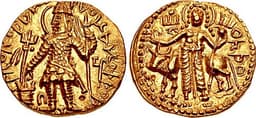
Kanishka III
Emperor · Ancient
36.4Total
Basic Information
Born
-1570
250
Died
-1550
270
Era
Ancient
Ancient
Nationality
Kassite Dynasty
Kushan Empire
Occupation
Emperor
Emperor
Civilization
Middle Eastern
Indian
Score Comparison
Military (10%)
22.6
10.2
Political (20%)
26.4
33.6
Influence (20%)
47.1
43.2
Legacy (20%)
38.3
33.3
Leadership (15%)
31.2
44.5
Strategy (15%)
39.6
45.0
TOTAL
36.2
36.4
Agum II — Complete Timeline
1550 BC
Return of the Marduk Statue to BabylonPolitical Action◆ Major
Agum II negotiated or led the recovery of the cult statue of Marduk from the Hittites, who had taken it after sacking Babylon around 1595 BC. This act restored the religious center of Babylon and legitimized Kassite rule over Mesopotamia.
Kassite DynastyBabylonReligious Restoration
Impact: regionalconstructive
Kanishka III — Complete Timeline
255 AD
Reign as a Later Kushan RulerPolitical Action
Kanishka III ruled over a diminished Kushan territory, likely confined to the Punjab and Mathura regions. His reign saw further decline as the Sassanians and local Indian powers encroached, and he is considered a shadow of the earlier great Kushan emperors.
Kushan EmpireDeclineTerritorial Loss
destructive
260 AD
Issuance of Degraded CoinageCultural
Kanishka III issued coins with reduced gold content and cruder artistic style compared to earlier Kushan coinage. This reflects the economic strain and loss of control over trade routes that characterized the later Kushan period.
CoinageEconomyDecline
destructive
This comparison has not been analyzed yet.
One-time AI generation (~1 minute). Scores and timeline are already available below.
Rankings
🥇
Kanishka IIILeader
Mil: 10.2Pol: 33.6Inf: 43.2
36.4
🥈
Agum II
Mil: 22.6Pol: 26.4Inf: 47.1
36.2
+0.2 behind
How This Comparison Works
Algorithm
Each figure is scored on 6 dimensions (0—100 scale) based on structured historical data: Military (10%), Political (20%), Influence (20%), Legacy (20%), Leadership (15%), Strategy (15%). The weighted total produces the final ranking.
Data Sources
Scores are computed from structured sub-indicators in the database. Scale factors adjust for era (Ancient ×0.85, Modern ×1.0) and civilization size (Eastern ×1.05, Other ×0.80) to account for differences in population and military scale.
Maximum 3 Figures
Comparisons are limited to 2—3 figures to ensure readability and statistical meaningfulness.
Error Margins
±5 points per dimension — Sub-scores are derived from historical records with inherent uncertainty. Two figures within 5 points on a dimension should be considered roughly equivalent in that area.
Total Score Accuracy
±3 points overall — The weighted combination of 6 dimensions produces a total score with approximately ±3 points of uncertainty. Differences of less than 3 points are not statistically significant— the figures are effectively tied.
Known Limitations
- Historical records are incomplete and uneven across civilizations
- Figures from oral-tradition societies may be underrepresented
- Occupation labels can misclassify multi-role figures
- Scores measure capability and impact, not moral character
- Quantitative scoring is a comparison tool, not absolute truth
Capability Radar
Military (10%) — Battles & Warfare
Battles
10
5
Win Rate
10
5
Expansion
5
5
Political (20%) — Governance & Reform
Reform
10
5
Diplomacy
30
10
Economy
10
10
Influence (20%) — Cultural & Global Reach
Cultural
30
10
Global
10
5
Legacy (20%) — Historical Impact
Historical
30
10
Longevity
20
10
Leadership (15%) — Power & Stability
Tenure
20
10
Stability
15
10
Strategy (15%) — Tactics & Innovation
Strategy
10
5
Tactics
10
5
Reform
5
5
Similar Comparisons
Comments & Discussion
No comments yet. Be the first to share your thoughts!