Loading...
Kanishka III vs Nicomedes IV
Nicomedes IV leads by 1.1 pts · 2 figures compared
…
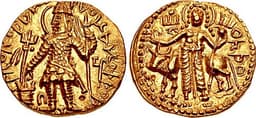
Kanishka III
Emperor · Ancient
36.4Total

Nicomedes IV
Emperor · Ancient
37.5Total
Basic Information
Born
250
-94
Died
270
-74
Era
Ancient
Ancient
Nationality
Kushan Empire
Bithynia
Occupation
Emperor
Emperor
Civilization
Indian
Western
Score Comparison
Military (10%)
10.2
27.0
Political (20%)
33.6
25.0
Influence (20%)
43.2
47.9
Legacy (20%)
33.3
40.0
Leadership (15%)
44.5
33.6
Strategy (15%)
45.0
40.2
TOTAL
36.4
37.5
Kanishka III — Complete Timeline
255 AD
Reign as a Later Kushan RulerPolitical Action
Kanishka III ruled over a diminished Kushan territory, likely confined to the Punjab and Mathura regions. His reign saw further decline as the Sassanians and local Indian powers encroached, and he is considered a shadow of the earlier great Kushan emperors.
Kushan EmpireDeclineTerritorial Loss
destructive
260 AD
Issuance of Degraded CoinageCultural
Kanishka III issued coins with reduced gold content and cruder artistic style compared to earlier Kushan coinage. This reflects the economic strain and loss of control over trade routes that characterized the later Kushan period.
CoinageEconomyDecline
destructive
Nicomedes IV — Complete Timeline
90 BC
Restoration by Roman SenatePolitical Action◆ Major
After being driven from his throne by Mithridates VI of Pontus, Nicomedes IV was restored to power by a Roman commission led by Manius Aquillius. This intervention deepened Roman involvement in Anatolia and provoked the First Mithridatic War.
Mithridatic WarsRoman InterventionRestoration
Impact: regionalconstructive
88 BC
Alliance with Rome against MithridatesPolitical Action◆ Major
Nicomedes IV, under Roman pressure, attacked Mithridates VI's territory, raiding as far as Amastris. This aggression gave Mithridates a casus belli for his invasion of the Roman province of Asia, leading to the First Mithridatic War.
Mithridatic WarsProvocationRoman Policy
Impact: regionaldestructive
74 BC
Bequest of Bithynia to RomePolitical Action
Nicomedes IV died without a legitimate heir and bequeathed his kingdom of Bithynia to the Roman Republic in his will. This act made Bithynia a Roman province, ending the independent kingdom and triggering the Third Mithridatic War.
Roman AnnexationProvinceMithridatic Wars
Impact: regional
Expert Analysis
Origins
Kanishka III, a later ruler of the Kushan Empire, reigned during the mid-4th century CE, likely around 350-375 CE. The Kushan Empire, once a vast territory spanning Central Asia and northern India, had been in decline since the Sasanian conquests in the 3rd century. Kanishka III’s lineage is uncertain, but he was probably a descendant of the great Kanishka I. His realm was confined to the Punjab and Mathura regions, a shadow of its former glory. Little is known of his early life; he inherited a weakened state with limited resources.
Nicomedes IV, the last king of Bithynia (reigned c. 94–74 BCE), was the son of Nicomedes III. Bithynia was a Hellenistic kingdom in northwestern Anatolia. Nicomedes IV was born around 120 BCE and educated in Greek culture. His father had expanded Bithynia’s influence, but the kingdom faced threats from Pontus and Rome. Nicomedes IV’s upbringing prepared him for diplomacy rather than warfare.
Rise to Power
Kanishka III ascended to the throne during a period of fragmentation. The Kushan Empire had lost its western provinces to the Sasanians, and local governors asserted independence. Kanishka III’s authority was limited to the eastern heartland. He likely came to power through dynastic succession, but his reign saw no major campaigns or expansions. His rule was characterized by maintaining what remained rather than conquering new territories.
Nicomedes IV became king after his father’s death in 94 BCE. His early reign was threatened by Mithridates VI of Pontus, who supported a rival claimant, Socrates Chrestus. Nicomedes IV was driven from his throne in 90 BCE but was restored by the Roman Senate under a commission led by Manius Aquillius. This restoration came at a price: Bithynia became a client kingdom of Rome. Nicomedes IV’s rise was thus tied to Roman intervention.
Leadership & Governance
Kanishka III’s governance is evidenced primarily by his coinage. He issued gold and copper coins with crude artistic styles and reduced gold content, reflecting economic strain. His inscriptions are rare, suggesting limited administrative capacity. Kanishka III continued the Kushan tradition of patronizing Buddhism, but his rule was reactive, not proactive. He scored 44.5 in leadership, indicating modest effectiveness in managing a declining state.
Nicomedes IV ruled as a Roman client. He maintained Bithynia’s internal autonomy but deferred to Rome in foreign affairs. His leadership score of 33.6 reflects his dependence on Rome. He was a weak ruler who failed to assert independence, but his governance preserved the kingdom’s stability. He allowed Roman influence to grow, which ultimately led to the kingdom’s annexation.
Triumph & Tragedy
Kanishka III’s greatest success was simply maintaining Kushan rule in a period of collapse. He kept the dynasty alive and issued coins that asserted his legitimacy. His greatest failure was the inability to reverse the empire’s decline; he scored only 10.2 in military, indicating no significant victories. The Kushan Empire faded into obscurity after his reign.
Nicomedes IV’s triumph was the peaceful bequest of Bithynia to Rome, ensuring his kingdom’s legacy. However, his tragedy was his subservience: he was manipulated by Rome into attacking Mithridates, triggering the First Mithridatic War. His alliance with Rome (score 27.0 military) was ineffective. He died without an heir, ending the dynasty.
Character & Destiny
Kanishka III appears as a ruler resigned to decline. His coinage shows a lack of innovation, and his political score of 33.6 suggests he was unable to forge strong alliances. His character was likely cautious, but circumstances were against him. The Kushan Empire’s fate was sealed by external pressures.
Nicomedes IV was pragmatic and diplomatic, but weak-willed. He chose Roman protection over independence, which saved his throne temporarily but doomed his kingdom. His political score of 25.0 reflects his lack of agency. His destiny was to be the last of his line, a pawn in Roman expansion.
Legacy
Kanishka III’s legacy is minimal. He is a footnote in Kushan history, remembered only by numismatists. The Kushan Empire contributed to the spread of Buddhism and art, but Kanishka III added nothing. His legacy score of 33.3 is modest.
Nicomedes IV’s legacy is more significant: his bequest made Bithynia a Roman province, integrating it into the Roman world. This facilitated the spread of Roman culture in Anatolia. His influence score of 47.9 reflects this enduring impact. He is remembered as the king who gave his kingdom to Rome.
Conclusion
Nicomedes IV had greater historical impact than Kanishka III. Despite lower leadership and political scores, his bequest of Bithynia to Rome had lasting consequences, shaping the region for centuries. Kanishka III presided over a dying empire with no lasting influence. Nicomedes IV’s total score of 37.5 edges Kanishka III’s 36.4, but the gap is narrow. However, in terms of legacy, Nicomedes IV clearly surpasses Kanishka III. The latter was a mere caretaker of a fading realm; the former was a catalyst for Roman expansion. Therefore, Nicomedes IV stands as the more significant figure.
Rankings
🥇
Nicomedes IVLeader
Mil: 27.0Pol: 25.0Inf: 47.9
37.5
🥈
Kanishka III
Mil: 10.2Pol: 33.6Inf: 43.2
36.4
+1.1 behind
How This Comparison Works
Algorithm
Each figure is scored on 6 dimensions (0—100 scale) based on structured historical data: Military (10%), Political (20%), Influence (20%), Legacy (20%), Leadership (15%), Strategy (15%). The weighted total produces the final ranking.
Data Sources
Scores are computed from structured sub-indicators in the database. Scale factors adjust for era (Ancient ×0.85, Modern ×1.0) and civilization size (Eastern ×1.05, Other ×0.80) to account for differences in population and military scale.
Maximum 3 Figures
Comparisons are limited to 2—3 figures to ensure readability and statistical meaningfulness.
Error Margins
±5 points per dimension — Sub-scores are derived from historical records with inherent uncertainty. Two figures within 5 points on a dimension should be considered roughly equivalent in that area.
Total Score Accuracy
±3 points overall — The weighted combination of 6 dimensions produces a total score with approximately ±3 points of uncertainty. Differences of less than 3 points are not statistically significant— the figures are effectively tied.
Known Limitations
- Historical records are incomplete and uneven across civilizations
- Figures from oral-tradition societies may be underrepresented
- Occupation labels can misclassify multi-role figures
- Scores measure capability and impact, not moral character
- Quantitative scoring is a comparison tool, not absolute truth
Capability Radar
Military (10%) — Battles & Warfare
Battles
5
7
Win Rate
5
7
Expansion
5
11
Political (20%) — Governance & Reform
Reform
5
10
Diplomacy
10
30
Economy
10
15
Influence (20%) — Cultural & Global Reach
Cultural
10
10
Global
5
15
Legacy (20%) — Historical Impact
Historical
10
30
Longevity
10
20
Leadership (15%) — Power & Stability
Tenure
10
20
Stability
10
10
Strategy (15%) — Tactics & Innovation
Strategy
5
13
Tactics
5
17
Reform
5
19
Similar Comparisons
Comments & Discussion
No comments yet. Be the first to share your thoughts!