Loading...
This comparison has not been analyzed yet.
One-time AI generation (~1 minute). Scores and timeline are already available below.
Agha Mohammad Khan vs Ngolo Diarra
Agha Mohammad Khan leads by 4.8 pts · 2 figures compared
…
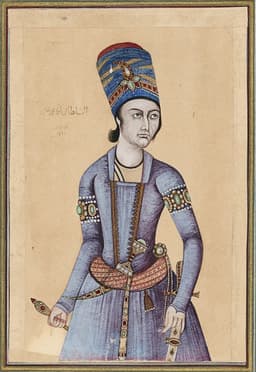
Agha Mohammad Khan
Emperor · Modern
58.3Total

Ngolo Diarra
Emperor · Modern
53.5Total
Basic Information
Born
1742
1700
Died
1797
1790
Era
Modern
Modern
Nationality
Persia
Bamana Empire
Occupation
Emperor
Emperor
Civilization
Middle Eastern
Other
Score Comparison
Military (10%)
78.0
50.0
Political (20%)
68.0
68.0
Influence (20%)
57.2
54.1
Legacy (20%)
54.0
43.3
Leadership (15%)
40.0
53.2
Strategy (15%)
65.0
60.0
TOTAL
58.3
53.5
Agha Mohammad Khan — Complete Timeline
1794 AD
Captured KermanWar◆ Major
Agha Mohammad Khan besieged and captured Kerman, the last Zand stronghold. He ordered the massacre of the city's defenders and the blinding of the Zand ruler Lotf Ali Khan, brutally crushing all opposition and solidifying Qajar control over southern Persia.
SiegeMassacreZand Defeat
Impact: nationaldestructive
Founded the Qajar DynastyPolitical Action
Agha Mohammad Khan defeated the Zand dynasty and established the Qajar dynasty, unifying Persia under his rule. He crowned himself shah in 1796, ending decades of civil war and foreign intervention, and establishing a dynasty that would rule until 1925.
Dynasty FoundingUnification
Impact: national
1795 AD
Reconquered GeorgiaWar◆ Major
Agha Mohammad Khan invaded Georgia, then under Russian protection, and sacked Tbilisi. He reasserted Persian sovereignty over the region, but this campaign provoked Russian intervention and led to the Russo-Persian War of 1804-1813, which ultimately resulted in Persian loss of the Caucasus.
InvasionGeorgiaRusso-Persian Conflict
Impact: regionaldestructive
1797 AD
Assassinated in ShushaPolitical Action◆ Major
Agha Mohammad Khan was assassinated by his own servants in Shusha, Karabakh, during a dispute. His death created a succession crisis, but his nephew Fath-Ali Shah quickly took the throne, continuing the Qajar dynasty. The assassination highlighted the violent internal politics of the Qajar court.
AssassinationSuccession Crisis
Impact: nationaltragic
Ngolo Diarra — Complete Timeline
1766 AD
Conquest of SegouWar
Ngolo Diarra, a former slave, led a successful military campaign to capture the city of Segou from the ruling Coulibaly dynasty. This victory established him as the new faama (king) of the Bamana Empire, marking the beginning of his reign.
ConquestBamana EmpireSegou
Impact: regional
Establishment of Segou as CapitalPolitical Action◆ Major
After his conquest, Ngolo Diarra made Segou the permanent capital of the Bamana Empire. He initiated a building program that included the construction of a royal palace and fortifications, transforming the city into a major political and economic center.
CapitalUrban DevelopmentSegou
Impact: nationalconstructive
1770 AD
Expansion of the Bamana EmpireWar◆ Major
Ngolo Diarra launched military campaigns that expanded Bamana control over the Niger River valley, including the conquest of the important trading city of Djenn
ExpansionTradeNiger River
Impact: regional
1775 AD
Reorganization of the Bamana ArmyReform◆ Major
Ngolo Diarra restructured the Bamana military, creating a professional standing army with a core of slave soldiers loyal directly to him. This reform reduced the power of traditional nobles and increased the central authority of the faama.
Military ReformCentralizationSlave Soldiers
Impact: nationalconstructive
This comparison has not been analyzed yet.
One-time AI generation (~1 minute). Scores and timeline are already available below.
Rankings
🥇
Agha Mohammad KhanLeader
Mil: 78.0Pol: 68.0Inf: 57.2
58.3
🥈
Ngolo Diarra
Mil: 50.0Pol: 68.0Inf: 54.1
53.5
+4.8 behind
How This Comparison Works
Algorithm
Each figure is scored on 6 dimensions (0—100 scale) based on structured historical data: Military (10%), Political (20%), Influence (20%), Legacy (20%), Leadership (15%), Strategy (15%). The weighted total produces the final ranking.
Data Sources
Scores are computed from structured sub-indicators in the database. Scale factors adjust for era (Ancient ×0.85, Modern ×1.0) and civilization size (Eastern ×1.05, Other ×0.80) to account for differences in population and military scale.
Maximum 3 Figures
Comparisons are limited to 2—3 figures to ensure readability and statistical meaningfulness.
Error Margins
±5 points per dimension — Sub-scores are derived from historical records with inherent uncertainty. Two figures within 5 points on a dimension should be considered roughly equivalent in that area.
Total Score Accuracy
±3 points overall — The weighted combination of 6 dimensions produces a total score with approximately ±3 points of uncertainty. Differences of less than 3 points are not statistically significant— the figures are effectively tied.
Known Limitations
- Historical records are incomplete and uneven across civilizations
- Figures from oral-tradition societies may be underrepresented
- Occupation labels can misclassify multi-role figures
- Scores measure capability and impact, not moral character
- Quantitative scoring is a comparison tool, not absolute truth
Capability Radar
Military (10%) — Battles & Warfare
Battles
75
45
Win Rate
80
50
Expansion
80
55
Political (20%) — Governance & Reform
Reform
55
55
Diplomacy
50
45
Economy
40
50
Influence (20%) — Cultural & Global Reach
Cultural
45
40
Global
40
25
Legacy (20%) — Historical Impact
Historical
60
40
Longevity
55
30
Leadership (15%) — Power & Stability
Tenure
65
50
Stability
30
50
Strategy (15%) — Tactics & Innovation
Strategy
75
45
Tactics
70
40
Reform
60
50
Similar Comparisons
Comments & Discussion
No comments yet. Be the first to share your thoughts!