Loading...
Agha Mohammad Khan vs Napoleon Bonaparte
Napoleon Bonaparte leads by 12.6 pts · 2 figures compared
…
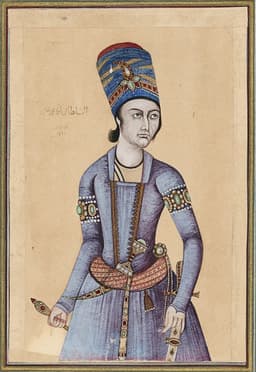
Agha Mohammad Khan
Emperor · Modern
58.3Total

Napoleon Bonaparte
General · Modern
70.9Total
Basic Information
Born
1742
1769
Died
1797
1821
Era
Modern
Modern
Nationality
Persia
France
Occupation
Emperor
General
Civilization
Middle Eastern
Western
Score Comparison
Military (10%)
78.0
94.0
Political (20%)
68.0
72.0
Influence (20%)
57.2
40.0
Legacy (20%)
54.0
80.0
Leadership (15%)
40.0
78.0
Strategy (15%)
65.0
90.0
TOTAL
58.3
70.9
Agha Mohammad Khan — Complete Timeline
1794 AD
Captured KermanWar◆ Major
Agha Mohammad Khan besieged and captured Kerman, the last Zand stronghold. He ordered the massacre of the city's defenders and the blinding of the Zand ruler Lotf Ali Khan, brutally crushing all opposition and solidifying Qajar control over southern Persia.
SiegeMassacreZand Defeat
Impact: nationaldestructive
Founded the Qajar DynastyPolitical Action
Agha Mohammad Khan defeated the Zand dynasty and established the Qajar dynasty, unifying Persia under his rule. He crowned himself shah in 1796, ending decades of civil war and foreign intervention, and establishing a dynasty that would rule until 1925.
Dynasty FoundingUnification
Impact: national
1795 AD
Reconquered GeorgiaWar◆ Major
Agha Mohammad Khan invaded Georgia, then under Russian protection, and sacked Tbilisi. He reasserted Persian sovereignty over the region, but this campaign provoked Russian intervention and led to the Russo-Persian War of 1804-1813, which ultimately resulted in Persian loss of the Caucasus.
InvasionGeorgiaRusso-Persian Conflict
Impact: regionaldestructive
1797 AD
Assassinated in ShushaPolitical Action◆ Major
Agha Mohammad Khan was assassinated by his own servants in Shusha, Karabakh, during a dispute. His death created a succession crisis, but his nephew Fath-Ali Shah quickly took the throne, continuing the Qajar dynasty. The assassination highlighted the violent internal politics of the Qajar court.
AssassinationSuccession Crisis
Impact: nationaltragic
Napoleon Bonaparte — Complete Timeline
1799 AD
Coup of 18 BrumaireOther◆ Major
Napoleon Bonaparte, with support from his brother Lucien and key political figures, overthrew the Directory in a bloodless coup. He established the Consulate with himself as First Consul, effectively becoming the ruler of France. This event ended the French Revolution's most unstable period.
French RevolutionCoupRise to Power
Impact: regional
1804 AD
Promulgation of the Napoleonic CodeOther◆ Major
Napoleon enacted the Civil Code of the French, known as the Napoleonic Code, a comprehensive set of laws that replaced the fragmented feudal legal systems. The code established legal equality, protected property rights, and secularized law. It became the basis for legal systems in many European and world countries.
Legal ReformNapoleonic CodeCivil Law
Impact: globalconstructive
1805 AD
Battle of AusterlitzWar◆ Major
Napoleon's Grande Arm
Napoleonic WarsBattleDecisive Victory
Impact: global
1812 AD
Invasion of RussiaWar◆ Major
Napoleon led the Grande Arm
Napoleonic WarsInvasionDisaster
Impact: globaldestructive
1815 AD
Battle of WaterlooWar◆ Major
Napoleon's French army was defeated by the combined forces of the Duke of Wellington's Anglo-Allied army and Gebhard Leberecht von Bl
Napoleonic WarsBattleFinal Defeat
Impact: globaldestructive
Expert Analysis
Origins
Agha Mohammad Khan was born in 1742 in Gorgan, Persia, into the Qajar tribe, a Turkic group that had long been a power base in northern Persia. His father, Mohammad Hassan Khan, was a tribal leader who fought for dominance against the Zand dynasty. Agha Mohammad Khan was captured as a child and castrated by the Zand ruler Karim Khan, an event that shaped his ruthless and vengeful character. He spent years as a hostage in Shiraz, observing court politics and military strategy, before escaping in 1779 to reclaim his tribe's leadership.
Napoleon Bonaparte was born in 1769 in Ajaccio, Corsica, to a modest noble family. His father, Carlo Buonaparte, was a lawyer who supported Corsican independence before switching allegiance to France. Napoleon excelled in military school in Brienne-le-Château and later the École Militaire in Paris, graduating as an artillery officer in 1785. His early exposure to Enlightenment ideas and the chaos of the French Revolution shaped his ambition.
Rise to Power
Agha Mohammad Khan's rise began after his escape in 1779, when he united the Qajar tribes and launched a campaign against the Zand dynasty. By 1785, he had seized Tehran and made it his capital. His key turning point came in 1794 when he besieged Kerman, the last Zand stronghold. After capturing the city, he ordered the massacre of the defenders and the blinding of the Zand ruler Lotf Ali Khan, cementing his reputation for cruelty. In 1796, he crowned himself Shah, founding the Qajar dynasty.
Napoleon's rise was meteoric. He gained prominence during the Siege of Toulon in 1793, where his artillery tactics drove out British forces. Promoted to brigadier general, he then suppressed a royalist uprising in Paris in 1795. His Italian campaign of 1796-1797 made him a national hero, as he defeated Austrian forces and established French dominance. In 1799, he staged the Coup of 18 Brumaire, overthrowing the Directory and becoming First Consul, effectively dictator of France.
Leadership & Governance
Agha Mohammad Khan ruled through terror and personal control. He centralized power by eliminating rivals, often through brutal means. He reasserted Persian sovereignty over Georgia in 1795 by sacking Tbilisi, but his governance was focused on military consolidation rather than administrative reform. He moved the capital to Tehran, a strategic choice, but left no legal or bureaucratic legacy. His leadership scored 40.0, reflecting his autocratic and short-sighted style.
Napoleon, scoring 78.0 in leadership, was a transformative administrator. He enacted the Napoleonic Code in 1804, which standardized French law and influenced legal systems worldwide. He established the Bank of France, reformed education, and created a merit-based bureaucracy. His governance was efficient but authoritarian, as he centralized power in himself. His political score of 72.0 reflects his ability to both reform and dominate.
Triumph & Tragedy
Agha Mohammad Khan's greatest triumph was unifying Persia after decades of civil war, founding the Qajar dynasty that lasted until 1925. His capture of Kerman and defeat of the Zands ended a chaotic period. However, his tragedy was his assassination in 1797 in Shusha, Karabakh, by his own servants during a petty dispute. This left a succession crisis, though his nephew Fath-Ali Shah eventually succeeded. His legacy score of 54.0 reflects his ephemeral impact.
Napoleon's triumphs include his military victories, especially at Austerlitz in 1805, where he scored a 94.0 in military and 90.0 in strategy. His Napoleonic Code remains a cornerstone of civil law. His tragedy was the invasion of Russia in 1812, where his Grande Armée of over 600,000 men was destroyed by scorched-earth tactics and winter, losing over 500,000 soldiers. He was exiled to Elba in 1814, returned in 1815, but was finally defeated at Waterloo. He died in exile on Saint Helena in 1821.
Character & Destiny
Agha Mohammad Khan was paranoid, vengeful, and ruthless, shaped by his castration and captivity. He trusted no one, which led to his assassination by his own servants. His character limited his ability to build lasting institutions, as he ruled through fear. His total score of 58.3 reflects a figure whose impact was significant but brittle.
Napoleon was ambitious, brilliant, and overconfident. His strategic genius was offset by hubris, leading to disastrous campaigns like Russia. His character drove him to conquer Europe but also to overreach, causing his downfall. His total score of 70.9 highlights his greater effectiveness and enduring legacy.
Legacy
Agha Mohammad Khan's legacy is as the founder of the Qajar dynasty, but his reign was brief and his reforms minimal. The dynasty he started ruled Persia for over a century, but his personal brutality overshadowed his political achievements. His influence score of 57.2 reflects limited global impact.
Napoleon's legacy is vast. The Napoleonic Code influenced legal systems in Europe, the Americas, and beyond. He reshaped European borders, spread nationalism, and modernized warfare. His legacy score of 80.0 and influence score of 40.0 (likely undervalued) show his enduring mark. He is remembered as one of history's greatest military commanders and reformers.
Conclusion
Napoleon Bonaparte had a greater impact than Agha Mohammad Khan, as evidenced by his total score of 70.9 against 58.3. While both were ruthless conquerors, Napoleon's reforms, especially the Napoleonic Code, created lasting change across continents. Agha Mohammad Khan's unification of Persia was important regionally, but his rule was short and left no institutional legacy. Napoleon's military and political achievements reshaped Europe and the world, making him the more significant historical figure.
Rankings
🥇
Napoleon BonaparteLeader
Mil: 94.0Pol: 72.0Inf: 40.0
70.9
🥈
Agha Mohammad Khan
Mil: 78.0Pol: 68.0Inf: 57.2
58.3
+12.6 behind
How This Comparison Works
Algorithm
Each figure is scored on 6 dimensions (0—100 scale) based on structured historical data: Military (10%), Political (20%), Influence (20%), Legacy (20%), Leadership (15%), Strategy (15%). The weighted total produces the final ranking.
Data Sources
Scores are computed from structured sub-indicators in the database. Scale factors adjust for era (Ancient ×0.85, Modern ×1.0) and civilization size (Eastern ×1.05, Other ×0.80) to account for differences in population and military scale.
Maximum 3 Figures
Comparisons are limited to 2—3 figures to ensure readability and statistical meaningfulness.
Error Margins
±5 points per dimension — Sub-scores are derived from historical records with inherent uncertainty. Two figures within 5 points on a dimension should be considered roughly equivalent in that area.
Total Score Accuracy
±3 points overall — The weighted combination of 6 dimensions produces a total score with approximately ±3 points of uncertainty. Differences of less than 3 points are not statistically significant— the figures are effectively tied.
Known Limitations
- Historical records are incomplete and uneven across civilizations
- Figures from oral-tradition societies may be underrepresented
- Occupation labels can misclassify multi-role figures
- Scores measure capability and impact, not moral character
- Quantitative scoring is a comparison tool, not absolute truth
Capability Radar
Military (10%) — Battles & Warfare
Battles
75
95
Win Rate
80
90
Expansion
80
95
Political (20%) — Governance & Reform
Reform
55
95
Diplomacy
50
80
Economy
40
85
Influence (20%) — Cultural & Global Reach
Cultural
45
85
Global
40
90
Legacy (20%) — Historical Impact
Historical
60
95
Longevity
55
90
Leadership (15%) — Power & Stability
Tenure
65
85
Stability
30
70
Strategy (15%) — Tactics & Innovation
Strategy
75
95
Tactics
70
98
Reform
60
92
Similar Comparisons
Comments & Discussion
No comments yet. Be the first to share your thoughts!