Loading...
Abolhassan Banisadr vs Francisco Macias Nguema
Francisco Macias Nguema leads by 15.2 pts · 2 figures compared
…
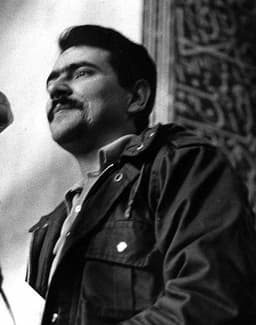
Abolhassan Banisadr
Politician · Modern
39.0Total
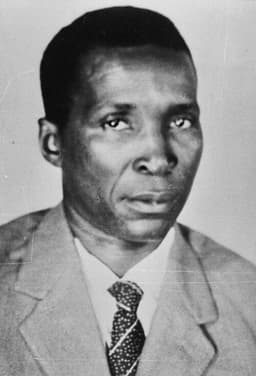
Francisco Macias Nguema
Politician · Modern
54.2Total
Basic Information
Born
1933
1924
Died
—
—
Era
Modern
Modern
Nationality
Iran
Equatorial Guinea
Occupation
Politician
Politician
Civilization
Middle Eastern
Other
Score Comparison
Military (10%)
30.2
50.0
Political (20%)
26.4
68.0
Influence (20%)
49.4
60.0
Legacy (20%)
40.0
40.8
Leadership (15%)
34.6
62.9
Strategy (15%)
44.5
43.3
TOTAL
39.0
54.2
Abolhassan Banisadr — Complete Timeline
1980 AD
Iran-Iraq War BeginsWar◆ Major
As president, Banisadr oversaw Iran's initial response to the Iraqi invasion in September 1980. He advocated for a professional military strategy, but his authority was undermined by hardliners and the Revolutionary Guards.
Iran-Iraq WarMilitaryConflict
Impact: regionaltragic
Election as First President of IranPolitical Action◆ Major
Abolhassan Banisadr won Iran's first presidential election after the 1979 Islamic Revolution, with 76% of the vote. He was a close ally of Ayatollah Khomeini and advocated for a democratic Islamic republic.
ElectionIslamic RevolutionIran
Impact: nationalconstructive
1981 AD
Impeachment and ExilePolitical Action◆ Major
Banisadr was impeached by the Iranian parliament in June 1981 after conflicts with the clerical establishment. He fled to France, where he lived in exile, and was sentenced to death in absentia.
ImpeachmentExilePolitical Conflict
Impact: nationaltragic
Francisco Macias Nguema — Complete Timeline
1968 AD
Became First President of Equatorial GuineaPolitical Action◆ Major
Francisco Macias Nguema was elected as the first president of Equatorial Guinea upon its independence from Spain. He quickly consolidated power, establishing a one-party state and eliminating political opponents.
IndependenceFirst PresidentAuthoritarianism
Impact: national
1972 AD
Declared Himself President for LifePolitical Action
Macias Nguema declared himself President for Life, centralizing all power in his hands. He initiated a reign of terror, ordering the execution of thousands of political opponents, intellectuals, and perceived enemies.
DictatorshipRepressionHuman Rights Abuses
Impact: nationaldestructive
1979 AD
Overthrown and ExecutedPolitical Action
Macias Nguema was overthrown in a coup led by his nephew Teodoro Obiang Nguema Mbasogo. He was captured, tried for crimes including genocide and treason, and executed by firing squad. His regime had caused the death of an estimated 50,000 people.
CoupExecutionEnd of Tyranny
Impact: nationaltragic
Expert Analysis
Origins
Abolhassan Banisadr was born in 1933 in Hamadan, Iran, into a religious family. His father was an ayatollah. He studied economics at the University of Paris, where he became involved in anti-Shah activism. His exile in France during the 1970s allowed him to develop close ties with Ayatollah Ruhollah Khomeini, becoming a key advisor on economic and political matters.
Francisco Macias Nguema was born in 1924 in Mongomo, Spanish Guinea (later Equatorial Guinea). He was the son of a witch doctor and received limited formal education, working as a clerk in the colonial administration. He joined the colonial civil service and rose through the ranks, becoming mayor of Mongomo. His political career began in the 1960s as a nationalist leader pushing for independence from Spain.
Rise to Power
Banisadr's rise was tied to the 1979 Iranian Revolution. He returned to Iran with Khomeini in February 1979 and quickly became a key figure in the provisional government. In January 1980, he won Iran's first presidential election with 76% of the vote, defeating conservative candidates. As president, he initially held significant power, including command of the armed forces, but faced opposition from the Islamic Republican Party and the clergy.
Macias Nguema became Equatorial Guinea's first president upon independence from Spain on October 12, 1968, after winning a UN-supervised election. He quickly consolidated power by eliminating political rivals. In 1970, he banned all opposition parties and declared a one-party state. By 1972, he declared himself President for Life, centralizing all authority. His regime was marked by extreme brutality, with an estimated 50,000 to 80,000 people killed out of a population of 300,000.
Leadership & Governance
Banisadr's leadership style was intellectual and technocratic. He advocated for a mixed economy and a professional military, clashing with the clerical establishment that sought to impose Islamic rule. As president, he tried to maintain independent control over the military during the Iran-Iraq War (starting September 1980), but faced constant interference from the Revolutionary Guards and clerics. His governance scores 26.4 in political and 34.6 in leadership, reflecting his inability to consolidate power.
Macias Nguema ruled through terror and totalitarianism. He eliminated all political opposition, executed perceived enemies, and destroyed the country's infrastructure. He banned education, closed schools, and expelled foreign missionaries. His personal cult of personality led to his image being displayed everywhere. He scored 68.0 in political and 62.9 in leadership, demonstrating his effective but brutal control. However, his strategy score of 43.3 reflects the long-term damage to the country.
Triumph & Tragedy
Banisadr's greatest success was his role in the Iranian Revolution and becoming the first president, symbolizing a break from the monarchy. He also initially managed the war effort, though his strategy of relying on regular forces rather than militias was sound but undermined. His tragedy was his impeachment and exile in June 1981 after failing to balance the clerics' power. He spent the rest of his life in France, politically marginalized.
Macias Nguema's triumph was achieving independence and becoming president. However, his tragedy was his descent into genocidal dictatorship. He destroyed Equatorial Guinea's economy, caused mass emigration (one-third of the population fled), and was eventually overthrown by his nephew on August 3, 1979. He was tried and executed in September 1979. His legacy is one of pure horror.
Character & Destiny
Banisadr was an intellectual idealist, believing in democratic and economic reforms. His character was too conciliatory and indecisive against the clerics' ruthlessness. His destiny was to be a transitional figure, unable to match the organizational power of Khomeini's faction.
Macias Nguema was paranoid and sadistic. He feared educated people and intellectuals, leading him to eliminate them. His character of absolute power corrupting led to a regime of terror. His destiny was to be overthrown and executed, fitting for a tyrant.
Legacy
Banisadr's legacy is minimal in Iran, where he is often forgotten or dismissed. He is remembered in exile as a symbol of the lost democratic potential of the revolution. His influence score of 49.4 reflects some ideological impact but limited practical effect.
Macias Nguema's legacy is one of a cautionary tale. He is remembered as one of Africa's worst dictators. The country still struggles with the effects of his rule. His legacy score of 40.8 is surprisingly low given his infamy, but reflects the negative nature of his impact.
Conclusion
While Macias Nguema scores higher (54.2 total vs 39.0), his impact was overwhelmingly negative. Banisadr's failure was one of missed opportunity, while Macias Nguema's was one of active destruction. In terms of historical significance, Macias Nguema's brutal regime had a more profound and lasting impact on Equatorial Guinea, but Banisadr's role in the Iranian Revolution represents a moment of potential that was crushed. Ultimately, Macias Nguema's tyranny shaped a nation's trajectory more decisively, albeit disastrously. Therefore, Macias Nguema had greater impact, but for the worse.
Rankings
🥇
Francisco Macias NguemaLeader
Mil: 50.0Pol: 68.0Inf: 60.0
54.2
🥈
Abolhassan Banisadr
Mil: 30.2Pol: 26.4Inf: 49.4
39.0
+15.2 behind
How This Comparison Works
Algorithm
Each figure is scored on 6 dimensions (0—100 scale) based on structured historical data: Military (10%), Political (20%), Influence (20%), Legacy (20%), Leadership (15%), Strategy (15%). The weighted total produces the final ranking.
Data Sources
Scores are computed from structured sub-indicators in the database. Scale factors adjust for era (Ancient ×0.85, Modern ×1.0) and civilization size (Eastern ×1.05, Other ×0.80) to account for differences in population and military scale.
Maximum 3 Figures
Comparisons are limited to 2—3 figures to ensure readability and statistical meaningfulness.
Error Margins
±5 points per dimension — Sub-scores are derived from historical records with inherent uncertainty. Two figures within 5 points on a dimension should be considered roughly equivalent in that area.
Total Score Accuracy
±3 points overall — The weighted combination of 6 dimensions produces a total score with approximately ±3 points of uncertainty. Differences of less than 3 points are not statistically significant— the figures are effectively tied.
Known Limitations
- Historical records are incomplete and uneven across civilizations
- Figures from oral-tradition societies may be underrepresented
- Occupation labels can misclassify multi-role figures
- Scores measure capability and impact, not moral character
- Quantitative scoring is a comparison tool, not absolute truth
Capability Radar
Military (10%) — Battles & Warfare
Battles
19
21
Win Rate
25
27
Expansion
27
30
Political (20%) — Governance & Reform
Reform
20
0
Diplomacy
15
0
Economy
10
0
Influence (20%) — Cultural & Global Reach
Cultural
10
0
Global
15
0
Legacy (20%) — Historical Impact
Historical
20
5
Longevity
10
0
Leadership (15%) — Power & Stability
Tenure
15
11
Stability
5
0
Strategy (15%) — Tactics & Innovation
Strategy
30
28
Tactics
32
32
Reform
36
37
Similar Comparisons
Comments & Discussion
No comments yet. Be the first to share your thoughts!