Loading...
Abeid Karume vs Christine Lagarde
Christine Lagarde leads by 11.5 pts · 2 figures compared
…
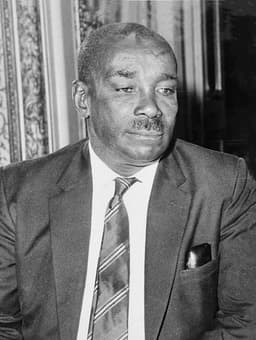
Abeid Karume
Politician · Modern
45.0Total

Christine Lagarde
Politician · Modern
56.5Total
Basic Information
Born
1905
1956
Died
1972
—
Era
Modern
Modern
Nationality
Tanzania
France
Occupation
Politician
Politician
Civilization
Other
Western
Score Comparison
Military (10%)
20.0
50.0
Political (20%)
35.1
62.7
Influence (20%)
51.8
58.3
Legacy (20%)
42.5
50.0
Leadership (15%)
58.8
72.0
Strategy (15%)
53.8
42.0
TOTAL
45.0
56.5
Abeid Karume — Complete Timeline
1964 AD
Zanzibar RevolutionPolitical Action
Karume led the Zanzibar Revolution in January 1964, overthrowing the Sultanate and establishing the People's Republic of Zanzibar. The revolution resulted in the overthrow of the Arab-dominated government and the installation of an Afro-Shirazi Party regime, leading to significant social and political changes.
RevolutionZanzibarOverthrow
Impact: regionaldestructive
First President of ZanzibarPolitical Action◆ Major
Following the revolution, Karume became the first President of Zanzibar in 1964. He led the government until his assassination in 1972, implementing policies of nationalization and land redistribution, while also consolidating power through authoritarian means.
PresidencyZanzibarLeadership
Impact: regional
Union with TanganyikaPolitical Action◆ Major
In April 1964, Karume negotiated the union of Zanzibar with Tanganyika to form the United Republic of Tanzania. This act created a single sovereign state, though Zanzibar retained significant autonomy, including its own president and government.
UnionTanzaniaZanzibar
Impact: regionalconstructive
1972 AD
Assassination of Abeid KarumePolitical Action◆ Major
Karume was assassinated in April 1972 by four gunmen while playing chess at the Afro-Shirazi Party headquarters in Zanzibar City. His death led to a period of political instability and a crackdown on opposition, with his successor Aboud Jumbe taking power.
AssassinationZanzibarPolitical Violence
Impact: regionaltragic
Christine Lagarde — Complete Timeline
2011 AD
Appointed Managing Director of the IMFPolitical Action
Christine Lagarde became the first woman to lead the International Monetary Fund. She managed the IMF's response to the Eurozone debt crisis, including bailouts for Greece, Ireland, and Portugal, and advocated for global financial stability.
IMFFinancial CrisisGlobal Economy
Impact: globalconstructive
2016 AD
Convicted of Negligence in Tapie Arbitration CaseOther◆ Major
A French court found Lagarde guilty of negligence for her role in a
Legal CaseNegligenceFrench Politics
Impact: nationaldestructive
2019 AD
Elected President of the European Central BankPolitical Action
Lagarde became the first woman to lead the European Central Bank, succeeding Mario Draghi. She took office during a period of low inflation and economic slowdown, continuing accommodative monetary policy and launching a strategic review.
ECBMonetary PolicyFirst Woman
Impact: globalconstructive
2020 AD
Launched ECB Monetary Policy Strategy ReviewReform◆ Major
Lagarde initiated a review of the ECB's monetary policy strategy, the first since 2003. The review examined inflation targeting, climate change, and digital currencies, resulting in a new symmetric 2% inflation target adopted in 2021.
ECBMonetary PolicyStrategy Review
Impact: globalconstructive
Responded to COVID-19 Economic CrisisPolitical Action◆ Major
Lagarde oversaw the ECB's emergency response to the pandemic, including the
COVID-19ECBMonetary Policy
Impact: regionalconstructive
2022 AD
Raised Interest Rates to Combat InflationPolitical Action◆ Major
Lagarde led the ECB in raising interest rates for the first time in 11 years to combat surging inflation. The rate hikes continued through 2023, marking a shift from years of accommodative policy and impacting borrowing costs across the eurozone.
InflationInterest RatesECB
Impact: regional
Expert Analysis
Origins
Abeid Amani Karume (1905–1972) was born in Mwera, Zanzibar, into a poor family. He received minimal formal education, attending only a few years of Quranic school. He worked as a sailor and later a carpenter, experiences that exposed him to the harsh realities of colonial rule and the Arab-dominated elite. His early life instilled a deep resentment of the existing power structures.
Christine Lagarde (born 1956) was born in Paris, France, to an academic family. She excelled in school, attending the elite Lycée François-Ier, and later earned a master's degree in English and a law degree from the University of Paris X. She also holds a master's from Sciences Po. Her early career as a lawyer at Baker & McKenzie, where she became the first female chair, shaped her expertise in competition and labor law.
Rise to Power
Karume rose through the Afro-Shirazi Party (ASP), a political organization representing the African majority against the Arab-dominated Zanzibar Nationalist Party. On January 12, 1964, he led the Zanzibar Revolution, a swift and violent uprising that overthrew Sultan Jamshid bin Abdullah. Within hours, the revolutionaries seized control, and Karume became President of the People's Republic of Zanzibar. The revolution resulted in the deaths of thousands of Arab and Indian civilians.
Lagarde's rise was through technocratic and political channels. She served as French Minister of Agriculture and Fisheries (2005–2007) and then Minister of Economic Affairs, Finance and Industry (2007–2011). In 2011, she became the first female Managing Director of the International Monetary Fund (IMF), a position she held until 2019. In 2019, she became the first woman to lead the European Central Bank (ECB), succeeding Mario Draghi.
Leadership & Governance
Karume's governance was authoritarian and nationalist. He implemented policies to redistribute land and wealth from the Arab minority to the African majority. He forced the nationalization of foreign-owned plantations and businesses. His regime suppressed political dissent, detaining opponents without trial. The union with Tanganyika in April 1964 created Tanzania, but Karume maintained significant autonomy for Zanzibar. His leadership score of 58.8 reflects his ability to consolidate power but also his brutal methods.
Lagarde's leadership is consensus-driven and institution-focused. At the IMF, she managed the Eurozone debt crisis, approving bailouts for Greece, Ireland, and Portugal. At the ECB, she launched a monetary policy strategy review, the first since 2003, which incorporated climate change considerations. She responded to the COVID-19 crisis with the €1.85 trillion Pandemic Emergency Purchase Programme (PEPP). Her leadership score of 72.0 reflects her high effectiveness in multilateral settings.
Triumph & Tragedy
Karume's greatest triumph was the Zanzibar Revolution, which ended centuries of Arab domination and established a republic. The union with Tanganyika created a stable state. However, his failures include the violent ethnic cleansing during the revolution and economic mismanagement. His policies led to food shortages and a decline in Zanzibar's clove industry. He was assassinated in 1972, leaving a mixed legacy.
Lagarde's triumphs include steering the IMF through the Eurozone crisis and leading the ECB's pandemic response. She was convicted of negligence in 2016 for her role in the Tapie arbitration case, where she approved a €403 million payout to businessman Bernard Tapie. This was a significant personal and professional failure, though she avoided a criminal record. Her influence score of 58.3 and legacy score of 50.0 reflect her ongoing impact but also the controversy.
Character & Destiny
Karume was pragmatic but ruthless. He was known for his simplicity and directness, often speaking in Swahili. His character shaped his destiny: his authoritarianism maintained power but isolated him, leading to his assassination. Historical assessments view him as a revolutionary who secured African majority rule but at a high human cost.
Lagarde is diplomatic and polished. Her legal background and international experience made her effective in global finance. Her conviction for negligence shows a willingness to accept responsibility, but also a tendency to delegate. Her character has allowed her to navigate male-dominated institutions.
Legacy
Karume's legacy is the creation of Tanzania and the end of Arab rule in Zanzibar. However, his revolution also entrenched ethnic divisions. Zanzibar remains a semi-autonomous region within Tanzania, with ongoing tensions. His political score of 35.1 and legacy score of 42.5 reflect his limited long-term institutional impact.
Lagarde's legacy is still forming. She broke gender barriers at the IMF and ECB. Her policy reviews may shape central banking for decades. However, the Tapie case tarnished her reputation. Her total score of 56.5 is higher than Karume's 45.0.
Conclusion
Christine Lagarde has had greater impact due to her influence on global economic policy and her role in two of the world's most powerful financial institutions. Karume's impact was regionally significant but narrower in scope. Lagarde's total score of 56.5 surpasses Karume's 45.0, and her leadership score of 72.0 is markedly higher. While Karume's revolution altered Zanzibar's political structure, Lagarde's decisions affected the global economy. The data supports Lagarde as the more impactful figure.
Rankings
🥇
Christine LagardeLeader
Mil: 50.0Pol: 62.7Inf: 58.3
56.5
🥈
Abeid Karume
Mil: 20.0Pol: 35.1Inf: 51.8
45.0
+11.5 behind
How This Comparison Works
Algorithm
Each figure is scored on 6 dimensions (0—100 scale) based on structured historical data: Military (10%), Political (20%), Influence (20%), Legacy (20%), Leadership (15%), Strategy (15%). The weighted total produces the final ranking.
Data Sources
Scores are computed from structured sub-indicators in the database. Scale factors adjust for era (Ancient ×0.85, Modern ×1.0) and civilization size (Eastern ×1.05, Other ×0.80) to account for differences in population and military scale.
Maximum 3 Figures
Comparisons are limited to 2—3 figures to ensure readability and statistical meaningfulness.
Error Margins
±5 points per dimension — Sub-scores are derived from historical records with inherent uncertainty. Two figures within 5 points on a dimension should be considered roughly equivalent in that area.
Total Score Accuracy
±3 points overall — The weighted combination of 6 dimensions produces a total score with approximately ±3 points of uncertainty. Differences of less than 3 points are not statistically significant— the figures are effectively tied.
Known Limitations
- Historical records are incomplete and uneven across civilizations
- Figures from oral-tradition societies may be underrepresented
- Occupation labels can misclassify multi-role figures
- Scores measure capability and impact, not moral character
- Quantitative scoring is a comparison tool, not absolute truth
Capability Radar
Military (10%) — Battles & Warfare
Battles
15
29
Win Rate
20
29
Expansion
10
34
Political (20%) — Governance & Reform
Reform
30
70
Diplomacy
25
80
Economy
20
85
Influence (20%) — Cultural & Global Reach
Cultural
30
40
Global
20
70
Legacy (20%) — Historical Impact
Historical
35
55
Longevity
20
50
Leadership (15%) — Power & Stability
Tenure
40
75
Stability
15
75
Strategy (15%) — Tactics & Innovation
Strategy
15
36
Tactics
10
39
Reform
10
46
Similar Comparisons
Comments & Discussion
No comments yet. Be the first to share your thoughts!