Loading...
Analysis will be generated on first visit.
Scores and timeline are available below. The page will refresh automatically when ready.
Gaitana vs Zhang Xianzhong
Zhang Xianzhong leads by 5.3 pts · 2 figures compared
…
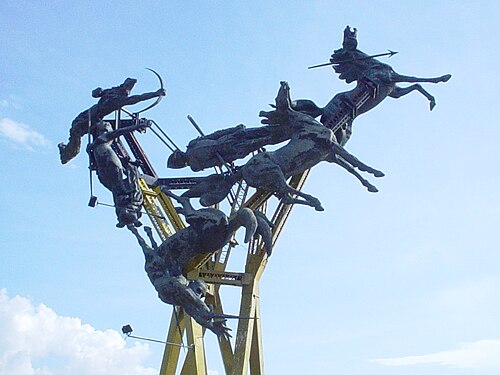
Gaitana
Revolutionary · Medieval
43.8Total

Zhang Xianzhong
Revolutionary · Modern
49.1Total
Basic Information
Born
1500
1606
Died
1550
1647
Era
Medieval
Modern
Nationality
Yalcon
China
Occupation
Revolutionary
Revolutionary
Civilization
Other
Eastern
Score Comparison
Military (10%)
29.8
63.4
Political (20%)
35.8
34.4
Influence (20%)
55.4
62.9
Legacy (20%)
44.9
56.0
Leadership (15%)
31.8
34.5
Strategy (15%)
58.8
45.9
TOTAL
43.8
49.1
Rankings
🥇
Zhang XianzhongLeader
Mil: 63.4Pol: 34.4Inf: 62.9
49.1
🥈
Gaitana
Mil: 29.8Pol: 35.8Inf: 55.4
43.8
+5.3 behind
How This Comparison Works
Algorithm
Each figure is scored on 6 dimensions (0—100 scale) based on structured historical data: Military (10%), Political (20%), Influence (20%), Legacy (20%), Leadership (15%), Strategy (15%). The weighted total produces the final ranking.
Data Sources
Scores are computed from structured sub-indicators in the database. Scale factors adjust for era (Ancient ×0.85, Modern ×1.0) and civilization size (Eastern ×1.05, Other ×0.80) to account for differences in population and military scale.
Maximum 3 Figures
Comparisons are limited to 2—3 figures to ensure readability and statistical meaningfulness.
Error Margins
±5 points per dimension — Sub-scores are derived from historical records with inherent uncertainty. Two figures within 5 points on a dimension should be considered roughly equivalent in that area.
Total Score Accuracy
±3 points overall — The weighted combination of 6 dimensions produces a total score with approximately ±3 points of uncertainty. Differences of less than 3 points are not statistically significant— the figures are effectively tied.
Known Limitations
- Historical records are incomplete and uneven across civilizations
- Figures from oral-tradition societies may be underrepresented
- Occupation labels can misclassify multi-role figures
- Scores measure capability and impact, not moral character
- Quantitative scoring is a comparison tool, not absolute truth
Capability Radar
Military (10%) — Battles & Warfare
Battles
15
55
Win Rate
10
50
Expansion
5
60
Political (20%) — Governance & Reform
Reform
5
5
Diplomacy
10
10
Economy
5
5
Influence (20%) — Cultural & Global Reach
Cultural
20
20
Global
10
15
Legacy (20%) — Historical Impact
Historical
25
35
Longevity
20
25
Leadership (15%) — Power & Stability
Tenure
10
30
Stability
5
5
Strategy (15%) — Tactics & Innovation
Strategy
15
40
Tactics
20
45
Reform
5
10
Analysis will be generated on first visit.
Scores and timeline are available below. The page will refresh automatically when ready.
Gaitana — Complete Timeline
1540 AD
Led the Yalcon Rebellion against Spanish colonizersWar◆ Major
Gaitana organized and led indigenous Yalcon forces in a rebellion against Spanish colonial rule in present-day Colombia. The rebellion targeted Spanish settlements and encomiendas, resisting forced labor and land seizure. The uprising was eventually suppressed by Spanish forces, but it became a symbol of indigenous resistance.
Indigenous RebellionColonial ResistanceYalcon
Impact: regional
Captured and executed Spanish encomendero Pedro de AñascoOther◆ Major
During the Yalcon rebellion, Gaitana's forces captured the Spanish encomendero Pedro de A
ExecutionColonial ConflictIndigenous Leadership
Impact: regional
1541 AD
Rebellion suppressed by Spanish forces under Sebastián de BelalcázarWar◆ Major
Spanish conquistador Sebasti
Military DefeatColonial SuppressionEnd of Rebellion
Impact: regionaldestructive
Zhang Xianzhong — Complete Timeline
1630 AD
Launched Rebellion in ShaanxiWar◆ Major
Zhang Xianzhong joined a peasant rebellion in Shaanxi province during the late Ming dynasty. He quickly rose to become a major rebel leader, gathering a large army and establishing a base of operations in the region.
Ming DynastyRebellionShaanxi
Impact: regionaldestructive
1644 AD
Captured and Sacked ChengduWar◆ Major
Zhang Xianzhong captured the city of Chengdu, the capital of Sichuan province. He then proclaimed the Daxi dynasty and made Chengdu his capital. The capture was accompanied by widespread destruction and massacres of the local population.
Ming-Qing TransitionSichuanMassacre
Impact: regionaldestructive
Proclaimed the Daxi DynastyPolitical Action◆ Major
Zhang Xianzhong proclaimed the Daxi (Great Western) dynasty in Sichuan. He established a government and minted his own coinage. His rule was characterized by extreme violence, including the systematic killing of scholars, officials, and civilians.
Daxi DynastyProclamationSichuan
Impact: regionaldestructive
1647 AD
Killed in Battle Against Qing ForcesWar◆ Major
Zhang Xianzhong was killed in battle against Qing forces in Xichong, Sichuan. His death led to the collapse of the Daxi dynasty. The Qing conquest of Sichuan was completed shortly after, but the province had been devastated by years of warfare.
Qing DynastyBattleDeath
Impact: regionaltragic
Similar Comparisons
Comments & Discussion
ChengduCrusher6/16/2026
Zhang Xianzhong wasn’t just a rebel; he was a demographic anomaly. Comparing a man who allegedly slaughtered millions of Sichuan civilians to a woman leading a guerrilla uprising is like comparing a wildfire to a campfire. Gaitana burned with righteous fury; Zhang burned for power. Only one left a trail of bureaucratic records corroborating mass depopulation. Read Yongzheng’s memos on Sichuan resettlement—he’s basically begging farmers to repopulate a province Zhang emptied.
铁血考据党6/16/2026
张献忠屠蜀,数字到底靠不靠谱?我翻过《蜀碧》和《荒书》,里面说是杀了几百万,但清初四川人口统计明显被战乱、瘟疫和逃跑扭曲了。和盖塔娜比?她领导的是个小规模反抗,顶多几个村子。张献忠呢?他控制过整个四川,但所谓“六亿人头”纯属夸张。建议这些搞比较史的,先查查户籍黄册再说。
ClassicsMender6/16/2026
Gaitana’s story echoes through time as a symbol of maternal resistance—her son’s capture broke her into a warrior. Zhang Xianzhong? He was a product of Ming decay, a walking symptom of the Mandate of Heaven pulling away. One fought for family and tribe; the other fought to seize a dying throne. Apples and oranges, but both reflect societies in collapse. At least Gaitana’s legacy is a folk song; Zhang’s is a cautionary footnote.
嘲讽独眼龙6/16/2026
张献忠算“农民起义领袖”?别逗了,他屠城时眼睛都不眨一下。我信《客滇述》里的记载,他杀人的标准是“男人全杀,女人留用”。盖塔娜呢?她抓西班牙人当俘虏,还给儿子报仇。拿一个屠夫和一个母亲比?这是历史比较还是网络段子?要我说,张献忠最多是个暴力军阀,盖塔娜才是真·反抗者。