Loading...
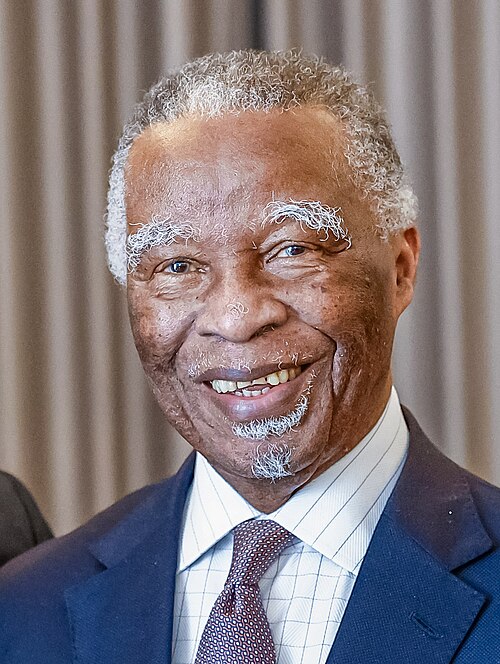
Thabo Mbeki
ModernPoliticianSouth Africa1942 — ?
Second post-apartheid president of South Africa.
Compare Thabo Mbeki with another historical figure:
Quick Facts
Born
1942
Country
South Africa
Era
Modern
Occupation
Politician
Score Overview
Military (10%)41
Political (20%)65
Influence (20%)57
Legacy (20%)56
Leadership (15%)72
Strategy (15%)41
Total Score56.9
Thabo Mbeki — Complete Timeline
1999 AD
Election as PresidentPolitical Action
Thabo Mbeki was elected President of South Africa in the country's second fully democratic elections, succeeding Nelson Mandela. He represented the ANC and promised to continue Mandela's legacy of reconciliation while focusing on economic growth and transformation.
PresidencyANCSuccession
Impact: nationalprogressive
Launch of the African RenaissanceCultural◆ Major
Mbeki championed the concept of an 'African Renaissance', promoting economic integration, democracy, and conflict resolution across the continent. This led to the establishment of the New Partnership for Africa's Development (NEPAD) and the African Peer Review Mechanism.
African RenaissanceNEPADPan-Africanism
Impact: regionalprogressive
2000 AD
HIV/AIDS DenialismPolitical Action◆ Major
Mbeki questioned the link between HIV and AIDS, and his government delayed the rollout of antiretroviral drugs. This policy, influenced by dissident scientists, led to hundreds of thousands of preventable deaths and drew widespread international condemnation.
HIV/AIDSDenialismPublic Health Crisis
Impact: nationaltragic
Zimbabwe InterventionPolitical Action◆ Major
Mbeki pursued a policy of 'quiet diplomacy' towards Robert Mugabe's Zimbabwe, refusing to condemn human rights abuses and land seizures. This approach was criticized as ineffective and complicit, failing to prevent Zimbabwe's economic collapse and political crisis.
ZimbabweQuiet DiplomacyMugabe
Impact: regional
2008 AD
Recall from PresidencyPolitical Action◆ Major
Mbeki was recalled by the ANC's National Executive Committee, effectively forcing his resignation as President. This followed a power struggle with Jacob Zuma, who had defeated Mbeki for the ANC presidency in 2007. Mbeki's departure marked a shift in ANC leadership.
RecallANC Power StruggleZuma
Impact: national
Detailed Scores
▶View all detailed scores
Military
Strategy
6
Tactics
5
Battles
6
Army Scale
5
War Impact
6
Political
Governance
7
Reform
7
Stability
7
Policy
7
Power
8
Influence
History
9
Global
8
Culture
9
Ideology
9
Legacy
9
People often compare with
See how Thabo Mbeki stacks up against other historical figures
Popular Comparisons
Thabo Mbeki vs Jonas Furrer
vs Jonas Furrer56
Thabo Mbeki vs Javier Perez de Cuellar
vs Javier Perez de Cuellar54
Thabo Mbeki vs Paul Doumer
vs Paul Doumer53
Thabo Mbeki vs Klaus Iohannis
vs Klaus Iohannis50
Thabo Mbeki vs Jambyn Batmonkh
vs Jambyn Batmonkh50
Thabo Mbeki vs S. R. Nathan
vs S. R. Nathan46