Loading...
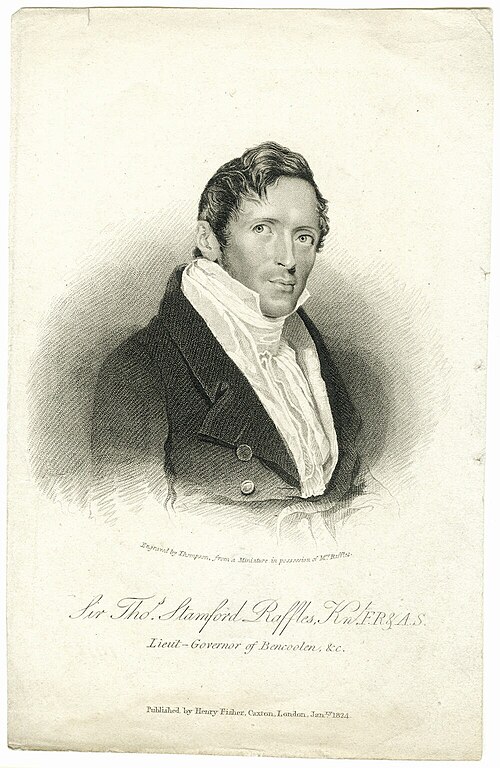
Sir Thomas Stamford Raffles
ModernPoliticianGreat Britain1781 — 1826
Founded modern Singapore, naturalist and explorer.
Compare Sir Thomas Stamford Raffles with another historical figure:
Quick Facts
Born
1781
Died
1826
Country
Great Britain
Era
Modern
Occupation
Politician
Score Overview
Military (10%)43
Political (20%)45
Influence (20%)58
Legacy (20%)55
Leadership (15%)67
Strategy (15%)54
Total Score54.8
Sir Thomas Stamford Raffles — Complete Timeline
1817 AD
Published 'The History of Java'Cultural◆ Major
Raffles published 'The History of Java' in 1817, a two-volume work detailing Javanese history, culture, and archaeology. The book included descriptions of Borobudur and other temples, and became a foundational text for Southeast Asian studies.
ScholarshipHistoryJava
Impact: globalconstructive
1818 AD
Discovery of the Rafflesia arnoldiiInvention◆ Major
Raffles, as a naturalist, discovered the Rafflesia arnoldii in Sumatra in 1818. This parasitic plant produces the largest individual flower in the world, up to one meter in diameter. The discovery was documented by botanist Joseph Arnold.
BotanyDiscoveryNatural History
Impact: globalconstructive
1819 AD
Founding of SingaporePolitical Action◆ Major
Raffles, as Lieutenant-Governor of Bencoolen, signed a treaty with the Sultan of Johor on February 6, 1819, establishing a British trading post on the island of Singapore. This action created a free port that rapidly grew into a major commercial hub.
ColonialismTradeSingapore
Impact: globalconstructive
1824 AD
Anglo-Dutch Treaty of 1824Political Action◆ Major
Raffles' establishment of Singapore led to the Anglo-Dutch Treaty of 1824, which divided the Malay Archipelago into British and Dutch spheres of influence. The treaty confirmed British control of Singapore and Malacca, while the Dutch retained the East Indies.
ColonialismTreatySoutheast Asia
Impact: global
Detailed Scores
▶View all detailed scores
Military
Strategy
6
Tactics
5
Battles
6
Army Scale
5
War Impact
6
Political
Governance
7
Reform
7
Stability
7
Policy
7
Power
8
Influence
History
9
Global
8
Culture
8
Ideology
9
Legacy
8
People often compare with
See how Sir Thomas Stamford Raffles stacks up against other historical figures
Popular Comparisons
Sir Thomas Stamford Raffles vs Mario Soares
vs Mario Soares64
Sir Thomas Stamford Raffles vs Bob Hawke
vs Bob Hawke60
Sir Thomas Stamford Raffles vs Antonio de Oliveira Salazar
vs Antonio de Oliveira Salazar56
Sir Thomas Stamford Raffles vs Jose Maria Velasco Ibarra
vs Jose Maria Velasco Ibarra49
Sir Thomas Stamford Raffles vs Alexander De Croo
vs Alexander De Croo48
Sir Thomas Stamford Raffles vs Muhyiddin Yassin
vs Muhyiddin Yassin41