Loading...
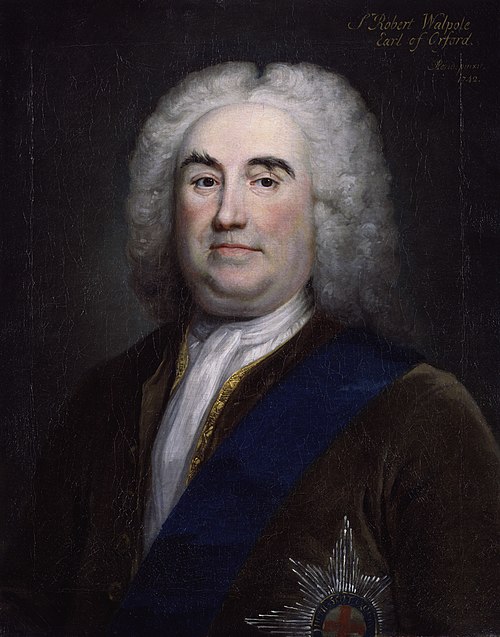
Robert Walpole
ModernPoliticianUnited Kingdom1676 — 1745
First de facto prime minister of Great Britain.
Compare Robert Walpole with another historical figure:
Quick Facts
Born
1676
Died
1745
Country
United Kingdom
Era
Modern
Occupation
Politician
Score Overview
Military (10%)50
Political (20%)70
Influence (20%)57
Legacy (20%)55
Leadership (15%)75
Strategy (15%)41
Total Score58.8
Robert Walpole — Complete Timeline
1720 AD
South Sea Bubble Crisis ManagementPolitical Action◆ Major
Walpole restored public confidence after the South Sea Company's collapse in 1720. He devised a plan to transfer company stock to the Bank of England and South Sea Company, stabilizing the financial system and protecting many investors from ruin.
Financial CrisisEconomic PolicySouth Sea Bubble
Impact: nationalconstructive
1721 AD
Became First Lord of the TreasuryPolitical Action
Robert Walpole was appointed First Lord of the Treasury and Chancellor of the Exchequer in April 1721, following the South Sea Bubble crisis. He is widely regarded as Britain's first de facto prime minister, holding power for over two decades.
Prime MinisterGovernment18th Century
Impact: nationalconstructive
1733 AD
Excise Tax Scheme ProposedReform
Walpole proposed an excise tax on wine and tobacco to replace customs duties and reduce smuggling. The plan faced intense public opposition and was withdrawn in April 1733. The failure weakened Walpole's political position but avoided widespread unrest.
TaxationReformPolitical Crisis
Impact: national
1742 AD
Resigned as Prime MinisterPolitical Action◆ Major
Walpole resigned as First Lord of the Treasury on February 11, 1742, after losing a vote of no confidence in the House of Commons. His resignation marked the end of his 21-year tenure and established the precedent of a prime minister leaving office when losing parliamentary support.
ResignationParliamentary SystemPrecedent
Impact: national
Detailed Scores
▶View all detailed scores
Military
Strategy
6
Tactics
5
Battles
6
Army Scale
5
War Impact
6
Political
Governance
7
Reform
7
Stability
7
Policy
7
Power
8
Influence
History
9
Global
8
Culture
9
Ideology
9
Legacy
9
People often compare with
See how Robert Walpole stacks up against other historical figures
Popular Comparisons
Robert Walpole vs Jimmy Carter
vs Jimmy Carter59
Robert Walpole vs Igor Sechin
vs Igor Sechin57
Robert Walpole vs Miguel Aleman
vs Miguel Aleman54
Robert Walpole vs S. Rajaratnam
vs S. Rajaratnam54
Robert Walpole vs Muhammad Yunus
vs Muhammad Yunus53
Robert Walpole vs Juan Jose Arevalo
vs Juan Jose Arevalo50