Loading...
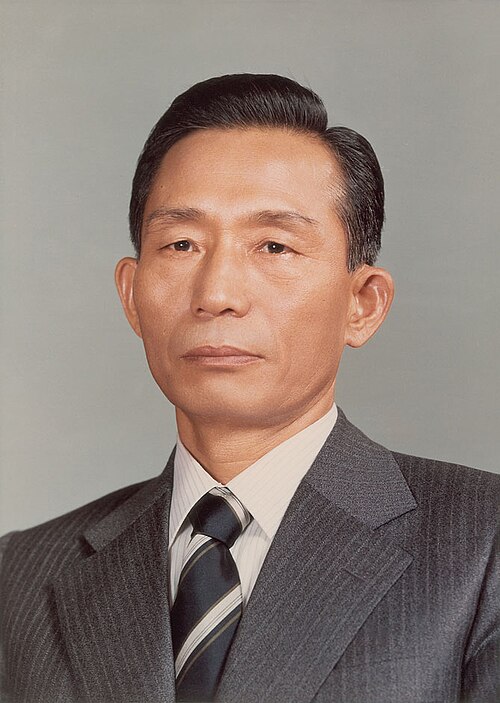
Park Chung-hee
ModernPoliticianKorea1917 — 1979
South Korean president who led rapid industrialization.
Compare Park Chung-hee with another historical figure:
Quick Facts
Born
1917
Died
1979
Country
Korea
Era
Modern
Occupation
Politician
Score Overview
Military (10%)21
Political (20%)82
Influence (20%)72
Legacy (20%)72
Leadership (15%)80
Strategy (15%)60
Total Score68.4
Park Chung-hee — Complete Timeline
1961 AD
May 16 Military CoupPolitical Action
Park Chung-hee led a military coup that overthrew the democratically elected government of Prime Minister Chang Myon. Park established the Supreme Council for National Reconstruction, suspended the constitution, and began authoritarian rule that lasted 18 years.
CoupAuthoritarianismSouth Korea
Impact: nationaldestructive
1962 AD
Five-Year Economic Development PlansReform◆ Major
Park Chung-hee launched the First Five-Year Economic Development Plan, focusing on export-oriented industrialization. The government directed investment into heavy industries, built infrastructure, and promoted chaebols, transforming South Korea from an agrarian economy into an industrial powerhouse.
Economic DevelopmentIndustrializationSouth Korea
Impact: nationalconstructive
1965 AD
Normalization of Relations with JapanPolitical Action◆ Major
Park Chung-hee signed the Treaty on Basic Relations with Japan, normalizing diplomatic ties. Japan provided $800 million in grants and loans, which funded South Korea's infrastructure projects and industrial growth, despite widespread public opposition due to colonial grievances.
Japan RelationsEconomic AidDiplomacy
Impact: regionalconstructive
1972 AD
Yushin ConstitutionPolitical Action◆ Major
Park Chung-hee imposed the Yushin Constitution, which gave him near-dictatorial powers. The constitution allowed the president to serve unlimited terms, appoint one-third of the National Assembly, and rule by emergency decree, effectively ending democratic processes.
AuthoritarianismConstitutionSouth Korea
Impact: nationaldestructive
1979 AD
Assassination of Park Chung-heePolitical Action
Park Chung-hee was assassinated by Kim Jae-gyu, the director of the Korean Central Intelligence Agency, during a dinner at a safe house. The assassination ended his 18-year rule and plunged South Korea into a period of political turmoil, leading to another military coup.
AssassinationPolitical CrisisSouth Korea
Impact: nationaltragic
Detailed Scores
▶View all detailed scores
Military
Strategy
6
Tactics
5
Battles
6
Army Scale
5
War Impact
6
Political
Governance
7
Reform
7
Stability
7
Policy
7
Power
8
Influence
History
9
Global
8
Culture
9
Ideology
9
Legacy
9
People often compare with
See how Park Chung-hee stacks up against other historical figures
Popular Comparisons
Park Chung-hee vs Alija Izetbegovic
vs Alija Izetbegovic55
Park Chung-hee vs I. K. Gujral
vs I. K. Gujral55
Park Chung-hee vs Kuniwo Nakamura
vs Kuniwo Nakamura54
Park Chung-hee vs Mohammad Daoud Khan
vs Mohammad Daoud Khan50
Park Chung-hee vs Eknath Shinde
vs Eknath Shinde38