Loading...
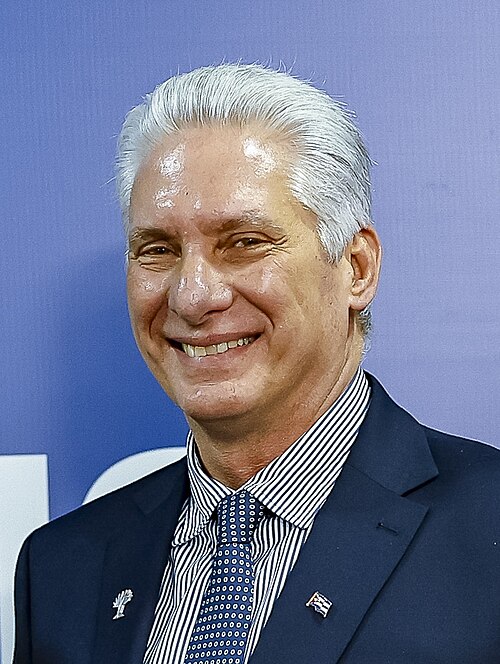
Miguel Diaz-Canel
ModernPoliticianCuba1960 — ?
First non-Castro Cuban president since 1959.
Compare Miguel Diaz-Canel with another historical figure:
Quick Facts
Born
1960
Country
Cuba
Era
Modern
Occupation
Politician
Score Overview
Military (10%)48
Political (20%)44
Influence (20%)51
Legacy (20%)41
Leadership (15%)40
Strategy (15%)41
Total Score44.4
Miguel Diaz-Canel — Complete Timeline
2018 AD
Elected President of CubaPolitical Action
Miguel Díaz-Canel was elected President of the Council of State and Council of Ministers by the National Assembly, succeeding Raúl Castro. He became the first non-Castro to lead Cuba since the 1959 revolution, marking a generational shift.
SuccessionCubaLeadership
Impact: global
2021 AD
Implemented Economic Reforms (Cuban Economic Model Update)Reform◆ Major
Díaz-Canel's government announced a series of economic reforms, including allowing small and medium-sized private enterprises, unifying the dual currency system, and reducing state subsidies. The reforms aimed to address chronic economic inefficiencies but faced implementation challenges.
Economic ReformCubaPrivate Sector
Impact: nationalconstructive
Faced Massive Protests (July 11 Protests)Political Action◆ Major
Díaz-Canel's government faced the largest anti-government protests in decades, sparked by economic hardship, food shortages, and COVID-19 restrictions. The protests were met with a crackdown, with thousands arrested. The events highlighted deep discontent with the regime.
ProtestsCubaCrackdown
Impact: nationaldestructive
2023 AD
Re-elected as PresidentPolitical Action◆ Major
Díaz-Canel was re-elected as President of Cuba by the National Assembly for a second five-year term. His re-election signaled continuity of the Communist Party's rule, with no significant political opening despite ongoing economic crisis.
ElectionCubaContinuity
Impact: national
Detailed Scores
▶View all detailed scores
Military
Strategy
6
Tactics
5
Battles
6
Army Scale
5
War Impact
6
Political
Governance
7
Reform
7
Stability
7
Policy
7
Power
8
Influence
History
9
Global
8
Culture
8
Ideology
9
Legacy
8
People often compare with
See how Miguel Diaz-Canel stacks up against other historical figures
Popular Comparisons
Miguel Diaz-Canel vs Yasser Arafat
vs Yasser Arafat61
Miguel Diaz-Canel vs Ram Manohar Lohia
vs Ram Manohar Lohia55
Miguel Diaz-Canel vs Gordon Brown
vs Gordon Brown53
Miguel Diaz-Canel vs Tansu Ciller
vs Tansu Ciller51
Miguel Diaz-Canel vs Alikhan Bukeikhanov
vs Alikhan Bukeikhanov49
Miguel Diaz-Canel vs Jose Lopez Portillo
vs Jose Lopez Portillo47