Loading...
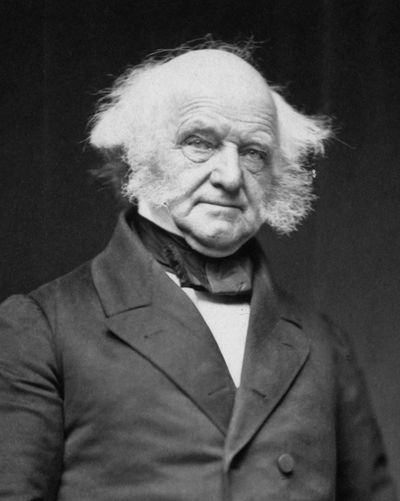
Martin Van Buren
ModernPoliticianUnited States1782 — 1862
Eighth president and founder of the Democratic Party.
Compare Martin Van Buren with another historical figure:
Quick Facts
Born
1782
Died
1862
Country
United States
Era
Modern
Occupation
Politician
Score Overview
Military (10%)50
Political (20%)45
Influence (20%)59
Legacy (20%)50
Leadership (15%)72
Strategy (15%)43
Total Score54.1
Martin Van Buren — Complete Timeline
1828 AD
Founded the Democratic PartyPolitical Action◆ Major
Van Buren organized the coalition of Jacksonian Democrats into the Democratic Party, creating a national political organization that supported Andrew Jackson's 1828 presidential campaign. This established the modern two-party system in the United States.
Political PartyJacksonian DemocracyParty System
Impact: nationalconstructive
1836 AD
Elected President of the United StatesPolitical Action◆ Major
Van Buren won the 1836 presidential election as the Democratic candidate, defeating Whig candidates William Henry Harrison and others. He succeeded Andrew Jackson and became the eighth president.
PresidencyElection
Impact: national
1837 AD
Panic of 1837Other◆ Major
A severe financial crisis began shortly after Van Buren took office, triggered by the collapse of speculative land bubbles and bank failures. The depression lasted until the mid-1840s, causing widespread unemployment and bank closures.
Economic CrisisDepressionBanking
Impact: nationaldestructive
1840 AD
Signed the Independent Treasury ActReform◆ Major
Van Buren signed legislation establishing an independent treasury system to manage federal funds without private banks. The system separated government deposits from state banks, aiming to prevent future panics.
Economic ReformTreasuryBanking
Impact: nationalconstructive
Lost 1840 Presidential ElectionPolitical Action◆ Major
Van Buren was defeated by Whig candidate William Henry Harrison in the 1840 election. The campaign focused on the economic depression and Van Buren's perceived elitism, leading to a landslide loss.
Election DefeatWhig Victory
Impact: nationaltragic
1848 AD
Free Soil Party CandidacyPolitical Action
Van Buren ran as the Free Soil Party candidate in the 1848 presidential election, opposing the expansion of slavery into territories. He split the Democratic vote, contributing to Whig Zachary Taylor's victory.
Third PartyAnti-SlaveryElection
Impact: national
Detailed Scores
▶View all detailed scores
Military
Strategy
6
Tactics
5
Battles
6
Army Scale
5
War Impact
6
Political
Governance
8
Reform
8
Stability
8
Policy
8
Power
9
Influence
History
9
Global
8
Culture
9
Ideology
9
Legacy
8
People often compare with
See how Martin Van Buren stacks up against other historical figures
Popular Comparisons
Martin Van Buren vs Mary Robinson
vs Mary Robinson61
Martin Van Buren vs Pranab Mukherjee
vs Pranab Mukherjee58
Martin Van Buren vs Grover Cleveland
vs Grover Cleveland54
Martin Van Buren vs Benito Mussolini
vs Benito Mussolini53
Martin Van Buren vs P. W. Botha
vs P. W. Botha53
Martin Van Buren vs George Reid
vs George Reid53