Loading...
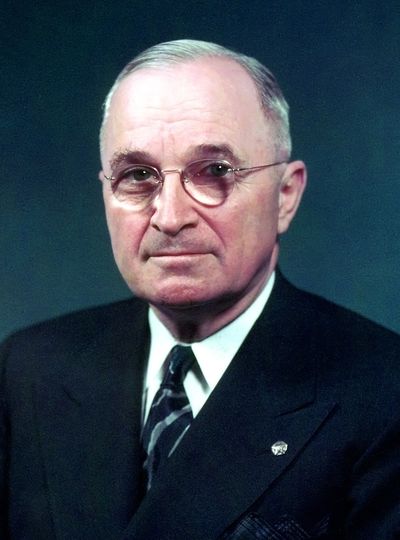
Harry S. Truman
ModernPoliticianUnited States1884 — 1972
US president who ordered atomic bombs, began the Cold War.
Compare Harry S. Truman with another historical figure:
Quick Facts
Born
1884
Died
1972
Country
United States
Era
Modern
Occupation
Politician
Score Overview
Military (10%)30
Political (20%)55
Influence (20%)68
Legacy (20%)72
Leadership (15%)80
Strategy (15%)55
Total Score63.7
Harry S. Truman — Complete Timeline
1945 AD
Ordered atomic bombings of Hiroshima and NagasakiWar
Truman authorized the use of atomic bombs against Japan. Hiroshima was bombed on August 6, Nagasaki on August 9. Japan surrendered on August 15, ending World War II. The bombings caused massive civilian casualties and initiated the nuclear age.
World War IINuclear WeaponsJapan
Impact: globaldestructive
1947 AD
Announced the Truman DoctrinePolitical Action◆ Major
Truman declared that the United States would provide political, military, and economic assistance to all democratic nations under threat from authoritarian forces. This policy was first applied to Greece and Turkey, marking the start of the Cold War containment strategy.
Cold WarContainmentForeign Policy
Impact: globalconstructive
1948 AD
Desegregated the U.S. armed forcesReform◆ Major
Truman issued Executive Order 9981, mandating equality of treatment and opportunity for all persons in the armed services regardless of race. This order began the process of racial integration in the U.S. military, a major step in the civil rights movement.
Civil RightsMilitaryDesegregation
Impact: nationalprogressive
Signed the Marshall Plan into lawPolitical Action◆ Major
Truman signed the Economic Cooperation Act, implementing the Marshall Plan. This program provided over $12 billion in economic aid to rebuild Western European economies after World War II, stabilizing the region and countering Soviet influence.
Cold WarEconomic AidEurope
Impact: globalconstructive
1950 AD
Ordered U.S. intervention in the Korean WarWar◆ Major
After North Korea invaded South Korea, Truman committed U.S. forces under a United Nations mandate. The war lasted until 1953, ended in an armistice, and solidified the division of Korea. It also led to the militarization of the Cold War.
Korean WarCold WarMilitary Intervention
Impact: global
Detailed Scores
▶View all detailed scores
Military
Strategy
6
Tactics
6
Battles
6
Army Scale
6
War Impact
6
Political
Governance
7
Reform
7
Stability
7
Policy
7
Power
8
Influence
History
9
Global
8
Culture
9
Ideology
9
Legacy
8
People often compare with
See how Harry S. Truman stacks up against other historical figures
Popular Comparisons
Harry S. Truman vs Lazaro Cardenas
vs Lazaro Cardenas63
Harry S. Truman vs Inoue Kaoru
vs Inoue Kaoru55
Harry S. Truman vs Carlos Salinas de Gortari
vs Carlos Salinas de Gortari55
Harry S. Truman vs Alain Berset
vs Alain Berset54
Harry S. Truman vs Maulana Fazl-ur-Rehman
vs Maulana Fazl-ur-Rehman50
Harry S. Truman vs Akhtar Mengal
vs Akhtar Mengal48