Loading...
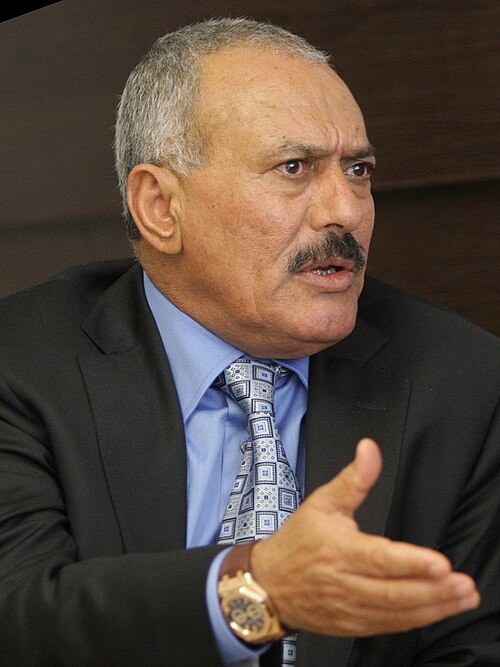
Ali Abdullah Saleh al-Ahmar
ModernPoliticianYemen1947 — ?
Longtime Yemeni president and tribal leader.
Compare Ali Abdullah Saleh al-Ahmar with another historical figure:
Quick Facts
Born
1947
Country
Yemen
Era
Modern
Occupation
Politician
Score Overview
Military (10%)45
Political (20%)47
Influence (20%)54
Legacy (20%)45
Leadership (15%)40
Strategy (15%)41
Total Score46.4
Ali Abdullah Saleh al-Ahmar — Complete Timeline
1978 AD
Became President of North YemenPolitical Action
Ali Abdullah Saleh became President of the Yemen Arab Republic (North Yemen) after the assassination of President Ahmad al-Ghashmi. He consolidated power through a combination of tribal alliances and military force.
SuccessionNorth Yemen
Impact: national
1990 AD
Unified North and South YemenPolitical Action
Saleh oversaw the unification of North Yemen and the People's Democratic Republic of Yemen (South Yemen) into the Republic of Yemen. He became the first president of the unified state, though tensions between the former regions persisted.
UnificationYemen
Impact: regionalconstructive
1994 AD
Won the 1994 civil warWar◆ Major
After South Yemen seceded, Saleh's forces defeated the southern separatists in a brief civil war. The victory reasserted his control over the entire country and solidified his authoritarian rule.
Civil WarYemenSeparatism
Impact: nationaldestructive
2011 AD
Resigned during the Arab SpringPolitical Action
After months of mass protests, Saleh agreed to a Gulf Cooperation Council-brokered transition plan. He resigned as president in exchange for immunity, ending his 33-year rule. The transition led to a power vacuum and eventual civil war.
Arab SpringResignationYemen
Impact: nationaltragic
2017 AD
Killed by Houthi forcesWar◆ Major
After switching sides to ally with the Houthi movement, Saleh was killed by Houthi forces when he attempted to defect back to the Saudi-led coalition. His death marked the end of his political influence and deepened the Yemeni civil war.
DeathYemen Civil WarHouthi
Impact: nationaltragic
Detailed Scores
▶View all detailed scores
Military
Strategy
6
Tactics
5
Battles
6
Army Scale
5
War Impact
6
Political
Governance
7
Reform
7
Stability
7
Policy
7
Power
8
Influence
History
9
Global
8
Culture
8
Ideology
9
Legacy
8
People often compare with
See how Ali Abdullah Saleh al-Ahmar stacks up against other historical figures
Popular Comparisons
Ali Abdullah Saleh al-Ahmar vs Joachim Gauck
vs Joachim Gauck57
Ali Abdullah Saleh al-Ahmar vs Funmilayo Ransome-Kuti
vs Funmilayo Ransome-Kuti55
Ali Abdullah Saleh al-Ahmar vs Yeshey Zimba
vs Yeshey Zimba53
Ali Abdullah Saleh al-Ahmar vs Joko Widodo
vs Joko Widodo50
Ali Abdullah Saleh al-Ahmar vs Desmond Lee
vs Desmond Lee49
Ali Abdullah Saleh al-Ahmar vs Zeljko Komsic
vs Zeljko Komsic45