Loading...
Silvio Berlusconi vs Thomas Jefferson
Thomas Jefferson leads by 5.6 pts · 2 figures compared
…
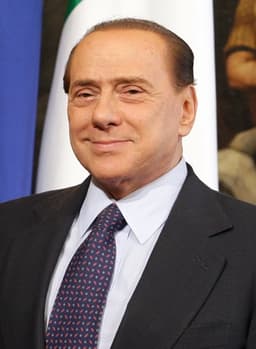
Silvio Berlusconi
Politician · Modern
58.7Total

Thomas Jefferson
Politician · Modern
64.3Total
Basic Information
Born
1936
1743
Died
—
1826
Era
Modern
Modern
Nationality
Italy
United States
Occupation
Politician
Politician
Civilization
Western
Western
Score Comparison
Military (10%)
50.0
40.0
Political (20%)
55.0
78.0
Influence (20%)
68.0
65.0
Legacy (20%)
52.0
65.0
Leadership (15%)
68.0
79.8
Strategy (15%)
52.2
41.7
TOTAL
58.7
64.3
Silvio Berlusconi — Complete Timeline
1978 AD
Founding of FininvestPolitical Action◆ Major
Berlusconi founded Fininvest, a holding company that acquired local television stations and later built Italy's largest private media empire. This gave him control over three national TV networks by the 1980s, shaping Italian media and politics.
Media EmpireBusiness
Impact: national
1994 AD
First Election as Prime MinisterPolitical Action◆ Major
Berlusconi won the 1994 general election as leader of the Forza Italia party, becoming Prime Minister of Italy on May 10. His coalition government collapsed after seven months due to internal conflicts and corruption investigations.
ElectionGovernment
Impact: national
2010 AD
Bunga Bunga ScandalPolitical Action◆ Major
Berlusconi faced allegations of paying for sex with an underage Moroccan dancer, Karima El Mahroug, and abusing his office to cover it up. The scandal led to multiple trials, damaging his political reputation and resulting in a conviction for tax fraud.
ScandalLegal
Impact: nationaldestructive
2011 AD
Resignation During Eurozone CrisisPolitical Action◆ Major
Berlusconi resigned as Prime Minister on November 16, 2011, amid the Eurozone debt crisis and market pressure. His government's inability to implement austerity measures led to his replacement by technocrat Mario Monti.
Economic CrisisResignation
Impact: national
2013 AD
Conviction for Tax FraudPolitical Action◆ Major
Berlusconi was convicted of tax fraud by Italy's Supreme Court on August 1, 2013, for inflating film rights prices in his Mediaset company. He was sentenced to four years in prison, commuted to community service, and banned from public office.
CorruptionLegal
Impact: nationaldestructive
Thomas Jefferson — Complete Timeline
1776 AD
Drafting of the Declaration of IndependencePolitical Action
Jefferson was the principal author of the Declaration of Independence, adopted by the Continental Congress on July 4, 1776. The document proclaimed the American colonies' separation from Britain and articulated natural rights to life, liberty, and the pursuit of happiness.
IndependenceFounding DocumentHuman Rights
Impact: globalprogressive
1786 AD
Virginia Statute for Religious FreedomReform◆ Major
Jefferson authored the Virginia Statute for Religious Freedom, which disestablished the Church of England in Virginia and guaranteed religious liberty. The statute became a model for the First Amendment to the U.S. Constitution.
Religious FreedomLawSeparation of Church and State
Impact: nationalprogressive
1803 AD
Louisiana PurchasePolitical Action
As President, Jefferson authorized the purchase of the Louisiana Territory from France for $15 million, doubling the size of the United States. The acquisition opened vast lands for westward expansion and strengthened federal power.
Territorial ExpansionDiplomacyLand Acquisition
Impact: globalconstructive
1807 AD
Embargo Act of 1807Political Action◆ Major
Jefferson signed the Embargo Act, prohibiting American ships from trading with foreign nations to avoid entanglement in the Napoleonic Wars. The act devastated the U.S. economy, particularly in New England, and was widely unpopular, leading to its repeal in 1809.
Trade PolicyEconomic SanctionsForeign Relations
Impact: nationaldestructive
1819 AD
Founding of the University of VirginiaCultural◆ Major
Jefferson founded the University of Virginia, designing its architecture and curriculum. The university emphasized secular education, scientific inquiry, and a broad liberal arts curriculum, reflecting Jefferson's commitment to public education.
EducationUniversityArchitecture
Impact: nationalconstructive
Expert Analysis
Origins
Silvio Berlusconi was born on September 29, 1936, in Milan, Italy, to a middle-class family. His father was a bank employee, and his mother was a homemaker. He earned a law degree from the University of Milan in 1961, but his early career was in real estate and construction. By the 1970s, he had built a successful property development business, and in 1978, he founded Fininvest, a holding company that entered the media sector by acquiring local television stations. This marked the beginning of his media empire.
Thomas Jefferson was born on April 13, 1743, at Shadwell, Virginia, into a wealthy planter family. His father was a surveyor and planter, and his mother came from a prominent Virginia family. He studied at the College of William & Mary, graduating in 1762, and then studied law under George Wythe. He was elected to the Virginia House of Burgesses in 1769, beginning his political career. His early life was steeped in Enlightenment ideas, which shaped his views on liberty and governance.
Rise to Power
Berlusconi's rise to political power was rapid and unconventional. In January 1994, he founded the Forza Italia party, leveraging his media empire to campaign effectively. He won the general election in March 1994 and became Prime Minister on May 10, 1994. However, his first government collapsed in December 1994 due to internal coalition conflicts and corruption investigations. Despite this, he remained a dominant figure in Italian politics, returning as Prime Minister in 2001, 2008, and briefly in 2011. His rise was fueled by his control over television networks, which he used to shape public opinion.
Jefferson's rise was more gradual and grounded in revolutionary politics. He gained prominence as the principal author of the Declaration of Independence in 1776. He served as Governor of Virginia (1779-1781), Minister to France (1785-1789), Secretary of State under George Washington (1790-1793), and Vice President under John Adams (1797-1801). His political ascent culminated in the 1800 presidential election, which he won after a contentious tie in the House of Representatives, defeating Adams. His rise was marked by intellectual leadership and party building, founding the Democratic-Republican Party.
Leadership & Governance
Berlusconi's leadership style was populist and media-centric. He passed laws that benefited his business interests, such as the 2002 law that decriminalized false accounting and the 2003 law that granted immunity from prosecution for top officials while in office. His governance was marked by conflicts of interest, as he remained the head of his media empire while serving as Prime Minister. He focused on tax cuts, pension reform, and foreign policy alignment with the United States. However, his economic policies failed to spur growth, and Italy's public debt remained high. He scored 68 in leadership and 55 in political scores.
Jefferson's leadership emphasized limited government, states' rights, and agrarian democracy. He reduced the national debt, cut taxes, and shrank the military. His most significant achievement was the Louisiana Purchase in 1803, which doubled the size of the United States. He also championed the Virginia Statute for Religious Freedom and founded the University of Virginia. However, his embargo policy of 1807 was a failure, devastating American trade without achieving its diplomatic goals. He scored 79.8 in leadership and 78 in political scores.
Triumph & Tragedy
Berlusconi's greatest triumph was building Italy's largest private media empire and dominating politics for two decades. He won three general elections and remained a central figure despite scandals. His tragedy was his conviction for tax fraud in 2013, which led to a ban from political office, and the "Bunga Bunga" scandal that tarnished his reputation. He also failed to address Italy's structural economic problems, and his resignation in 2011 came during a severe debt crisis.
Jefferson's greatest triumph is the Declaration of Independence, a foundational document of American democracy. The Louisiana Purchase was a strategic masterstroke. His tragedy includes his hypocrisy on slavery: he owned slaves throughout his life despite writing that "all men are created equal." The Embargo Act of 1807 was a policy disaster. He also left office with the nation deeply divided over slavery and foreign policy.
Character & Destiny
Berlusconi was charismatic, ambitious, and ruthless. He used his media power to attack opponents and protect himself. His destiny was shaped by his ability to survive legal challenges and maintain a loyal base, but his conflicts of interest and scandalous personal life ultimately limited his legacy. He scored 52.2 in strategy, reflecting his short-term focus.
Jefferson was an intellectual, idealistic, and pragmatic. He believed in reason and education but was constrained by the realities of his era. His destiny was to be a founding father, but his failure to reconcile slavery with liberty marred his legacy. He scored 41.7 in strategy, indicating less tactical acumen than Berlusconi in some respects.
Legacy
Berlusconi's legacy is mixed. He transformed Italian media and politics, but his tenure is associated with corruption and stagnation. He scored 52 in legacy. Jefferson's legacy is vast: the Declaration, Louisiana Purchase, and religious freedom are enduring achievements. He scored 65 in legacy. However, his legacy is complicated by slavery.
Conclusion
Thomas Jefferson had a greater impact on world history than Silvio Berlusconi. Jefferson's ideas on liberty and democracy influenced revolutions globally, while Berlusconi's influence was largely confined to Italy's recent political decay. Jefferson's total score of 64.3 versus Berlusconi's 58.7 reflects this. Jefferson's political score of 78 far exceeds Berlusconi's 55, and his leadership score of 79.8 beats Berlusconi's 68. While Berlusconi was a master of media and short-term tactics, Jefferson's contributions to governance and human rights are more profound and lasting.
Rankings
🥇
Thomas JeffersonLeader
Mil: 40.0Pol: 78.0Inf: 65.0
64.3
🥈
Silvio Berlusconi
Mil: 50.0Pol: 55.0Inf: 68.0
58.7
+5.6 behind
How This Comparison Works
Algorithm
Each figure is scored on 6 dimensions (0—100 scale) based on structured historical data: Military (10%), Political (20%), Influence (20%), Legacy (20%), Leadership (15%), Strategy (15%). The weighted total produces the final ranking.
Data Sources
Scores are computed from structured sub-indicators in the database. Scale factors adjust for era (Ancient ×0.85, Modern ×1.0) and civilization size (Eastern ×1.05, Other ×0.80) to account for differences in population and military scale.
Maximum 3 Figures
Comparisons are limited to 2—3 figures to ensure readability and statistical meaningfulness.
Error Margins
±5 points per dimension — Sub-scores are derived from historical records with inherent uncertainty. Two figures within 5 points on a dimension should be considered roughly equivalent in that area.
Total Score Accuracy
±3 points overall — The weighted combination of 6 dimensions produces a total score with approximately ±3 points of uncertainty. Differences of less than 3 points are not statistically significant— the figures are effectively tied.
Known Limitations
- Historical records are incomplete and uneven across civilizations
- Figures from oral-tradition societies may be underrepresented
- Occupation labels can misclassify multi-role figures
- Scores measure capability and impact, not moral character
- Quantitative scoring is a comparison tool, not absolute truth
Capability Radar
Military (10%) — Battles & Warfare
Battles
29
0
Win Rate
31
0
Expansion
33
65
Political (20%) — Governance & Reform
Reform
55
85
Diplomacy
60
75
Economy
70
70
Influence (20%) — Cultural & Global Reach
Cultural
65
80
Global
65
75
Legacy (20%) — Historical Impact
Historical
60
85
Longevity
40
80
Leadership (15%) — Power & Stability
Tenure
75
70
Stability
30
60
Strategy (15%) — Tactics & Innovation
Strategy
39
0
Tactics
41
0
Reform
42
20
Similar Comparisons
Comments & Discussion
No comments yet. Be the first to share your thoughts!