Loading...
This comparison has not been analyzed yet.
One-time AI generation (~1 minute). Scores and timeline are already available below.
Rashid al-Din Sinan vs Uli I of Mali
Rashid al-Din Sinan leads by 14.1 pts · 2 figures compared
…
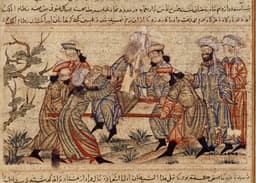
Rashid al-Din Sinan
Emperor · Medieval
50.6Total

Uli I of Mali
Emperor · Medieval
36.5Total
Basic Information
Born
1132
1255
Died
1193
1270
Era
Medieval
Medieval
Nationality
Nizari Ismaili
Mali Empire
Occupation
Emperor
Emperor
Civilization
Middle Eastern
Other
Score Comparison
Military (10%)
50.0
21.2
Political (20%)
39.4
27.9
Influence (20%)
53.3
47.9
Legacy (20%)
45.0
37.5
Leadership (15%)
65.7
34.6
Strategy (15%)
52.5
36.8
TOTAL
50.6
36.5
Rashid al-Din Sinan — Complete Timeline
1162 AD
Leadership of Syrian NizarisPolitical Action◆ Major
Rashid al-Din Sinan became the leader of the Nizari Ismaili community in Syria, based at the fortress of Masyaf. He consolidated control over a network of fortresses and expanded the sect's influence during the Crusader period.
Nizari IsmailiSyriaLeadership
Impact: regional
1174 AD
Assassination of Raymond of TripoliPolitical Action
Rashid al-Din Sinan ordered the assassination of Raymond III of Tripoli, a Crusader count. This act demonstrated the Nizaris' ability to target high-ranking Crusader leaders and influenced the political dynamics of the Crusader states.
AssassinationCrusader StatesNizari Ismaili
Impact: regionaldestructive
1176 AD
Meeting with SaladinPolitical Action◆ Major
Rashid al-Din Sinan met with Saladin, the Ayyubid sultan, after Saladin's failed siege of Masyaf. The meeting resulted in a truce, with Saladin ceasing his campaigns against the Nizaris and allowing them to maintain their fortresses in exchange for non-aggression.
Nizari IsmailiSaladinTruce
Impact: regional
1192 AD
Assassination of Conrad of MontferratPolitical Action◆ Major
Rashid al-Din Sinan's agents assassinated Conrad of Montferrat, the King of Jerusalem, in Tyre. This act removed a key Crusader leader and was likely carried out in coordination with Saladin, influencing the outcome of the Third Crusade.
AssassinationCrusader StatesThird Crusade
Impact: regionaldestructive
1193 AD
Death of Rashid al-Din SinanOther◆ Major
Rashid al-Din Sinan died at Masyaf, having led the Syrian Nizaris for over 30 years. He was succeeded by a new leader. His legacy includes the effective use of assassination as a political tool and the survival of the Nizari state in Syria.
Nizari IsmailiDeathLegacy
Impact: regional
Uli I of Mali — Complete Timeline
1255 AD
Succeeded Sundiata Keita as Mansa of MaliPolitical Action◆ Major
Uli I (also known as Wali Keita) succeeded his father Sundiata Keita as the Mansa (emperor) of the Mali Empire. His reign continued the expansion and consolidation of the empire founded by Sundiata.
Mali EmpireSuccession
Impact: regional
1260 AD
Made pilgrimage to MeccaCultural◆ Major
Uli I undertook the Hajj pilgrimage to Mecca, becoming one of the first Mali emperors to do so. His pilgrimage demonstrated the empire's wealth and Islamic piety, strengthening ties with the Muslim world.
HajjIslamic Diplomacy
Impact: regionalconstructive
Established diplomatic relations with EgyptPolitical Action
During his pilgrimage, Uli I established diplomatic relations with the Mamluk Sultanate in Egypt. This facilitated trade and cultural exchange between Mali and North Africa.
DiplomacyMamluk Sultanate
Impact: regionalconstructive
1265 AD
Expanded Mali Empire's territoryWar◆ Major
Uli I led military campaigns that expanded the Mali Empire's borders, incorporating new territories in the Sahel and along the Niger River. His conquests increased the empire's control over trade routes and resources.
Territorial ExpansionMilitary Campaign
Impact: regional
This comparison has not been analyzed yet.
One-time AI generation (~1 minute). Scores and timeline are already available below.
Rankings
🥇
Rashid al-Din SinanLeader
Mil: 50.0Pol: 39.4Inf: 53.3
50.6
🥈
Uli I of Mali
Mil: 21.2Pol: 27.9Inf: 47.9
36.5
+14.1 behind
How This Comparison Works
Algorithm
Each figure is scored on 6 dimensions (0—100 scale) based on structured historical data: Military (10%), Political (20%), Influence (20%), Legacy (20%), Leadership (15%), Strategy (15%). The weighted total produces the final ranking.
Data Sources
Scores are computed from structured sub-indicators in the database. Scale factors adjust for era (Ancient ×0.85, Modern ×1.0) and civilization size (Eastern ×1.05, Other ×0.80) to account for differences in population and military scale.
Maximum 3 Figures
Comparisons are limited to 2—3 figures to ensure readability and statistical meaningfulness.
Error Margins
±5 points per dimension — Sub-scores are derived from historical records with inherent uncertainty. Two figures within 5 points on a dimension should be considered roughly equivalent in that area.
Total Score Accuracy
±3 points overall — The weighted combination of 6 dimensions produces a total score with approximately ±3 points of uncertainty. Differences of less than 3 points are not statistically significant— the figures are effectively tied.
Known Limitations
- Historical records are incomplete and uneven across civilizations
- Figures from oral-tradition societies may be underrepresented
- Occupation labels can misclassify multi-role figures
- Scores measure capability and impact, not moral character
- Quantitative scoring is a comparison tool, not absolute truth
Capability Radar
Military (10%) — Battles & Warfare
Battles
20
10
Win Rate
25
10
Expansion
15
10
Political (20%) — Governance & Reform
Reform
30
20
Diplomacy
55
25
Economy
20
20
Influence (20%) — Cultural & Global Reach
Cultural
35
15
Global
25
10
Legacy (20%) — Historical Impact
Historical
40
15
Longevity
30
10
Leadership (15%) — Power & Stability
Tenure
45
20
Stability
40
20
Strategy (15%) — Tactics & Innovation
Strategy
55
10
Tactics
60
10
Reform
40
10
Similar Comparisons
Comments & Discussion
No comments yet. Be the first to share your thoughts!