Loading...
This comparison has not been analyzed yet.
One-time AI generation (~1 minute). Scores and timeline are already available below.
Rama II vs Zhu Youlang
Rama II leads by 11.3 pts · 2 figures compared
…
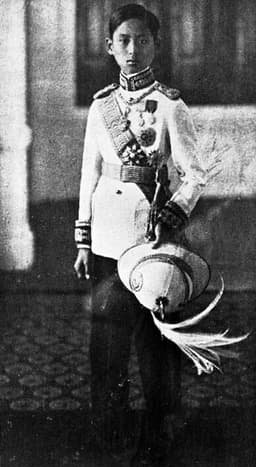
Rama II
Emperor · Modern
51.3Total

Zhu Youlang
Emperor · Modern
40.0Total
Basic Information
Born
1767
1623
Died
1824
1662
Era
Modern
Modern
Nationality
Thailand
China
Occupation
Emperor
Emperor
Civilization
Eastern
Eastern
Score Comparison
Military (10%)
14.9
21.2
Political (20%)
61.3
27.9
Influence (20%)
56.4
47.9
Legacy (20%)
45.0
40.0
Leadership (15%)
72.0
51.9
Strategy (15%)
45.0
39.6
TOTAL
51.3
40.0
Rama II — Complete Timeline
1809 AD
Burmese-Siamese War of 1809-1812War◆ Major
Burmese forces under the Konbaung dynasty invaded Siam, attacking Thalang (Phuket) and other southern provinces. Rama II's forces repelled the invasion, securing Siam's southern territories and maintaining the kingdom's independence.
Burmese-Siamese WarDefenseSouthern Campaign
Impact: regional
Accession to the Throne as King Rama IIPolitical Action◆ Major
Rama II succeeded his father, King Rama I, as the second monarch of the Chakri dynasty. His reign continued the consolidation of Siamese power after the fall of Ayutthaya and the establishment of Bangkok as the capital.
SuccessionChakri DynastyBangkok Period
Impact: nationalconstructive
1810 AD
Patronage of Literature and the ArtsCultural◆ Major
Rama II, a noted poet and playwright, actively patronized Siamese literature and the arts. He composed or revised major works including the Ramakien (Thai Ramayana) and several dance-dramas, fostering a cultural renaissance in early Bangkok.
LiteratureArtsCultural Renaissance
Impact: nationalconstructive
1815 AD
Restoration of Wat Phra Kaew and Temple ConstructionCultural
Rama II oversaw the restoration and expansion of Wat Phra Kaew (Temple of the Emerald Buddha) and other royal temples in Bangkok. These projects reinforced the symbolic and religious authority of the Chakri monarchy.
Temple RestorationBuddhismArchitecture
Impact: nationalconstructive
Zhu Youlang — Complete Timeline
1646 AD
Proclaimed Yongli EmperorPolitical Action◆ Major
Zhu Youlang was proclaimed the Yongli Emperor in Zhaoqing, Guangdong, after the death of the Longwu Emperor. He became the primary claimant of the Southern Ming, leading resistance against the Qing.
Southern MingCoronation
Impact: nationalconstructive
1647 AD
Alliance with the Xiying rebelsPolitical Action◆ Major
The Yongli Emperor formed an alliance with former rebel generals Li Dingguo and Sun Kewang of the Xiying army. This coalition temporarily strengthened the Southern Ming cause against the Qing.
AllianceSouthern Ming
Impact: nationalconstructive
1659 AD
Fled to BurmaWar◆ Major
Qing forces under Wu Sangui invaded Yunnan, forcing the Yongli Emperor to flee across the border into Burma. He was granted asylum by the Burmese king but was effectively a prisoner.
RetreatExile
Impact: regionaltragic
1661 AD
Captured by Wu SanguiWar◆ Major
Wu Sangui led a Qing expedition into Burma and demanded the surrender of the Yongli Emperor. The Burmese king handed him over to Wu Sangui, ending the last organized Southern Ming resistance.
CaptureQing Conquest
Impact: nationaltragic
1662 AD
Executed by Wu SanguiPolitical Action◆ Major
Wu Sangui executed the Yongli Emperor by strangulation in Kunming. The execution marked the final end of the Ming dynasty and solidified Qing control over all of China.
ExecutionEnd of Ming
Impact: nationaltragic
This comparison has not been analyzed yet.
One-time AI generation (~1 minute). Scores and timeline are already available below.
Rankings
🥇
Rama IILeader
Mil: 14.9Pol: 61.3Inf: 56.4
51.3
🥈
Zhu Youlang
Mil: 21.2Pol: 27.9Inf: 47.9
40.0
+11.3 behind
How This Comparison Works
Algorithm
Each figure is scored on 6 dimensions (0—100 scale) based on structured historical data: Military (10%), Political (20%), Influence (20%), Legacy (20%), Leadership (15%), Strategy (15%). The weighted total produces the final ranking.
Data Sources
Scores are computed from structured sub-indicators in the database. Scale factors adjust for era (Ancient ×0.85, Modern ×1.0) and civilization size (Eastern ×1.05, Other ×0.80) to account for differences in population and military scale.
Maximum 3 Figures
Comparisons are limited to 2—3 figures to ensure readability and statistical meaningfulness.
Error Margins
±5 points per dimension — Sub-scores are derived from historical records with inherent uncertainty. Two figures within 5 points on a dimension should be considered roughly equivalent in that area.
Total Score Accuracy
±3 points overall — The weighted combination of 6 dimensions produces a total score with approximately ±3 points of uncertainty. Differences of less than 3 points are not statistically significant— the figures are effectively tied.
Known Limitations
- Historical records are incomplete and uneven across civilizations
- Figures from oral-tradition societies may be underrepresented
- Occupation labels can misclassify multi-role figures
- Scores measure capability and impact, not moral character
- Quantitative scoring is a comparison tool, not absolute truth
Capability Radar
Military (10%) — Battles & Warfare
Battles
10
15
Win Rate
10
10
Expansion
10
5
Political (20%) — Governance & Reform
Reform
40
10
Diplomacy
50
20
Economy
40
5
Influence (20%) — Cultural & Global Reach
Cultural
60
15
Global
20
10
Legacy (20%) — Historical Impact
Historical
40
30
Longevity
30
20
Leadership (15%) — Power & Stability
Tenure
60
40
Stability
50
5
Strategy (15%) — Tactics & Innovation
Strategy
10
10
Tactics
10
10
Reform
10
5
Similar Comparisons
Comments & Discussion
No comments yet. Be the first to share your thoughts!