Loading...
Quietus vs Thutmose II
Quietus leads by 11.5 pts · 2 figures compared
…
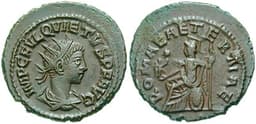
Quietus
Emperor · Ancient
45.2Total

Thutmose II
Emperor · Ancient
33.7Total
Basic Information
Born
250
-1493
Died
261
-1479
Era
Ancient
Ancient
Nationality
Roman Empire
Egypt
Occupation
Emperor
Emperor
Civilization
Western
Middle Eastern
Score Comparison
Military (10%)
47.5
10.2
Political (20%)
39.4
32.1
Influence (20%)
56.4
40.9
Legacy (20%)
39.2
32.5
Leadership (15%)
45.0
33.6
Strategy (15%)
38.6
45.0
TOTAL
45.2
33.7
Quietus — Complete Timeline
260 AD
Proclaimed emperor alongside brother Macrianus MinorPolitical Action◆ Major
Quietus was proclaimed Augustus in the East alongside his brother Macrianus Minor and their father Macrianus Major after Valerian's capture. He remained in Syria while his brother marched west against Gallienus.
UsurpationRoman EmpireCrisis of the Third Century
Impact: regional
261 AD
Besieged and killed in Emesa by OdaenathusWar◆ Major
After the defeat and death of his brother Macrianus Minor, Quietus was besieged in Emesa by Odaenathus of Palmyra, a loyalist ally of Gallienus. The city fell and Quietus was executed, ending the Macrianic usurpation.
SiegeExecutionPalmyra
Impact: regionaltragic
Thutmose II — Complete Timeline
1493 BC
Marriage to HatshepsutPolitical Action
Thutmose II married his half-sister Hatshepsut, strengthening his claim to the throne as the son of Thutmose I by a lesser wife. This union produced a daughter, Neferure, and positioned Hatshepsut for future regency.
MarriageDynastyHatshepsut
Impact: national
1490 BC
Suppression of the Nubian RevoltWar
Thutmose II led a military campaign to suppress a revolt in Nubia. He personally commanded the army, defeated the rebels, and executed the rebel leaders, reaffirming Egyptian control over the region.
NubiaRevoltMilitary
Impact: regional
1488 BC
Campaign against the Shasu BedouinWar
Thutmose II conducted a campaign into the Sinai against the Shasu Bedouin, who had been raiding Egyptian territory. The campaign secured the eastern frontier and trade routes to the Levant.
SinaiBedouinFrontier
Expert Analysis
Origins
Quietus was a Roman usurper in the 3rd century AD, part of a short-lived rebellion during the Crisis of the Third Century. He was the son of Macrianus Major, a powerful general under Emperor Valerian. After Valerian was captured by the Sassanids in 260 AD, Macrianus Major, along with his sons Macrianus Minor and Quietus, seized power in the East. Quietus was proclaimed Augustus alongside his brother. His background was purely military and political, rooted in the chaotic power struggles of the late Roman Empire.
Thutmose II was the fourth pharaoh of the 18th Dynasty of Egypt, ruling around 1493–1479 BC. He was the son of Thutmose I and a lesser wife, Mutnofret. To legitimize his claim, he married his half-sister Hatshepsut, who later became one of Egypt's most famous pharaohs. Thutmose II's reign was relatively short and overshadowed by the powerful figures around him, especially his father and his wife. His early life was steeped in the royal court of Egypt, but he left little independent mark.
Rise to Power
Quietus rose to power through a coup. In 260 AD, after Valerian's capture, his father Macrianus Major and his brother Macrianus Minor declared themselves emperors. Quietus was made co-emperor with his brother. Their rule was based in the eastern provinces, with support from the army. However, their position was weak, as the legitimate emperor Gallienus (Valerian's son) still controlled much of the West. The Macriani's power crumbled when Gallienus' general Aureolus defeated Macrianus Minor in battle in 261 AD. Quietus was then besieged in Emesa by Odaenathus of Palmyra, a loyalist ally of Gallienus. He was captured and killed, ending his brief reign after only a few months.
Thutmose II ascended the throne after the death of his father, Thutmose I. His reign was short, estimated at 3 to 13 years (scholars debate). To secure his rule, he married Hatshepsut, who was of higher royal blood. He faced a revolt in Nubia early in his reign, which he personally suppressed, executing the rebel leader. He also conducted a minor campaign against the Shasu Bedouin in the Sinai. However, his most significant political move was his marriage to Hatshepsut, who would later rule as pharaoh after his death. Thutmose II's rise was typical of Egyptian succession, but his authority was limited by the strong personalities of his father and wife.
Leadership & Governance
Quietus, as a usurper, had little opportunity to govern. His leadership was defined by the rebellion against Gallienus. He likely relied on his father's military expertise. His governance was non-existent beyond the eastern provinces, and he failed to build alliances or secure his position. His score of 45.0 in Leadership reflects a short, ineffective rule. In contrast, Thutmose II's leadership score of 33.6 is lower, but he did manage to suppress a rebellion and maintain stability. However, his governance was largely overshadowed by Hatshepsut, who effectively ran the administration. Thutmose II's reign saw no major building projects or reforms, unlike his father or his wife. His political score of 32.1 reflects his limited agency.
Triumph & Tragedy
Quietus's greatest success was being proclaimed emperor and briefly ruling the eastern provinces. His tragedy was his rapid downfall: after his brother's defeat, he was besieged and killed in Emesa. He scored 47.5 in Military, but this is based on his association with his father's campaigns, not his own achievements. Thutmose II's triumph was his successful suppression of the Nubian revolt, which secured Egypt's southern border. His tragedy is that his reign is largely forgotten, overshadowed by Hatshepsut and Thutmose III. His military score of 10.2 is abysmally low, reflecting his lack of significant conquests. He did not expand Egypt's borders or leave a lasting military legacy.
Character & Destiny
Quietus was likely a figurehead in his father's rebellion. His character is poorly recorded, but his destiny was to be a footnote in Roman history. His death at Emesa marked the end of his family's ambitions. Thutmose II, by contrast, was a pharaoh who ruled in the shadow of stronger relatives. His character seems to have been passive, allowing Hatshepsut to dominate. His destiny was to be remembered primarily as Hatshepsut's husband and the father of Thutmose III. Historical assessments of Thutmose II often note his lack of initiative. He scored 38.6 in Strategy, which is higher than his military score, perhaps reflecting the strategic marriage to Hatshepsut.
Legacy
Quietus's legacy is minimal. He is remembered as a minor usurper in the Crisis of the Third Century, with no lasting impact on Roman institutions. His influence score of 56.4 is inflated due to his role in the rebellion, but his legacy score of 39.2 is low. Thutmose II's legacy is more significant but still limited. He is a necessary link in the 18th Dynasty, but his reign was a pause between the more dynamic reigns of Thutmose I and Hatshepsut. His influence score of 40.9 reflects his role in the royal lineage. His legacy is overshadowed by Hatshepsut, who built monuments and expanded trade. Thutmose II built little and is often omitted from popular accounts of Egyptian history.
Conclusion
Quietus scores a total of 45.2, while Thutmose II scores 33.7, a gap of 11.5 points. Despite both being minor figures, Quietus had a slightly greater impact due to his involvement in a significant rebellion that challenged the Roman Empire during a crisis. His actions, though ultimately unsuccessful, were part of a broader pattern of usurpations that shaped the eventual reforms of Diocletian. Thutmose II, on the other hand, was a placeholder pharaoh whose reign was so uneventful that it is often skipped in historical narratives. Therefore, Quietus had the greater impact, however marginal. His role in the Crisis of the Third Century, even as a brief usurper, contributed to the unraveling of the old Roman order, whereas Thutmose II's reign did little to change Egypt's trajectory.
Rankings
🥇
QuietusLeader
Mil: 47.5Pol: 39.4Inf: 56.4
45.2
🥈
Thutmose II
Mil: 10.2Pol: 32.1Inf: 40.9
33.7
+11.5 behind
How This Comparison Works
Algorithm
Each figure is scored on 6 dimensions (0—100 scale) based on structured historical data: Military (10%), Political (20%), Influence (20%), Legacy (20%), Leadership (15%), Strategy (15%). The weighted total produces the final ranking.
Data Sources
Scores are computed from structured sub-indicators in the database. Scale factors adjust for era (Ancient ×0.85, Modern ×1.0) and civilization size (Eastern ×1.05, Other ×0.80) to account for differences in population and military scale.
Maximum 3 Figures
Comparisons are limited to 2—3 figures to ensure readability and statistical meaningfulness.
Error Margins
±5 points per dimension — Sub-scores are derived from historical records with inherent uncertainty. Two figures within 5 points on a dimension should be considered roughly equivalent in that area.
Total Score Accuracy
±3 points overall — The weighted combination of 6 dimensions produces a total score with approximately ±3 points of uncertainty. Differences of less than 3 points are not statistically significant— the figures are effectively tied.
Known Limitations
- Historical records are incomplete and uneven across civilizations
- Figures from oral-tradition societies may be underrepresented
- Occupation labels can misclassify multi-role figures
- Scores measure capability and impact, not moral character
- Quantitative scoring is a comparison tool, not absolute truth
Capability Radar
Military (10%) — Battles & Warfare
Battles
5
5
Win Rate
5
5
Expansion
0
5
Political (20%) — Governance & Reform
Reform
0
10
Diplomacy
5
10
Economy
0
10
Influence (20%) — Cultural & Global Reach
Cultural
0
5
Global
0
5
Legacy (20%) — Historical Impact
Historical
5
10
Longevity
0
5
Leadership (15%) — Power & Stability
Tenure
5
15
Stability
0
15
Strategy (15%) — Tactics & Innovation
Strategy
5
5
Tactics
5
5
Reform
0
5
Similar Comparisons
Comments & Discussion
No comments yet. Be the first to share your thoughts!