Loading...
This comparison has not been analyzed yet.
One-time AI generation (~1 minute). Scores and timeline are already available below.
Pertinax vs Yuri of Goguryeo
Pertinax leads by 2.6 pts · 2 figures compared
…
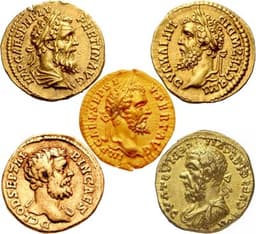
Pertinax
Emperor · Ancient
40.8Total

Yuri of Goguryeo
Emperor · Ancient
38.2Total
Basic Information
Born
126
-19
Died
193
-18
Era
Ancient
Ancient
Nationality
Roman Empire
Goguryeo
Occupation
Emperor
Emperor
Civilization
Western
Eastern
Score Comparison
Military (10%)
25.0
50.0
Political (20%)
35.1
32.1
Influence (20%)
43.2
43.2
Legacy (20%)
35.0
34.2
Leadership (15%)
49.9
33.6
Strategy (15%)
60.0
39.6
TOTAL
40.8
38.2
Pertinax — Complete Timeline
193 AD
Attempted Reforms and AusterityReform◆ Major
Pertinax attempted to restore discipline to the Praetorian Guard and reform the imperial finances. He reduced taxes, sold off Commodus's extravagant possessions, and tried to curb corruption. These reforms alienated the Praetorian Guard, who expected a large donative.
ReformsAusterityPraetorian Guard
Impact: nationalconstructive
Accession as EmperorPolitical Action◆ Major
Pertinax was proclaimed Roman emperor by the Praetorian Guard after the assassination of Commodus. He was the son of a freedman and had a distinguished military and political career. His accession was initially welcomed by the Senate and people as a return to good governance.
AccessionEmperorPraetorian Guard
Impact: globalconstructive
Assassination by Praetorian GuardPolitical Action◆ Major
After only 87 days in power, Pertinax was assassinated by the Praetorian Guard. The Guard stormed the imperial palace and killed him because he refused to pay them the promised donative. His death triggered a civil war and the auctioning of the empire to Didius Julianus.
AssassinationPraetorian GuardYear of the Five Emperors
Impact: globaltragic
Yuri of Goguryeo — Complete Timeline
19 BC
Accession to the throne of GoguryeoPolitical Action◆ Major
Upon the death of his father Jumong, Yuri became the second king of Goguryeo. He inherited a newly founded kingdom and continued its consolidation, establishing the royal lineage that would rule for centuries.
SuccessionFounding Dynasty
Impact: national
This comparison has not been analyzed yet.
One-time AI generation (~1 minute). Scores and timeline are already available below.
Rankings
🥇
PertinaxLeader
Mil: 25.0Pol: 35.1Inf: 43.2
40.8
🥈
Yuri of Goguryeo
Mil: 50.0Pol: 32.1Inf: 43.2
38.2
+2.6 behind
How This Comparison Works
Algorithm
Each figure is scored on 6 dimensions (0—100 scale) based on structured historical data: Military (10%), Political (20%), Influence (20%), Legacy (20%), Leadership (15%), Strategy (15%). The weighted total produces the final ranking.
Data Sources
Scores are computed from structured sub-indicators in the database. Scale factors adjust for era (Ancient ×0.85, Modern ×1.0) and civilization size (Eastern ×1.05, Other ×0.80) to account for differences in population and military scale.
Maximum 3 Figures
Comparisons are limited to 2—3 figures to ensure readability and statistical meaningfulness.
Error Margins
±5 points per dimension — Sub-scores are derived from historical records with inherent uncertainty. Two figures within 5 points on a dimension should be considered roughly equivalent in that area.
Total Score Accuracy
±3 points overall — The weighted combination of 6 dimensions produces a total score with approximately ±3 points of uncertainty. Differences of less than 3 points are not statistically significant— the figures are effectively tied.
Known Limitations
- Historical records are incomplete and uneven across civilizations
- Figures from oral-tradition societies may be underrepresented
- Occupation labels can misclassify multi-role figures
- Scores measure capability and impact, not moral character
- Quantitative scoring is a comparison tool, not absolute truth
Capability Radar
Military (10%) — Battles & Warfare
Battles
45
10
Win Rate
50
10
Expansion
10
15
Political (20%) — Governance & Reform
Reform
30
10
Diplomacy
25
10
Economy
35
10
Influence (20%) — Cultural & Global Reach
Cultural
10
10
Global
5
5
Legacy (20%) — Historical Impact
Historical
20
15
Longevity
10
10
Leadership (15%) — Power & Stability
Tenure
10
15
Stability
5
15
Strategy (15%) — Tactics & Innovation
Strategy
50
10
Tactics
55
10
Reform
30
5
Similar Comparisons
Comments & Discussion
No comments yet. Be the first to share your thoughts!