Loading...
This comparison has not been analyzed yet.
One-time AI generation (~1 minute). Scores and timeline are already available below.
Osei Tutu vs Umberto II of Italy
Osei Tutu leads by 27.6 pts · 2 figures compared
…

Osei Tutu
Emperor · Modern
68.8Total
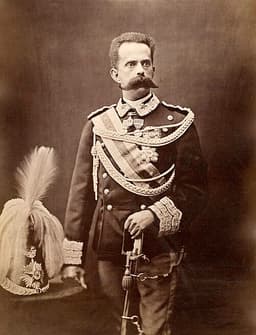
Umberto II of Italy
Emperor · Modern
41.2Total
Basic Information
Born
1660
1904
Died
1717
1983
Era
Modern
Modern
Nationality
Ashanti Empire
Italy
Occupation
Emperor
Emperor
Civilization
Other
Western
Score Comparison
Military (10%)
78.0
46.1
Political (20%)
79.2
45.1
Influence (20%)
82.0
45.5
Legacy (20%)
40.0
35.8
Leadership (15%)
78.0
33.6
Strategy (15%)
69.1
45.0
TOTAL
68.8
41.2
Osei Tutu — Complete Timeline
1700 AD
Military ReorganizationReform◆ Major
Osei Tutu reorganized the Ashanti army into a professional force with a centralized command structure. He introduced new tactics and weaponry, including firearms obtained from European traders, enhancing military effectiveness.
Military ReformFirearmsArmy
Impact: regionalconstructive
Introduction of the Golden StoolCultural◆ Major
Osei Tutu, with the help of priest Okomfo Anokye, introduced the Golden Stool as the symbol of the Ashanti nation. According to tradition, the stool descended from the sky, representing the soul of the Ashanti people.
Golden StoolSymbolismUnity
Impact: regionalconstructive
1701 AD
Battle of FeyiaseWar◆ Major
Osei Tutu led the Ashanti forces to victory against the Denkyira kingdom at Feyiase. This battle broke Denkyira's dominance and established Ashanti as the leading power in the region, controlling gold trade routes.
BattleDenkyiraGold Trade
Impact: regional
Formation of the Ashanti UnionPolitical Action
Osei Tutu united several Akan states into the Ashanti Union under the Golden Stool, a symbol of unity and sovereignty. This confederation became the Ashanti Empire, with Kumasi as its capital.
UnificationGolden StoolAshanti Empire
Impact: regionalconstructive
Establishment of the Odwira FestivalCultural
Osei Tutu instituted the Odwira festival, an annual celebration of purification and renewal. The festival reinforced Ashanti unity and the authority of the Asantehene, becoming a central cultural institution.
FestivalOdwiraCultural Institution
Impact: regionalconstructive
Umberto II of Italy — Complete Timeline
1946 AD
Accession to the ThronePolitical Action◆ Major
Umberto II became King of Italy upon his father Victor Emmanuel III's abdication. His reign lasted only 34 days, from May 9 to June 12, 1946, during the constitutional referendum on the monarchy.
MonarchySuccession
Impact: national
1946 Italian Institutional ReferendumPolitical Action
Umberto II accepted the results of the referendum that abolished the monarchy in favor of a republic. He went into exile in Portugal, never returning to Italy, ending the Savoy dynasty's rule.
ReferendumRepublicExile
Impact: national
Exile in CascaisPolitical Action
Umberto II settled in Cascais, Portugal, after the monarchy was abolished. He lived there for the rest of his life, never abdicating his claim to the throne, and became a symbolic figure for Italian monarchists.
ExileMonarchy
Impact: national
This comparison has not been analyzed yet.
One-time AI generation (~1 minute). Scores and timeline are already available below.
Rankings
🥇
Osei TutuLeader
Mil: 78.0Pol: 79.2Inf: 82.0
68.8
🥈
Umberto II of Italy
Mil: 46.1Pol: 45.1Inf: 45.5
41.2
+27.6 behind
How This Comparison Works
Algorithm
Each figure is scored on 6 dimensions (0—100 scale) based on structured historical data: Military (10%), Political (20%), Influence (20%), Legacy (20%), Leadership (15%), Strategy (15%). The weighted total produces the final ranking.
Data Sources
Scores are computed from structured sub-indicators in the database. Scale factors adjust for era (Ancient ×0.85, Modern ×1.0) and civilization size (Eastern ×1.05, Other ×0.80) to account for differences in population and military scale.
Maximum 3 Figures
Comparisons are limited to 2—3 figures to ensure readability and statistical meaningfulness.
Error Margins
±5 points per dimension — Sub-scores are derived from historical records with inherent uncertainty. Two figures within 5 points on a dimension should be considered roughly equivalent in that area.
Total Score Accuracy
±3 points overall — The weighted combination of 6 dimensions produces a total score with approximately ±3 points of uncertainty. Differences of less than 3 points are not statistically significant— the figures are effectively tied.
Known Limitations
- Historical records are incomplete and uneven across civilizations
- Figures from oral-tradition societies may be underrepresented
- Occupation labels can misclassify multi-role figures
- Scores measure capability and impact, not moral character
- Quantitative scoring is a comparison tool, not absolute truth
Capability Radar
Military (10%) — Battles & Warfare
Battles
75
23
Win Rate
80
28
Expansion
80
33
Political (20%) — Governance & Reform
Reform
90
0
Diplomacy
75
10
Economy
72
0
Influence (20%) — Cultural & Global Reach
Cultural
75
5
Global
65
5
Legacy (20%) — Historical Impact
Historical
80
10
Longevity
75
5
Leadership (15%) — Power & Stability
Tenure
70
5
Stability
78
5
Strategy (15%) — Tactics & Innovation
Strategy
82
32
Tactics
78
34
Reform
85
36
Similar Comparisons
Comments & Discussion
No comments yet. Be the first to share your thoughts!