Loading...
This comparison has not been analyzed yet.
One-time AI generation (~1 minute). Scores and timeline are already available below.
Nur ad-Din Zengi vs Simeon I
Simeon I leads by 5.7 pts · 2 figures compared
…
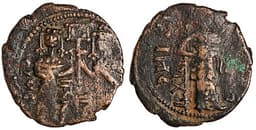
Nur ad-Din Zengi
Emperor · Medieval
64.4Total
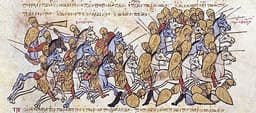
Simeon I
Emperor · Medieval
70.1Total
Basic Information
Born
1118
864
Died
1174
927
Era
Medieval
Medieval
Nationality
Zengid Dynasty
Bulgaria
Occupation
Emperor
Emperor
Civilization
Middle Eastern
Western
Score Comparison
Military (10%)
81.2
72.0
Political (20%)
65.7
65.0
Influence (20%)
58.3
82.0
Legacy (20%)
52.0
55.0
Leadership (15%)
79.8
79.8
Strategy (15%)
69.1
69.1
TOTAL
64.4
70.1
Nur ad-Din Zengi — Complete Timeline
1135 AD
Siege of DamascusWar◆ Major
Imad ad-Din Zengi besieged Damascus, attempting to expand his control over Syria. The siege failed due to strong defenses and the intervention of the Burid dynasty, preventing Zengi from unifying Muslim Syria under his rule.
DamascusSiegeBurid
Impact: regional
1144 AD
Capture of EdessaWar
Imad ad-Din Zengi, atabeg of Mosul, besieged and captured the Crusader city of Edessa. This was the first major Crusader territory to fall to Muslim forces, triggering the Second Crusade and establishing Zengi as a leading Muslim commander.
CrusadesEdessaSecond Crusade
Impact: global
1146 AD
Assassination of Imad ad-Din ZengiPolitical Action◆ Major
Imad ad-Din Zengi was assassinated by a Frankish slave in his sleep while besieging the fortress of Qal'at Ja'bar. His death fragmented his territories, which were divided between his sons Nur ad-Din and Saif ad-Din, but his legacy continued through Nur ad-Din's later successes.
AssassinationNur ad-DinQal'at Ja'bar
Impact: regionaltragic
Simeon I — Complete Timeline
893 AD
Establishment of the Preslav Literary SchoolCultural◆ Major
Under Simeon I's patronage, the Preslav Literary School flourished, producing translations of Greek religious texts and original works in Old Church Slavonic. This cultural golden age advanced Slavic literature and liturgy.
Cultural Golden AgeLiteratureSlavic Language
Impact: regionalconstructive
913 AD
Proclamation as Emperor (Tsar)Political Action◆ Major
Simeon I was crowned 'Emperor of the Bulgarians and the Romans' by the Patriarch of Constantinople, though the Byzantine court later disputed this. This act elevated Bulgaria to imperial status and challenged Byzantine supremacy.
CoronationImperial TitleByzantine Relations
Impact: regional
917 AD
Battle of AchelousWar
Simeon I's Bulgarian army decisively defeated the Byzantine forces at the Achelous River. This victory allowed Simeon to claim the title 'Tsar of the Bulgarians and the Romans' and established Bulgaria as a major power in the Balkans.
BattleByzantine-Bulgarian WarTsar Title
Impact: regional
924 AD
Siege of ConstantinopleWar◆ Major
Simeon I besieged Constantinople, the Byzantine capital, but failed to capture it. The siege ended with a peace treaty that recognized Simeon's imperial title but did not grant him control of the city.
SiegeByzantine EmpirePeace Treaty
Impact: regional
This comparison has not been analyzed yet.
One-time AI generation (~1 minute). Scores and timeline are already available below.
Rankings
🥇
Simeon ILeader
Mil: 72.0Pol: 65.0Inf: 82.0
70.1
🥈
Nur ad-Din Zengi
Mil: 81.2Pol: 65.7Inf: 58.3
64.4
+5.7 behind
How This Comparison Works
Algorithm
Each figure is scored on 6 dimensions (0—100 scale) based on structured historical data: Military (10%), Political (20%), Influence (20%), Legacy (20%), Leadership (15%), Strategy (15%). The weighted total produces the final ranking.
Data Sources
Scores are computed from structured sub-indicators in the database. Scale factors adjust for era (Ancient ×0.85, Modern ×1.0) and civilization size (Eastern ×1.05, Other ×0.80) to account for differences in population and military scale.
Maximum 3 Figures
Comparisons are limited to 2—3 figures to ensure readability and statistical meaningfulness.
Error Margins
±5 points per dimension — Sub-scores are derived from historical records with inherent uncertainty. Two figures within 5 points on a dimension should be considered roughly equivalent in that area.
Total Score Accuracy
±3 points overall — The weighted combination of 6 dimensions produces a total score with approximately ±3 points of uncertainty. Differences of less than 3 points are not statistically significant— the figures are effectively tied.
Known Limitations
- Historical records are incomplete and uneven across civilizations
- Figures from oral-tradition societies may be underrepresented
- Occupation labels can misclassify multi-role figures
- Scores measure capability and impact, not moral character
- Quantitative scoring is a comparison tool, not absolute truth
Capability Radar
Military (10%) — Battles & Warfare
Battles
75
85
Win Rate
80
80
Expansion
72
85
Political (20%) — Governance & Reform
Reform
75
75
Diplomacy
85
70
Economy
68
75
Influence (20%) — Cultural & Global Reach
Cultural
65
80
Global
55
60
Legacy (20%) — Historical Impact
Historical
70
75
Longevity
60
70
Leadership (15%) — Power & Stability
Tenure
70
80
Stability
72
70
Strategy (15%) — Tactics & Innovation
Strategy
82
85
Tactics
78
75
Reform
70
70
Similar Comparisons
Comments & Discussion
No comments yet. Be the first to share your thoughts!