Loading...
Nero vs Sima Ying
Nero leads by 6.2 pts · 2 figures compared
…

Nero
Emperor · Ancient
44.4Total
Sima Ying
Emperor · Ancient
38.2Total
Basic Information
Born
37
279
Died
68
306
Era
Ancient
Ancient
Nationality
Roman Empire
China
Occupation
Emperor
Emperor
Civilization
Western
Eastern
Score Comparison
Military (10%)
21.2
45.0
Political (20%)
26.4
32.1
Influence (20%)
58.3
44.0
Legacy (20%)
52.0
35.8
Leadership (15%)
41.5
33.6
Strategy (15%)
45.0
38.6
TOTAL
44.4
38.2
Nero — Complete Timeline
59 AD
Assassination of Agrippina the YoungerPolitical Action◆ Major
Nero ordered the murder of his mother Agrippina, who had been a dominant influence. He arranged a shipwreck and later had her killed at her villa, removing her political interference.
MatricidePower StruggleImperial Family
Impact: nationaldestructive
64 AD
Great Fire of RomeOther
A massive fire destroyed much of Rome, burning for six days. Nero was rumored to have started it to clear land for his palace, though he organized relief efforts and rebuilt the city with improved planning.
FireRomeRebuilding
Impact: nationaltragic
Construction of the Domus AureaCultural◆ Major
After the fire, Nero built a vast palace complex, the Domus Aurea, covering parts of the city. The project included extensive gardens, a lake, and lavish decorations, funded by heavy taxation.
PalaceArchitectureLuxury
Impact: nationaldestructive
Persecution of ChristiansPolitical Action◆ Major
Nero blamed Christians for the Great Fire and initiated the first state-sponsored persecution. Christians were arrested, tortured, and executed in public spectacles, including being burned alive as torches.
PersecutionChristiansScapegoat
Impact: regionaldestructive
68 AD
Revolt of Vindex and GalbaWar
Governor Vindex of Gaul and Galba of Spain rebelled against Nero's rule. The revolt spread, and the Praetorian Guard abandoned Nero, leading to his suicide and the end of the Julio-Claudian dynasty.
RevoltCivil WarEnd of Dynasty
Impact: globaltragic
Sima Ying — Complete Timeline
300 AD
Appointment as Crown PrincePolitical Action
Sima Ying, Prince of Chengdu, was named crown prince by the usurper Sima Lun. This elevated his status and made him a key player in the War of Eight Princes, as he commanded a powerful army in the north.
War of Eight PrincesSuccessionJin Dynasty
Impact: national
304 AD
Battle of YechengWar◆ Major
Sima Ying defeated the forces of Sima Yue at Yecheng, securing control over the central plains. This victory made him the most powerful prince in the empire, but his harsh rule alienated allies and led to further conflict.
War of Eight PrincesBattleJin Dynasty
Impact: national
306 AD
Defeat and death at the hands of Sima YueWar◆ Major
Sima Yue launched a campaign against Sima Ying, defeating him at Luoyang. Sima Ying was captured and executed, ending his role in the civil war. His death marked the final phase of the War of Eight Princes.
War of Eight PrincesExecutionJin Dynasty
Impact: nationaltragic
Expert Analysis
Origins
Nero Claudius Caesar Augustus Germanicus was born in 37 CE in Antium, Italy, into the Julio-Claudian dynasty. His father, Gnaeus Domitius Ahenobarbus, died when Nero was young, and his mother Agrippina the Younger married Emperor Claudius, securing Nero's adoption and succession. He was educated by the philosopher Seneca, focusing on rhetoric and the arts.
Sima Ying (279-306 CE) was born into the Sima family, the imperial clan of the Jin Dynasty. He was a son of Emperor Wu of Jin, the founder of the dynasty, and was named Prince of Chengdu. His early life was shaped by the factional struggles within the imperial court, typical of the Jin aristocracy.
Rise to Power
Nero became emperor in 54 CE at age 17 after Agrippina poisoned Claudius. Initially guided by Seneca and the Praetorian prefect Burrus, Nero's early rule was competent. However, he gradually asserted independence, ordering the murder of his mother in 59 CE and removing rivals. His popularity waned after the Great Fire of Rome in 64 CE, which he allegedly used to clear land for his Domus Aurea.
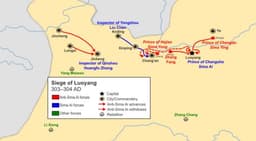
Sima Ying rose during the War of the Eight Princes, a series of civil wars among Jin princes. In 300 CE, Sima Lun, Prince of Zhao, usurped the throne and appointed Sima Ying as crown prince. After Sima Lun's fall, Sima Ying became a leading figure, defeating Sima Yue at the Battle of Yecheng in 303 CE, making him the most powerful prince in the central plains.
Leadership & Governance
Nero's leadership was autocratic and focused on personal indulgence. He neglected administration, leaving it to freedmen like Helius. His fiscal policies were extractive, raising taxes to fund his building projects and spectacles. He debased the currency, reducing the silver content of the denarius by 10%. In contrast, Sima Ying's governance was military-oriented, typical of a warlord. He controlled territory through force, but his political skills were weak, scoring 32.1 in political acumen compared to Nero's 26.4.
Triumph & Tragedy
Nero's greatest 'success' was stabilizing the empire early in his reign, with diplomatic relations with Parthia and a successful campaign in Britain (Boudica's revolt was suppressed in 61 CE). However, his greatest failure was the mismanagement after the Great Fire, leading to the persecution of Christians and widespread resentment. The Revolt of Vindex and Galba in 68 CE forced him to flee and commit suicide.
Sima Ying's triumph was the Battle of Yecheng, where his military score of 45.0 shone. But his defeat and execution by Sima Yue in 306 CE ended his ambition. His failure to secure alliances or maintain political support led to his downfall.
Character & Destiny
Nero was narcissistic and paranoid, ordering the murders of his mother, wife Octavia, and many senators. His artistic pretensions (he performed as a singer and actor) alienated the elite. His destiny was shaped by his inability to govern responsibly; the Praetorian Guard abandoned him, and he died at 30.
Sima Ying was ambitious but politically naive. He trusted Sima Yue, who ultimately betrayed him. His character was that of a military leader, but he lacked the cunning needed in the cutthroat Jin court. His fate was sealed by the shifting alliances of the War of Eight Princes.
Legacy
Nero's legacy is overwhelmingly negative in Western historiography, often depicted as a tyrant and arsonist. However, his influence score of 58.3 reflects his impact on Christian history (persecution) and Roman architecture (Domus Aurea). He is remembered as the last of the Julio-Claudian dynasty.
Sima Ying's legacy is minor, confined to the War of Eight Princes, a conflict that weakened the Jin Dynasty and led to the Sixteen Kingdoms period. His legacy score of 35.8 reflects his limited long-term impact.
Conclusion
Nero had greater impact than Sima Ying, as evidenced by his higher total score of 44.4 versus 38.2. While both were flawed rulers who contributed to instability, Nero's influence on Christian tradition and Roman history is more significant. Sima Ying's role in a brief civil war is less consequential. Therefore, Nero stands as the more impactful figure.
Rankings
🥇
NeroLeader
Mil: 21.2Pol: 26.4Inf: 58.3
44.4
🥈
Sima Ying
Mil: 45.0Pol: 32.1Inf: 44.0
38.2
+6.2 behind
How This Comparison Works
Algorithm
Each figure is scored on 6 dimensions (0—100 scale) based on structured historical data: Military (10%), Political (20%), Influence (20%), Legacy (20%), Leadership (15%), Strategy (15%). The weighted total produces the final ranking.
Data Sources
Scores are computed from structured sub-indicators in the database. Scale factors adjust for era (Ancient ×0.85, Modern ×1.0) and civilization size (Eastern ×1.05, Other ×0.80) to account for differences in population and military scale.
Maximum 3 Figures
Comparisons are limited to 2—3 figures to ensure readability and statistical meaningfulness.
Error Margins
±5 points per dimension — Sub-scores are derived from historical records with inherent uncertainty. Two figures within 5 points on a dimension should be considered roughly equivalent in that area.
Total Score Accuracy
±3 points overall — The weighted combination of 6 dimensions produces a total score with approximately ±3 points of uncertainty. Differences of less than 3 points are not statistically significant— the figures are effectively tied.
Known Limitations
- Historical records are incomplete and uneven across civilizations
- Figures from oral-tradition societies may be underrepresented
- Occupation labels can misclassify multi-role figures
- Scores measure capability and impact, not moral character
- Quantitative scoring is a comparison tool, not absolute truth
Capability Radar
Military (10%) — Battles & Warfare
Battles
10
35
Win Rate
5
30
Expansion
5
10
Political (20%) — Governance & Reform
Reform
20
5
Diplomacy
10
15
Economy
20
10
Influence (20%) — Cultural & Global Reach
Cultural
60
15
Global
60
5
Legacy (20%) — Historical Impact
Historical
70
25
Longevity
70
10
Leadership (15%) — Power & Stability
Tenure
40
20
Stability
10
10
Strategy (15%) — Tactics & Innovation
Strategy
5
25
Tactics
5
30
Reform
5
5
Similar Comparisons
Comments & Discussion
No comments yet. Be the first to share your thoughts!