Loading...
Napoleon Bonaparte vs Soeharto
Napoleon Bonaparte leads by 8.9 pts · 2 figures compared
…

Napoleon Bonaparte
General · Modern
70.9Total
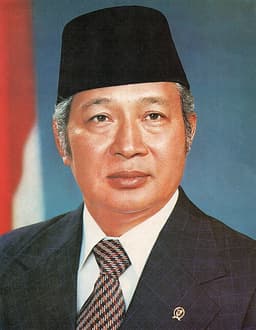
Soeharto
General · Modern
62.0Total
Basic Information
Born
1769
1921
Died
1821
—
Era
Modern
Modern
Nationality
France
Indonesia
Occupation
General
General
Civilization
Western
Eastern
Score Comparison
Military (10%)
94.0
55.0
Political (20%)
72.0
70.0
Influence (20%)
40.0
55.0
Legacy (20%)
80.0
58.0
Leadership (15%)
78.0
78.0
Strategy (15%)
90.0
60.0
TOTAL
70.9
62.0
Napoleon Bonaparte — Complete Timeline
1799 AD
Coup of 18 BrumaireOther◆ Major
Napoleon Bonaparte, with support from his brother Lucien and key political figures, overthrew the Directory in a bloodless coup. He established the Consulate with himself as First Consul, effectively becoming the ruler of France. This event ended the French Revolution's most unstable period.
French RevolutionCoupRise to Power
Impact: regional
1804 AD
Promulgation of the Napoleonic CodeOther◆ Major
Napoleon enacted the Civil Code of the French, known as the Napoleonic Code, a comprehensive set of laws that replaced the fragmented feudal legal systems. The code established legal equality, protected property rights, and secularized law. It became the basis for legal systems in many European and world countries.
Legal ReformNapoleonic CodeCivil Law
Impact: globalconstructive
1805 AD
Battle of AusterlitzWar◆ Major
Napoleon's Grande Arm
Napoleonic WarsBattleDecisive Victory
Impact: global
1812 AD
Invasion of RussiaWar◆ Major
Napoleon led the Grande Arm
Napoleonic WarsInvasionDisaster
Impact: globaldestructive
1815 AD
Battle of WaterlooWar◆ Major
Napoleon's French army was defeated by the combined forces of the Duke of Wellington's Anglo-Allied army and Gebhard Leberecht von Bl
Napoleonic WarsBattleFinal Defeat
Impact: globaldestructive
Soeharto — Complete Timeline
1966 AD
Assumed Power via SupersemarPolitical Action
Soeharto received the Supersemar order from President Sukarno, granting him authority to restore order after the 30 September Movement. This marked the beginning of his rise to power.
Power TransitionSupersemarIndonesia
Impact: national
1967 AD
Inaugurated as Acting PresidentPolitical Action◆ Major
Soeharto was inaugurated as acting president, replacing Sukarno. He formally became president in 1968, beginning the New Order regime that lasted 32 years.
PresidencyNew OrderIndonesia
Impact: national
1975 AD
Invasion of East TimorWar◆ Major
Soeharto ordered the invasion of East Timor following its declaration of independence. The occupation resulted in widespread human rights abuses and an estimated 100,000-200,000 deaths.
InvasionEast TimorHuman Rights
Impact: regionaldestructive
1998 AD
Resignation Amidst Economic CrisisPolitical Action
Soeharto resigned as president after massive protests triggered by the Asian Financial Crisis. His resignation ended the New Order regime and led to democratic reforms.
ResignationCrisisReformasi
Impact: nationaltragic
Expert Analysis
Napoleon Bonaparte vs Soeharto
# The General and the Strongman
On a June evening in 1815, a man in a gray overcoat stood on a muddy field near Waterloo, watching his empire crumble. One hundred and eighty-three years later, on a May morning in 1998, another man in a simple white shirt sat in a Jakarta palace, penning his resignation. Both were generals. Both had ruled nations. But the distance between them was not measured in years alone—it was the chasm between conquering a continent and holding an archipelago in an iron grip.
Origins
Napoleon Bonaparte was born in 1769 on the Mediterranean island of Corsica, a place that had only recently become French. His family was minor nobility, struggling and proud. The young Napoleon devoured books on military history and classical warfare, dreaming of glory. When the French Revolution erupted in 1789, it shattered the old order and opened doors that had been sealed for centuries. For a brilliant artillery officer of modest birth, the timing was everything.
Soeharto was born in 1921 in a small village in central Java, the son of a low-level civil servant. His early life was shaped by poverty and traditional Javanese culture, where hierarchy and obedience were sacred. When the Japanese invaded the Dutch East Indies in 1942, Soeharto joined their military training programs, learning discipline and survival. The Indonesian Revolution that followed gave him a cause, but not a grand vision—he was a man of practical ambition, not ideology.
The difference in their origins is not merely geographic. Napoleon emerged from a revolution that had already destroyed the old world and demanded new men. Soeharto emerged from a colonial struggle that required consolidating power, not remaking civilization.
Rise to Power
Napoleon’s ascent was meteoric. At twenty-four, he drove the British from Toulon. At twenty-six, he crushed a royalist uprising in Paris with a "whiff of grapeshot." At twenty-seven, he led a ragged army across the Alps into Italy and won six battles in a month. Each victory was a stepping stone. By 1799, disillusioned with the corrupt Directory, he staged a coup and made himself First Consul. Five years later, he crowned himself Emperor in Notre Dame.
Soeharto’s rise was slower and more careful. In 1965, Indonesia was in chaos. President Sukarno had tilted toward the Communist Party, and the country was paralyzed by inflation and street violence. On the night of September 30, 1965, leftist officers kidnapped and killed six generals. Soeharto, the commander of the army’s strategic reserve, moved decisively. He crushed the coup attempt, then used it as a pretext to destroy the Communist Party in a bloody purge that killed hundreds of thousands. By March 1966, he had maneuvered Sukarno into signing the Supersemar order, which granted him sweeping powers. He became acting president in 1967, formal president in 1968.
Napoleon seized power through audacity and genius. Soeharto seized power through patience and ruthlessness.
Leadership & Governance
As ruler, Napoleon was a force of nature. He reorganized France’s administration, created the Bank of France, and codified law in the Napoleonic Code, which abolished feudalism and established equality before the law. On the battlefield, he was unsurpassed—his campaigns in Austria, Prussia, and Russia were masterpieces of speed and maneuver. He won sixty battles and lost only seven. His political score of 75 reflects genuine reform, but also a fatal arrogance: he made his brothers kings, alienated allies, and provoked endless war.
Soeharto governed differently. He called his regime the "New Order," and it was built on stability, not glory. He opened Indonesia to foreign investment, achieved self-sufficiency in rice, and presided over decades of economic growth. His military score is low—22.4—because he was not a battlefield commander. But his political score of 69.3 reflects a masterful understanding of power. He built a network of patronage, controlled the military through rotation and retirement, and suppressed dissent with efficient brutality. The 1975 invasion of East Timor, which he ordered, was a brutal act of expansion that killed tens of thousands.
Napoleon governed by inspiration and terror. Soeharto governed by consensus and corruption.
Triumph & Tragedy
Napoleon’s greatest moment was Austerlitz in 1805, where he destroyed a combined Russian and Austrian army with a feigned retreat and a devastating attack on the center. It was the perfect battle. His worst moment was the invasion of Russia in 1812, where he lost half a million men to winter, disease, and guerrilla warfare. He never recovered. Exiled to Elba, he escaped, raised another army, and was defeated at Waterloo in 1815, ending his hundred days.
Soeharto’s greatest achievement was economic transformation. In the 1970s and 1980s, Indonesia’s GDP grew at seven percent annually, lifting millions from poverty. His tragedy was the Asian Financial Crisis of 1997–98, which exposed the cronyism at the heart of his system. The currency collapsed, riots erupted, and students filled the streets. On May 21, 1998, he resigned, ending thirty-two years of rule. He lived another decade in quiet retirement, unrepentant and unpunished.
Napoleon’s fall was dramatic, like a Greek tragedy. Soeharto’s fall was slow, like a dying star.
Character & Destiny
Napoleon was restless, brilliant, and incapable of stopping. "I live only for posterity," he said, and he meant it. He believed in destiny and in his own genius. His personality drove him to conquer, to reform, to gamble. It also drove him to overreach. He could not share power, could not delegate, could not accept limits.
Soeharto was calculating, patient, and deeply suspicious. He trusted no one, not even his own generals. His Javanese worldview emphasized harmony, but also control. He saw power as something to be held, not displayed. He built a system that depended entirely on him, and when he left, it collapsed.
Napoleon’s character was a flame. Soeharto’s was a shadow.
Legacy
Napoleon’s legacy is global. The Napoleonic Code influenced legal systems from Europe to Latin America to the Middle East. His military innovations are still studied. He reshaped nationalism, warfare, and statecraft. But he also left a trail of destruction and a legend that has inspired dictators and democrats alike.
Soeharto’s legacy is more ambiguous. He is remembered in Indonesia as the father of development, but also as a dictator who stole billions and crushed human rights. The occupation of East Timor remains a wound. His scores—Legacy 72.2, Influence 68.8—reflect a leader who transformed his country but left it deeply flawed.
Conclusion
One man conquered Europe and changed the world. The other held an archipelago and changed a nation. Both were generals who became rulers, but their paths diverged like rivers flowing from the same mountain. Napoleon’s ambition was boundless; Soeharto’s was contained. Napoleon sought immortality; Soeharto sought security. In the end, one died in exile on a remote island, the other in a Jakarta mansion. Both remind us that power is a mirror: it reveals not only what a man can achieve, but what he cannot resist.
Rankings
🥇
Napoleon BonaparteLeader
Mil: 94.0Pol: 72.0Inf: 40.0
70.9
🥈
Soeharto
Mil: 55.0Pol: 70.0Inf: 55.0
62.0
+8.9 behind
How This Comparison Works
Algorithm
Each figure is scored on 6 dimensions (0—100 scale) based on structured historical data: Military (10%), Political (20%), Influence (20%), Legacy (20%), Leadership (15%), Strategy (15%). The weighted total produces the final ranking.
Data Sources
Scores are computed from structured sub-indicators in the database. Scale factors adjust for era (Ancient ×0.85, Modern ×1.0) and civilization size (Eastern ×1.05, Other ×0.80) to account for differences in population and military scale.
Maximum 3 Figures
Comparisons are limited to 2—3 figures to ensure readability and statistical meaningfulness.
Error Margins
±5 points per dimension — Sub-scores are derived from historical records with inherent uncertainty. Two figures within 5 points on a dimension should be considered roughly equivalent in that area.
Total Score Accuracy
±3 points overall — The weighted combination of 6 dimensions produces a total score with approximately ±3 points of uncertainty. Differences of less than 3 points are not statistically significant— the figures are effectively tied.
Known Limitations
- Historical records are incomplete and uneven across civilizations
- Figures from oral-tradition societies may be underrepresented
- Occupation labels can misclassify multi-role figures
- Scores measure capability and impact, not moral character
- Quantitative scoring is a comparison tool, not absolute truth
Capability Radar
Military (10%) — Battles & Warfare
Battles
95
35
Win Rate
90
40
Expansion
95
20
Political (20%) — Governance & Reform
Reform
95
55
Diplomacy
80
65
Economy
85
70
Influence (20%) — Cultural & Global Reach
Cultural
85
50
Global
90
55
Legacy (20%) — Historical Impact
Historical
95
60
Longevity
90
55
Leadership (15%) — Power & Stability
Tenure
85
85
Stability
70
75
Strategy (15%) — Tactics & Innovation
Strategy
95
45
Tactics
98
30
Reform
92
60
Similar Comparisons
Comments & Discussion
苏哈托密码6/16/2026
把拿破仑和苏哈托并列,本身就是对历史的暴力肢解。拿破仑是欧洲文明的改造者,民法典至今还是法治基石;苏哈托不过是美国冷战棋盘的傀儡,用“新秩序”掩盖30年屠杀50万人的血腥。他们唯一的共同点?都是强人,但一个是建筑大师,一个是恐吓专家。
The Guns of August6/16/2026
As a military historian, the tactical gulf is staggering. Napoleon mastered rapid maneuver, decisive battles like Austerlitz, and turned artillery into a mobile weapon of shock. Soeharto? His military 'expertise' was in crushing unarmed civilians—the 1991 Santa Cruz massacre exposed his regime's cowardice. One fought empires; the other butchered his own people from a palace.
权力皮影戏6/16/2026
数据不会说谎:拿破仑10年扩张,法国版图从阿尔卑斯到莱茵河,人均寿命短暂下降但理性主义崛起。苏哈托32年统治,印尼GDP从50美元涨到1100美元但家族贪污300亿,人均寿命停滞。一个用革命燃烧历史,一个用腐败冻结社会。成长路径不同,但道德天平早已倾斜。
Historian1446/16/2026
Comparing Napoleon to Soeharto is like comparing a surgical strike to a sledgehammer. Napoleon transformed Europe through the Napoleonic Code, meritocracy, and legal reform—his impact echoes in modern civil law systems. Soeharto just crushed dissent with corruption and military cronies. One built institutions; the other just built his family's fortune. Context matters, but legacy doesn't lie.