Loading...
Napoleon Bonaparte vs Oduduwa
Napoleon Bonaparte leads by 11.2 pts · 2 figures compared
…

Napoleon Bonaparte
General · Modern
70.9Total
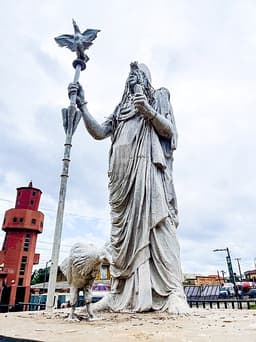
Oduduwa
Emperor · Medieval
59.7Total
Basic Information
Born
1769
950
Died
1821
1020
Era
Modern
Medieval
Nationality
France
Ife
Occupation
General
Emperor
Civilization
Western
Other
Score Comparison
Military (10%)
94.0
50.0
Political (20%)
72.0
46.6
Influence (20%)
40.0
68.0
Legacy (20%)
80.0
68.0
Leadership (15%)
78.0
67.0
Strategy (15%)
90.0
36.8
TOTAL
70.9
59.7
Napoleon Bonaparte — Complete Timeline
1799 AD
Coup of 18 BrumaireOther◆ Major
Napoleon Bonaparte, with support from his brother Lucien and key political figures, overthrew the Directory in a bloodless coup. He established the Consulate with himself as First Consul, effectively becoming the ruler of France. This event ended the French Revolution's most unstable period.
French RevolutionCoupRise to Power
Impact: regional
1804 AD
Promulgation of the Napoleonic CodeOther◆ Major
Napoleon enacted the Civil Code of the French, known as the Napoleonic Code, a comprehensive set of laws that replaced the fragmented feudal legal systems. The code established legal equality, protected property rights, and secularized law. It became the basis for legal systems in many European and world countries.
Legal ReformNapoleonic CodeCivil Law
Impact: globalconstructive
1805 AD
Battle of AusterlitzWar◆ Major
Napoleon's Grande Arm
Napoleonic WarsBattleDecisive Victory
Impact: global
1812 AD
Invasion of RussiaWar◆ Major
Napoleon led the Grande Arm
Napoleonic WarsInvasionDisaster
Impact: globaldestructive
1815 AD
Battle of WaterlooWar◆ Major
Napoleon's French army was defeated by the combined forces of the Duke of Wellington's Anglo-Allied army and Gebhard Leberecht von Bl
Napoleonic WarsBattleFinal Defeat
Impact: globaldestructive
Oduduwa — Complete Timeline
1000 AD
Foundation of the Yoruba civilization at Ile-IfeCultural
According to Yoruba oral tradition, Oduduwa descended from heaven at Ile-Ife and founded the Yoruba civilization. He is credited with establishing the first Yoruba kingdom and the sacred city of Ile-Ife, which became the spiritual and cultural heartland of the Yoruba people.
Impact: regionalconstructive
1010 AD
Establishment of the Yoruba royal dynastiesPolitical Action◆ Major
Oduduwa is said to have sent his sons and grandsons to found the various Yoruba kingdoms, including Oyo, Benin, and Ketu. This act established the royal lineages that ruled these states for centuries, creating a network of related kingdoms under the spiritual authority of the Ooni of Ife.
Impact: regionalconstructive
Expert Analysis
Napoleon Bonaparte vs Oduduwa
# The Emperor and the Progenitor: Napoleon and Oduduwa’s Contrasting Visions of Power
On a June morning in 1815, Napoleon Bonaparte stood on a muddy field near Waterloo, watching his Imperial Guard crumble under British fire. He had conquered Europe from Madrid to Moscow, but now his world was shrinking to a barren island in the South Atlantic. Eight centuries earlier and thousands of miles away, another ruler—Oduduwa of Ife—faced no such dramatic end. According to Yoruba tradition, he simply descended from the sky, founded a civilization, and vanished into legend, leaving behind not a single battlefield but an entire lineage of kings. How could two men who both claimed supreme authority meet fates so different? The answer lies not in their ambitions, which were equally vast, but in the worlds they inhabited and the tools they wielded.
Origins
Napoleon was born in 1769 on Corsica, an island that had just become French. His family was minor nobility, but his world was one of revolution—the French Revolution of 1789 would tear apart the old order and create opportunities for ambitious outsiders. He was shaped by Enlightenment ideas, by the chaos of war, and by a burning need to prove himself to a continent that looked down on Corsicans. His education at military school taught him artillery tactics and the cold calculus of power.
Oduduwa’s origins are shrouded in myth rather than history. Born around 950 in a region that would become modern-day Nigeria, he emerged not from a revolutionary upheaval but from a cosmological drama. Yoruba oral tradition tells that he descended from heaven at Ile-Ife, bringing with him a chain, a palm nut, and a rooster—symbols of connection between the spiritual and earthly realms. Where Napoleon was forged by the gunpowder and pamphlets of a collapsing monarchy, Oduduwa was formed by the rhythms of agricultural society, by lineage and ritual, by the belief that rulers were not elected but chosen by the gods.
Rise to Power
Napoleon’s ascent was a masterpiece of opportunism and violence. In 1793, at age twenty-four, he drove British forces from Toulon with brilliant artillery placement. By 1796, he was commanding the Army of Italy, where his lightning campaigns forced Austria to sue for peace. The turning point came in 1799, when he returned from a failed Egyptian campaign to stage a coup d’état, becoming First Consul of France. He crowned himself Emperor in 1804, taking the crown from the Pope’s hands and placing it on his own head—a gesture that announced his power came from himself, not from God or tradition.
Oduduwa’s rise is told differently. He did not conquer; he founded. At Ile-Ife around 1000, he established the first Yoruba kingdom, not by military might but by spiritual authority. According to tradition, his sons and grandsons were sent to found new kingdoms—Oyo, Benin, Ketu—each becoming a royal dynasty that traced its legitimacy back to him. His power was not won through battles but through bloodline. Where Napoleon seized power, Oduduwa inherited it from the heavens.
Leadership & Governance
Napoleon governed with a mixture of genius and tyranny. His Napoleonic Code, enacted in 1804, standardized French law, abolished feudalism, and established principles of meritocracy and property rights that influenced legal systems worldwide. He reformed education, built roads and canals, and centralized the state. But he also censored the press, suppressed dissent, and spent France’s youth on his battlefields. His military strategy was revolutionary: he used speed, massed artillery, and the corps system to overwhelm enemies, winning victories at Austerlitz (1805) and Jena (1806). Yet his political wisdom was limited by his arrogance—he could conquer but not consolidate, alienating potential allies and creating coalitions against himself.
Oduduwa’s governance was the opposite: slow, ritualistic, and enduring. He established the concept of sacred kingship, where the *Ooni* (ruler) of Ife was both political leader and spiritual intermediary. He created a system of chieftaincies and councils that balanced royal power with noble and priestly influence. His military strategy score of 30 reflects that he was not a warrior in the Napoleonic mold; his power came from legitimacy, not force. The Yoruba kingdoms he founded would last for centuries, while Napoleon’s empire crumbled in fifteen years.
Triumph & Tragedy
Napoleon’s greatest triumph was Austerlitz, where he destroyed a Russo-Austrian army in a single day, forcing the Holy Roman Empire to dissolve. His greatest tragedy was the invasion of Russia in 1812. Marching with 600,000 men, he reached Moscow only to find it burning, then retreated through the winter, losing most of his army. By 1814, he was exiled to Elba. He escaped in 1815, raised another army, and met final defeat at Waterloo. His tragedy was not that he failed, but that his ambition was boundless while his resources were finite.
Oduduwa’s triumph was not a battle but a civilization. He founded a culture that would produce sophisticated bronze sculptures, complex urban planning, and a political system that survived European colonialism. His tragedy, if it can be called that, is that we know him only through myth. No historical records confirm his existence; he is a figure of faith rather than fact. His legacy is powerful but intangible, while Napoleon’s is documented in every archive in Europe.
Character & Destiny
Napoleon was driven by an insatiable need for glory. “I am not a man,” he once said, “but a thing—a thing of destiny.” His personality—brilliant, impatient, charismatic, tyrannical—shaped every decision. He could not stop conquering because he could not imagine a world where he was not the center. This hubris led to his downfall. Oduduwa, by contrast, is portrayed as a founder, not a conqueror. His personality is serene, paternal, divine. He did not need to fight because his authority was unquestioned. Their destinies reflected their characters: Napoleon died alone on Saint Helena, exiled and bitter; Oduduwa passed into legend, his name synonymous with the beginning of a people.
Legacy
Napoleon’s legacy is a contradiction. He spread revolutionary ideals of nationalism and meritocracy across Europe, but also inspired militarism and dictatorship. His legal codes remain influential; his military tactics are still studied. Yet his name is associated with both glory and disaster. His scores—Military 94, Political 75, Influence 82—reflect a man who changed the world but could not control the change.
Oduduwa’s legacy is quieter but deeper. Every Yoruba king today traces his lineage to Oduduwa. The *Ooni* of Ife is still considered a sacred ruler. His influence score of 69.2 and legacy score of 69.9 underestimate his impact because they measure Western metrics of power. In West Africa, he is not a historical figure to be scored; he is the father of a civilization.
Conclusion
Napoleon and Oduduwa represent two poles of human ambition. One sought to remake the world through force and law; the other through lineage and spirit. Napoleon’s story is a warning about the limits of will; Oduduwa’s is a testament to the power of myth. In the end, the emperor who conquered Europe left behind a corpse on an island, while the progenitor who descended from the sky left behind a people. Perhaps the deepest difference is this: Napoleon wanted to be remembered; Oduduwa wanted to be forgotten in the service of something larger. One got his wish; the other got eternity.
Rankings
🥇
Napoleon BonaparteLeader
Mil: 94.0Pol: 72.0Inf: 40.0
70.9
🥈
Oduduwa
Mil: 50.0Pol: 46.6Inf: 68.0
59.7
+11.2 behind
How This Comparison Works
Algorithm
Each figure is scored on 6 dimensions (0—100 scale) based on structured historical data: Military (10%), Political (20%), Influence (20%), Legacy (20%), Leadership (15%), Strategy (15%). The weighted total produces the final ranking.
Data Sources
Scores are computed from structured sub-indicators in the database. Scale factors adjust for era (Ancient ×0.85, Modern ×1.0) and civilization size (Eastern ×1.05, Other ×0.80) to account for differences in population and military scale.
Maximum 3 Figures
Comparisons are limited to 2—3 figures to ensure readability and statistical meaningfulness.
Error Margins
±5 points per dimension — Sub-scores are derived from historical records with inherent uncertainty. Two figures within 5 points on a dimension should be considered roughly equivalent in that area.
Total Score Accuracy
±3 points overall — The weighted combination of 6 dimensions produces a total score with approximately ±3 points of uncertainty. Differences of less than 3 points are not statistically significant— the figures are effectively tied.
Known Limitations
- Historical records are incomplete and uneven across civilizations
- Figures from oral-tradition societies may be underrepresented
- Occupation labels can misclassify multi-role figures
- Scores measure capability and impact, not moral character
- Quantitative scoring is a comparison tool, not absolute truth
Capability Radar
Military (10%) — Battles & Warfare
Battles
95
10
Win Rate
90
10
Expansion
95
30
Political (20%) — Governance & Reform
Reform
95
50
Diplomacy
80
40
Economy
85
40
Influence (20%) — Cultural & Global Reach
Cultural
85
80
Global
90
70
Legacy (20%) — Historical Impact
Historical
95
80
Longevity
90
80
Leadership (15%) — Power & Stability
Tenure
85
40
Stability
70
50
Strategy (15%) — Tactics & Innovation
Strategy
95
10
Tactics
98
10
Reform
92
10
Similar Comparisons
Comments & Discussion
SABRE_RATTLER6/16/2026
Waterloo buff here. Napoleon's fatal flaw wasn't hubris—it was refusing to delegate command. At Waterloo, he micromanaged Ney's cavalry charges while Grouchy's 33,000 men sat idle three miles away. Meanwhile, Oduduwa's entire mythos screams: "Delegation is divinity." Yoruba oral tradition says Oduduwa descended with a chain and cockerel—but the real power move was founding a council of chiefs. Napoleon died alone on St. Helena; Oduduwa's legacy governs millions still. One trusted no one, the oth
铁血考据党6/16/2026
少谈神话多查碳测。Oduduwa在950年左右活跃?对不起,伊费最早的城市地层碳十四数据集中在1000-1200年,更早的“天空降临”纯属信仰叙事。拿破仑的军衔、战役、法律都有白纸黑字,尸骨验过两回。拿一个传说人物跟实证史学家硬比,这叫文明降级打击。建议先把奥杜杜瓦的青铜头像送去牛津做热释光测年,再谈谁是“文明奠基人”。