Loading...
Nahapana vs Napoleon Bonaparte
Napoleon Bonaparte leads by 28.9 pts · 2 figures compared
…
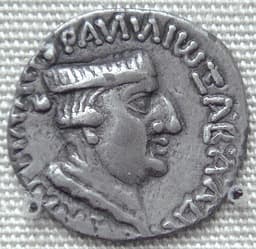
Nahapana
Emperor · Ancient
42.0Total

Napoleon Bonaparte
General · Modern
70.9Total
Basic Information
Born
33
1769
Died
78
1821
Era
Ancient
Modern
Nationality
India
France
Occupation
Emperor
General
Civilization
Indian
Western
Score Comparison
Military (10%)
46.7
94.0
Political (20%)
30.8
72.0
Influence (20%)
45.5
40.0
Legacy (20%)
36.7
80.0
Leadership (15%)
55.3
78.0
Strategy (15%)
38.3
90.0
TOTAL
42.0
70.9
Nahapana — Complete Timeline
50 AD
Expanded Kshaharata TerritoryWar◆ Major
Nahapana expanded the Kshaharata kingdom by conquering parts of Gujarat, Malwa, and the Deccan. He defeated local rulers and established control over a large area, making his kingdom a major power in western India.
ConquestExpansionKshaharata
Impact: regional
55 AD
Issued Coins with Brahmi and Greek ScriptsCultural
Nahapana issued silver and copper coins featuring his name in Brahmi and Greek scripts. These coins were widely circulated and influenced later Satavahana coinage, reflecting cultural syncretism.
CoinageCultural SyncretismTrade
Impact: regionalconstructive
60 AD
Controlled Major Trade RoutesOther◆ Major
Nahapana's kingdom controlled key trade routes connecting the Deccan to the western coast, including the port of Bharuch. He issued coins and facilitated trade with the Roman Empire, amassing significant wealth.
TradeCoinageWealth
Impact: regional
78 AD
Defeated by Gautamiputra SatakarniWar
Nahapana, the Kshaharata Shaka ruler, was decisively defeated by the Satavahana king Gautamiputra Satakarni. The battle ended Nahapana's rule and resulted in the Satavahanas reclaiming territories in the Deccan and western India.
DefeatSatavahanaEnd of Reign
Impact: regionaltragic
Napoleon Bonaparte — Complete Timeline
1799 AD
Coup of 18 BrumaireOther◆ Major
Napoleon Bonaparte, with support from his brother Lucien and key political figures, overthrew the Directory in a bloodless coup. He established the Consulate with himself as First Consul, effectively becoming the ruler of France. This event ended the French Revolution's most unstable period.
French RevolutionCoupRise to Power
Impact: regional
1804 AD
Promulgation of the Napoleonic CodeOther◆ Major
Napoleon enacted the Civil Code of the French, known as the Napoleonic Code, a comprehensive set of laws that replaced the fragmented feudal legal systems. The code established legal equality, protected property rights, and secularized law. It became the basis for legal systems in many European and world countries.
Legal ReformNapoleonic CodeCivil Law
Impact: globalconstructive
1805 AD
Battle of AusterlitzWar◆ Major
Napoleon's Grande Arm
Napoleonic WarsBattleDecisive Victory
Impact: global
1812 AD
Invasion of RussiaWar◆ Major
Napoleon led the Grande Arm
Napoleonic WarsInvasionDisaster
Impact: globaldestructive
1815 AD
Battle of WaterlooWar◆ Major
Napoleon's French army was defeated by the combined forces of the Duke of Wellington's Anglo-Allied army and Gebhard Leberecht von Bl
Napoleonic WarsBattleFinal Defeat
Impact: globaldestructive
Expert Analysis
nahapana-vs-napoleon-bonaparte
# The Conqueror's Mirror
On a June morning in 1815, Napoleon Bonaparte watched his imperial guard march toward the ridge of Mont-Saint-Jean, their bearskin caps bobbing like a dark tide. He had gambled everything on this single battle, and he was losing. Half a world away and eighteen centuries earlier, another emperor—Nahapana of the Kshaharata Shakas—faced his own Waterloo on a dusty plain in western India. The Satavahana king Gautamiputra Satakarni was closing in, and Nahapana's silver coins, stamped with his name in Brahmi and Greek, would soon be melted down and restruck in the name of his conqueror. Both men rose from obscurity to build empires. Both fell to a single, crushing defeat. Why did one become a legend while the other faded into a footnote?
Origins
Napoleon was born in 1769 on the island of Corsica, a rocky outcrop of Mediterranean ambition that had only recently become French. His family was minor nobility, but in the volatile years before the French Revolution, that title meant little more than a coat of arms and a thin purse. He attended military school in mainland France, where classmates mocked his Corsican accent and provincial manners. The revolution that erupted in 1789 cracked open the old order, and Napoleon—hungry, brilliant, and ruthless—slipped through the fissure.
Nahapana's origins are murkier. He was a Shaka, a descendant of Central Asian nomads who had swept into India centuries earlier and settled in the west. By the year 33 CE, when he likely assumed power, the Shakas had become Indianized rulers, patrons of trade and Buddhism. Nahapana inherited a kingdom that was already wealthy from the monsoon-driven commerce of the Arabian Sea. But he was not born to a throne that anyone in Delhi or Pataliputra would have recognized as legitimate. He was a foreigner in a land of ancient dynasties, and that insecurity shaped everything he did.
Rise to Power
Napoleon rose through sheer velocity. By 1796, at age twenty-six, he commanded the French army in Italy and won a string of victories that made him a national hero. He was not just a general; he was a political phenomenon. In 1799, he overthrew the Directory in a coup and made himself First Consul. Five years later, he crowned himself emperor in Notre Dame, taking the crown from the pope's hands and placing it on his own head—a gesture that said everything about his belief in self-made destiny.
Nahapana's ascent was slower and more commercial. Around the year 50, he expanded the Kshaharata territory by conquering parts of Gujarat, Malwa, and the Deccan, defeating local rulers who could not match his cavalry or his coinage. But his real power came from controlling trade routes. His kingdom commanded the port of Bharuch, a gateway for spices, textiles, and Roman gold flowing into India. He issued silver and copper coins in both Brahmi and Greek scripts—a bilingual gesture that signaled his reach to both Indian merchants and Hellenistic traders from the west. By 60, he was the richest man in western India.
Leadership & Governance
Napoleon governed with the same energy he brought to battle. He reformed French law into the Napoleonic Code, a system of civil rights and property protections that spread across Europe. He built roads, standardized education, and centralized the state. But he also made enemies. He crowned his brothers kings, placed his marshals on thrones, and treated Europe like a chessboard where every piece was his to move.
Nahapana governed through a lighter touch. His inscriptions record grants to Buddhist monasteries and Jain temples, suggesting a ruler who bought loyalty through patronage rather than fear. He minted coins with such consistent purity that they became a trusted currency across the region—a kind of ancient credit rating. But his military was not built for conquest on Napoleon's scale. His power was economic, not ideological. When Gautamiputra Satakarni—a Satavahana king from the Deccan who styled himself "destroyer of the Shakas"—marched against him, Nahapana's army was outmaneuvered.
Triumph & Tragedy
Napoleon's greatest moment was Austerlitz in 1805, where he crushed the combined armies of Russia and Austria in a single day. His greatest tragedy was the invasion of Russia in 1812, where 600,000 men marched east and only a fraction returned. He was exiled to Elba, escaped, raised another army, and met his end at Waterloo on June 18, 1815. The tragedy was not that he lost—it was that he could not stop.
Nahapana's tragedy was simpler. In 78 CE, after decades of careful rule, he was decisively defeated by Gautamiputra Satakarni in a battle that ended his dynasty. His coins were restruck, his inscriptions defaced, his name erased from the political map of India. He did not return from exile. He did not raise another army. He vanished.
Character & Destiny
Napoleon was driven by an insatiable hunger for glory. "I am the successor, not of Louis XIV, but of Charlemagne," he once said. He believed that history was a stage and he was its lead actor. This ambition made him great, but it also made him blind. He could not consolidate his victories because he always needed the next one.
Nahapana was a builder, not a conqueror. He minted coins, controlled trade, and patronized religions. But he lacked the military genius to defend what he built. His scores tell the story: a political score of 42.7 and a leadership score of 40.5, compared to Napoleon's 75.0 and 80.0. He was a competent ruler in an age of predators, and that was not enough.
Legacy
Napoleon's legacy is everywhere. The Napoleonic Code underpins the legal systems of dozens of countries. His campaigns are studied in military academies. His name is synonymous with ambition and disaster. Even in defeat, he shaped the modern world.
Nahapana's legacy is more fragile. His coins survive in museum cases, their bilingual legends a puzzle for numismatists. His name appears in a few inscriptions, mostly as the man who lost to Gautamiputra. His influence score of 62.3 is respectable for a regional ruler, but his legacy score of 49.8 reflects the truth: he was forgotten by everyone except scholars.
Conclusion
The difference between Napoleon and Nahapana is not simply one of scale or talent. It is a difference of context. Napoleon rose in a Europe that was inventing nationalism, mass armies, and the modern state. He failed, but his failure was epic enough to be remembered. Nahapana ruled in an ancient world where empires rose and fell like monsoon rains, and the names of the fallen were washed away. Both men built kingdoms on the edge of a sword. But one sword left a scar that still aches, while the other was melted down and restruck into coins that no one spends. In the end, history is not kind to those who merely manage what they inherit. It remembers only those who reach for what they cannot hold.
Rankings
🥇
Napoleon BonaparteLeader
Mil: 94.0Pol: 72.0Inf: 40.0
70.9
🥈
Nahapana
Mil: 46.7Pol: 30.8Inf: 45.5
42.0
+28.9 behind
How This Comparison Works
Algorithm
Each figure is scored on 6 dimensions (0—100 scale) based on structured historical data: Military (10%), Political (20%), Influence (20%), Legacy (20%), Leadership (15%), Strategy (15%). The weighted total produces the final ranking.
Data Sources
Scores are computed from structured sub-indicators in the database. Scale factors adjust for era (Ancient ×0.85, Modern ×1.0) and civilization size (Eastern ×1.05, Other ×0.80) to account for differences in population and military scale.
Maximum 3 Figures
Comparisons are limited to 2—3 figures to ensure readability and statistical meaningfulness.
Error Margins
±5 points per dimension — Sub-scores are derived from historical records with inherent uncertainty. Two figures within 5 points on a dimension should be considered roughly equivalent in that area.
Total Score Accuracy
±3 points overall — The weighted combination of 6 dimensions produces a total score with approximately ±3 points of uncertainty. Differences of less than 3 points are not statistically significant— the figures are effectively tied.
Known Limitations
- Historical records are incomplete and uneven across civilizations
- Figures from oral-tradition societies may be underrepresented
- Occupation labels can misclassify multi-role figures
- Scores measure capability and impact, not moral character
- Quantitative scoring is a comparison tool, not absolute truth
Capability Radar
Military (10%) — Battles & Warfare
Battles
30
95
Win Rate
20
90
Expansion
35
95
Political (20%) — Governance & Reform
Reform
20
95
Diplomacy
25
80
Economy
30
85
Influence (20%) — Cultural & Global Reach
Cultural
20
85
Global
10
90
Legacy (20%) — Historical Impact
Historical
25
95
Longevity
15
90
Leadership (15%) — Power & Stability
Tenure
40
85
Stability
30
70
Strategy (15%) — Tactics & Innovation
Strategy
25
95
Tactics
25
98
Reform
15
92
Similar Comparisons
Comments & Discussion
SkepticalSphinx6/17/2026
This comparison is a reach. Sure, both lost one big battle, but framing Napoleon and Nahapana as mirror images ignores scale—Napoleon commanded armies of 500,000 across Europe; Nahapana ruled a few coastal ports in Gujarat. Calling Nahapana an “emperor” inflates his rank. The real story is how Western historiography elevates European failures while Indian ones get erased. Not a mirror—just a trick of the light.
数据侦探6/17/2026
拿拿破仑跟纳哈帕纳比?搞笑吧。拿破仑打了六十多场仗,输了滑铁卢就被捧成悲剧英雄;纳哈帕纳输给萨塔卡尼一次,连名字都快没人记得。再说,纳哈帕纳的钱币上刻着希腊文和婆罗米文,说明他靠贸易而不是军力统治。你要非说两者都是“一败定终身”,那只能暴露你对古印度结构的无知。数据不撒谎:纳哈帕纳的帝国本来就薄得像张纸。
ClassicsCorner6/17/2026
Nahapana's defeat is far more culturally resonant than Napoleon's. When Gautamiputra Satakarni melted down Nahapana's coins, he wasn't just winning—he was reasserting Sanskritic civilization over Indo-Greek influence. Napoleon's fall rearranged borders; Nahapana's fall reshaped identity. Plus, Kshaharata rule left traces in Jain texts; Napoleon left memoirs. One legacy is literary, the other bureaucratic. I'll take the poetic footnote over the overwritten legend any day.
文史老饕6/17/2026
说句实话,滑铁卢大家都知道,纳哈帕纳的“Waterloo”——可能就是今天的包纳加尔附近——谁在乎?可恰恰是这种忽视让我更爱这个故事。纳哈帕纳的钱币上同时有希腊文、婆罗米文,他的统治是“西徐亚-印度”混血的活标本。拿破仑的失败改变欧洲地图,纳哈帕纳的失败却抹掉了一个文明断层。一个写满教科书,一个藏在考古柜里。我选后者,因为它神秘得多。
RevisionistRevolt6/17/2026
Stop romanticizing defeat. Neither man was a tragic hero—Napoleon restored slavery, Nahapana was a foreign invader who squeezed taxes from local farmers. The comparison fetishizes their downfalls while ignoring the civilians crushed under both. I'd trade every story about Mont-Saint-Jean for one account of a Gujarati village under Shaka rule. History loves a loser with a good PR team, and both had one. But their victims never got a voice.