Loading...
This comparison has not been analyzed yet.
One-time AI generation (~1 minute). Scores and timeline are already available below.
Myint Swe vs Sani Abacha
Sani Abacha leads by 1.7 pts · 2 figures compared
…
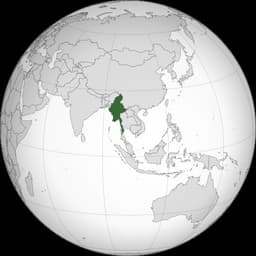
Myint Swe
General · Modern
35.3Total

Sani Abacha
General · Modern
37.0Total
Basic Information
Born
1951
1943
Died
—
—
Era
Modern
Modern
Nationality
Myanmar
Nigeria
Occupation
General
General
Civilization
Eastern
Other
Score Comparison
Military (10%)
10.2
22.6
Political (20%)
26.4
26.4
Influence (20%)
47.1
47.9
Legacy (20%)
37.5
36.7
Leadership (15%)
34.6
47.3
Strategy (15%)
39.6
25.0
TOTAL
35.3
37.0
Myint Swe — Complete Timeline
2016 AD
Appointed as Vice President of MyanmarPolitical Action◆ Major
Myint Swe was appointed as First Vice President of Myanmar under President Htin Kyaw, representing the military's interests. His appointment was part of the power-sharing arrangement following the 2015 elections that brought the NLD to power.
Myanmar PoliticsMilitaryPower Sharing
Impact: national
2021 AD
Assumed Acting Presidency After CoupPolitical Action
Following the February 1 military coup that detained elected leaders, Myint Swe was appointed acting president by the military. He delegated his powers to coup leader Min Aung Hlaing, legitimizing the junta's takeover and triggering widespread civil disobedience.
CoupMilitary JuntaConstitutional Crisis
Impact: nationaldestructive
Declared State of EmergencyPolitical Action◆ Major
As acting president, Myint Swe declared a one-year state of emergency, granting the military full legislative, executive, and judicial powers. This declaration suspended the constitution and enabled the junta to suppress pro-democracy protests violently.
State of EmergencyRepressionConstitution
Impact: nationaldestructive
Sani Abacha — Complete Timeline
1993 AD
1993 Nigerian coup d'étatPolitical Action
General Sani Abacha seized power in a coup, overthrowing the interim government of Ernest Shonekan. Abacha cited the need to restore order after the political crisis following the annulled 1993 election.
CoupMilitary RuleAbacha
Impact: nationaldestructive
1994 AD
Suppression of political oppositionPolitical Action◆ Major
Abacha's regime arrested and detained numerous political opponents, including former head of state Olusegun Obasanjo and his deputy Shehu Musa Yar'Adua, who were accused of plotting a coup. The crackdown consolidated Abacha's authoritarian rule.
RepressionPolitical PrisonersAuthoritarianism
Impact: nationaldestructive
1995 AD
Execution of Ken Saro-WiwaPolitical Action◆ Major
Abacha's regime executed writer and environmental activist Ken Saro-Wiwa and eight other Ogoni activists after a controversial trial. The execution drew international condemnation and led to Nigeria's suspension from the Commonwealth.
ExecutionHuman RightsInternational Condemnation
Impact: globaltragic
1998 AD
Transition to civilian rule programPolitical Action◆ Major
Abacha initiated a transition program to civilian rule, with himself as the sole presidential candidate. The program was widely seen as a sham to legitimize his continued rule. It ended abruptly with his death.
TransitionCivilian RuleSham
Impact: nationaldestructive
Death of Sani AbachaOther
Abacha died suddenly at the age of 54, officially from a heart attack. His death ended his five-year dictatorship and opened the door for a transition to civilian rule in Nigeria.
DeathDictatorshipTransition
Impact: national
This comparison has not been analyzed yet.
One-time AI generation (~1 minute). Scores and timeline are already available below.
Rankings
🥇
Sani AbachaLeader
Mil: 22.6Pol: 26.4Inf: 47.9
37.0
🥈
Myint Swe
Mil: 10.2Pol: 26.4Inf: 47.1
35.3
+1.7 behind
How This Comparison Works
Algorithm
Each figure is scored on 6 dimensions (0—100 scale) based on structured historical data: Military (10%), Political (20%), Influence (20%), Legacy (20%), Leadership (15%), Strategy (15%). The weighted total produces the final ranking.
Data Sources
Scores are computed from structured sub-indicators in the database. Scale factors adjust for era (Ancient ×0.85, Modern ×1.0) and civilization size (Eastern ×1.05, Other ×0.80) to account for differences in population and military scale.
Maximum 3 Figures
Comparisons are limited to 2—3 figures to ensure readability and statistical meaningfulness.
Error Margins
±5 points per dimension — Sub-scores are derived from historical records with inherent uncertainty. Two figures within 5 points on a dimension should be considered roughly equivalent in that area.
Total Score Accuracy
±3 points overall — The weighted combination of 6 dimensions produces a total score with approximately ±3 points of uncertainty. Differences of less than 3 points are not statistically significant— the figures are effectively tied.
Known Limitations
- Historical records are incomplete and uneven across civilizations
- Figures from oral-tradition societies may be underrepresented
- Occupation labels can misclassify multi-role figures
- Scores measure capability and impact, not moral character
- Quantitative scoring is a comparison tool, not absolute truth
Capability Radar
Military (10%) — Battles & Warfare
Battles
5
10
Win Rate
5
10
Expansion
5
5
Political (20%) — Governance & Reform
Reform
5
5
Diplomacy
10
15
Economy
5
10
Influence (20%) — Cultural & Global Reach
Cultural
5
5
Global
5
10
Legacy (20%) — Historical Impact
Historical
10
15
Longevity
5
5
Leadership (15%) — Power & Stability
Tenure
15
40
Stability
5
5
Strategy (15%) — Tactics & Innovation
Strategy
10
15
Tactics
10
15
Reform
5
5
Similar Comparisons
Comments & Discussion
No comments yet. Be the first to share your thoughts!