Loading...
Mustafa Kemal Ataturk vs Trajan
Mustafa Kemal Ataturk leads by 4.0 pts · 2 figures compared
…
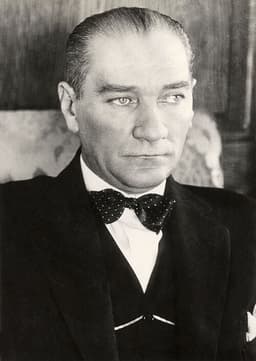
Mustafa Kemal Ataturk
Politician · Modern
80.0Total

Trajan
Emperor · Ancient
76.0Total
Basic Information
Born
1881
53
Died
1938
117
Era
Modern
Ancient
Nationality
Turkey
Roman Empire
Occupation
Politician
Emperor
Civilization
Middle Eastern
Western
Score Comparison
Military (10%)
75.0
86.0
Political (20%)
85.0
79.2
Influence (20%)
75.0
82.0
Legacy (20%)
90.0
65.6
Leadership (15%)
80.0
73.2
Strategy (15%)
65.0
76.0
TOTAL
80.0
76.0
Mustafa Kemal Ataturk — Complete Timeline
1915 AD
Battle of GallipoliWar
As a colonel, Mustafa Kemal commanded Ottoman forces at Gallipoli, successfully repelling Allied landings. His leadership at critical points like Chunuk Bair made him a national hero and laid the foundation for his political career.
World War IOttoman EmpireMilitary Victory
Impact: regional
1919 AD
Turkish War of IndependenceWar
Kemal organized and led the Turkish National Movement against the Allied occupation of Anatolia and the Treaty of S
Independence WarNational MovementAnkara
Impact: nationalconstructive
1922 AD
Abolition of the SultanatePolitical Action◆ Major
The Grand National Assembly of Turkey, under Kemal's leadership, abolished the Ottoman Sultanate, ending 600 years of imperial rule. This severed the link with the old regime and paved the way for the proclamation of the Republic.
SultanateRepublicPolitical Reform
Impact: nationalprogressive
1923 AD
Proclamation of the Republic of TurkeyPolitical Action
Kemal declared Turkey a republic, becoming its first president. He moved the capital to Ankara and initiated a series of radical reforms to modernize and secularize the state, including the adoption of a new legal code and the Latin alphabet.
RepublicModernizationSecularism
Impact: globalprogressive
1925 AD
Adoption of the Hat LawReform◆ Major
Kemal introduced the Hat Law, banning the fez and encouraging Western-style hats. This was part of his broader cultural revolution to secularize and Westernize Turkish society, symbolizing the break with Ottoman traditions.
Cultural ReformSecularismWesternization
Impact: nationalprogressive
1934 AD
Granting of Women's SuffrageReform◆ Major
Kemal's government granted women the right to vote and stand for election in national elections, ahead of many European countries. This reform was part of his commitment to gender equality and modernization of Turkish society.
Women's RightsSuffrageModernization
Impact: nationalprogressive
Trajan — Complete Timeline
101 AD
Implemented the Alimenta Welfare ProgramReform◆ Major
Trajan expanded the Alimenta program, a state-funded welfare system that provided food subsidies and educational support for poor children in Italy. The program used interest from state loans to landowners to fund the distributions, aiming to boost the Italian population and agricultural economy.
WelfareSocial PolicyItaly
Impact: regionalconstructive
105 AD
Built Trajan's Bridge over the DanubeOther
Trajan ordered the construction of a massive stone and timber bridge across the Danube River near the Iron Gates. Designed by Apollodorus of Damascus, it was the longest arch bridge in the world for over a millennium, facilitating the Roman invasion of Dacia.
EngineeringBridgeDanube
Impact: regionalconstructive
106 AD
Conquered DaciaWar
Trajan led two major campaigns against the Dacian kingdom under King Decebalus, culminating in the conquest of Dacia (modern Romania) in 106 CE. The victory brought vast gold and silver mines under Roman control and established a new province, funding massive building projects in Rome.
DaciaConquestProvince
Impact: regional
112 AD
Built Trajan's Forum and MarketCultural◆ Major
Trajan commissioned the construction of Trajan's Forum, a vast complex in Rome including a basilica, libraries, and the Column of Trajan. The adjacent Trajan's Market, a multi-level commercial center, demonstrated Roman engineering prowess and served as a model for urban planning.
ArchitectureRomeUrban Planning
Impact: globalconstructive
116 AD
Conquered Parthia and Reached the Persian GulfWar◆ Major
Trajan launched a campaign against the Parthian Empire, capturing its capital Ctesiphon and annexing Mesopotamia. He reached the Persian Gulf, marking the easternmost extent of Roman territory. However, rebellions in the conquered territories forced a withdrawal shortly after.
ParthiaMesopotamiaExpansion
Impact: global
Expert Analysis
Origins
Mustafa Kemal Atatürk (1881–1938) was born in Salonika, then part of the Ottoman Empire, to a modest family. His father was a customs officer, and his mother a devout Muslim. He attended military schools, showing early aptitude for mathematics and leadership. Trajan (53–117 CE) was born in Italica, Spain, into a prominent Roman family. His father was a senator and governor, providing him with a privileged path into the Roman military and political elite. Atatürk's origins were humble, while Trajan's were aristocratic, shaping their different approaches to leadership.
Rise to Power
Atatürk rose through the Ottoman military, distinguishing himself at the Battle of Gallipoli (1915), where he repelled Allied forces. After WWI, he led the Turkish War of Independence (1919–1923) against occupying powers, culminating in the proclamation of the Republic of Turkey (1923). Trajan's rise was smoother: adopted by Emperor Nerva in 97 CE, he succeeded him in 98 CE, acclaimed by the Senate and army. His early military campaigns in Germania secured his reputation. Atatürk's rise was revolutionary, Trajan's dynastic.
Leadership & Governance
Atatürk implemented radical reforms: abolished the sultanate (1922), adopted secular laws, introduced the Latin alphabet, granted women suffrage, and promoted industrialization. His governance was autocratic yet transformative, earning him a score of L=90. Trajan expanded Rome to its greatest extent, conquering Dacia (106 CE) and Parthia (116 CE). He built public works like Trajan's Forum and implemented the Alimenta welfare program for orphans. His rule was efficient but less transformative culturally. Trajan scores L=66, reflecting his military focus over institutional change.
Triumph & Tragedy
Atatürk's greatest triumph was forging a modern, independent Turkey from the ashes of empire. His tragedy was his early death from cirrhosis at 57, leaving some reforms incomplete. Trajan's triumph was the Dacian conquest and vast territorial expansion. His tragedy was overextension; his Parthian gains were soon lost after his death, and his bridge over the Danube was dismantled. Both faced mortality, but Atatürk's legacy endured more durably.
Character & Destiny
Atatürk was charismatic, visionary, and disciplined, with a destiny to modernize Turkey. He was pragmatic yet ruthless in suppressing opposition. Trajan was known for his justice, humility, and military prowess—the "optimus princeps." He was beloved by the army and Senate. Atatürk's character was more driven by ideology, Trajan's by duty and conquest. Their destinies were shaped by their eras: Atatürk in a post-imperial nationalist age, Trajan in Rome's golden age.
Legacy
Atatürk's legacy is monumental: modern Turkey, secularism, and national identity. His reforms remain foundational, with scores: M=75, P=85, I=75, L=90, D=80, S=65, T=80. Trajan's legacy includes Rome's maximum extent, architectural marvels, and a reputation as a good emperor. His scores: M=86, P=79, I=82, L=66, D=73, S=76, T=76. Atatürk's transformative impact on a nation's culture and governance gives him a higher overall score (gap 4.0).
Conclusion
Both leaders achieved greatness in their domains. Atatürk's profound cultural and political restructuring of Turkey arguably surpasses Trajan's territorial expansions, as Atatürk's changes have persisted for a century. Trajan's empire crumbled, but Atatürk's nation thrives. Thus, Mustafa Kemal Atatürk is the greater leader in terms of lasting influence and societal transformation.
Rankings
🥇
Mustafa Kemal AtaturkLeader
Mil: 75.0Pol: 85.0Inf: 75.0
80.0
🥈
Trajan
Mil: 86.0Pol: 79.2Inf: 82.0
76.0
+4.0 behind
How This Comparison Works
Algorithm
Each figure is scored on 6 dimensions (0—100 scale) based on structured historical data: Military (10%), Political (20%), Influence (20%), Legacy (20%), Leadership (15%), Strategy (15%). The weighted total produces the final ranking.
Data Sources
Scores are computed from structured sub-indicators in the database. Scale factors adjust for era (Ancient ×0.85, Modern ×1.0) and civilization size (Eastern ×1.05, Other ×0.80) to account for differences in population and military scale.
Maximum 3 Figures
Comparisons are limited to 2—3 figures to ensure readability and statistical meaningfulness.
Error Margins
±5 points per dimension — Sub-scores are derived from historical records with inherent uncertainty. Two figures within 5 points on a dimension should be considered roughly equivalent in that area.
Total Score Accuracy
±3 points overall — The weighted combination of 6 dimensions produces a total score with approximately ±3 points of uncertainty. Differences of less than 3 points are not statistically significant— the figures are effectively tied.
Known Limitations
- Historical records are incomplete and uneven across civilizations
- Figures from oral-tradition societies may be underrepresented
- Occupation labels can misclassify multi-role figures
- Scores measure capability and impact, not moral character
- Quantitative scoring is a comparison tool, not absolute truth
Capability Radar
Military (10%) — Battles & Warfare
Battles
85
95
Win Rate
90
98
Expansion
60
95
Political (20%) — Governance & Reform
Reform
98
88
Diplomacy
85
85
Economy
75
90
Influence (20%) — Cultural & Global Reach
Cultural
90
85
Global
80
85
Legacy (20%) — Historical Impact
Historical
95
90
Longevity
85
88
Leadership (15%) — Power & Stability
Tenure
85
90
Stability
70
92
Strategy (15%) — Tactics & Innovation
Strategy
85
92
Tactics
88
88
Reform
80
85
Similar Comparisons
Comments & Discussion
No comments yet. Be the first to share your thoughts!