Loading...
Mustafa Kemal Ataturk vs Theodosius I
Mustafa Kemal Ataturk leads by 4.0 pts · 2 figures compared
…
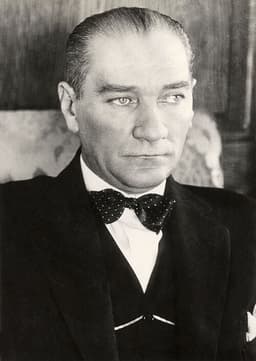
Mustafa Kemal Ataturk
Politician · Modern
80.0Total

Theodosius I
Emperor · Ancient
76.0Total
Basic Information
Born
1881
347
Died
1938
395
Era
Modern
Ancient
Nationality
Turkey
Roman Empire
Occupation
Politician
Emperor
Civilization
Middle Eastern
Western
Score Comparison
Military (10%)
75.0
72.5
Political (20%)
85.0
65.0
Influence (20%)
75.0
85.0
Legacy (20%)
90.0
90.0
Leadership (15%)
80.0
68.0
Strategy (15%)
65.0
50.0
TOTAL
80.0
76.0
Mustafa Kemal Ataturk — Complete Timeline
1915 AD
Battle of GallipoliWar
As a colonel, Mustafa Kemal commanded Ottoman forces at Gallipoli, successfully repelling Allied landings. His leadership at critical points like Chunuk Bair made him a national hero and laid the foundation for his political career.
World War IOttoman EmpireMilitary Victory
Impact: regional
1919 AD
Turkish War of IndependenceWar
Kemal organized and led the Turkish National Movement against the Allied occupation of Anatolia and the Treaty of S
Independence WarNational MovementAnkara
Impact: nationalconstructive
1922 AD
Abolition of the SultanatePolitical Action◆ Major
The Grand National Assembly of Turkey, under Kemal's leadership, abolished the Ottoman Sultanate, ending 600 years of imperial rule. This severed the link with the old regime and paved the way for the proclamation of the Republic.
SultanateRepublicPolitical Reform
Impact: nationalprogressive
1923 AD
Proclamation of the Republic of TurkeyPolitical Action
Kemal declared Turkey a republic, becoming its first president. He moved the capital to Ankara and initiated a series of radical reforms to modernize and secularize the state, including the adoption of a new legal code and the Latin alphabet.
RepublicModernizationSecularism
Impact: globalprogressive
1925 AD
Adoption of the Hat LawReform◆ Major
Kemal introduced the Hat Law, banning the fez and encouraging Western-style hats. This was part of his broader cultural revolution to secularize and Westernize Turkish society, symbolizing the break with Ottoman traditions.
Cultural ReformSecularismWesternization
Impact: nationalprogressive
1934 AD
Granting of Women's SuffrageReform◆ Major
Kemal's government granted women the right to vote and stand for election in national elections, ahead of many European countries. This reform was part of his commitment to gender equality and modernization of Turkish society.
Women's RightsSuffrageModernization
Impact: nationalprogressive
Theodosius I — Complete Timeline
380 AD
Edict of ThessalonicaPolitical Action
Theodosius I issued the Edict of Thessalonica, declaring Nicene Christianity the official state religion of the Roman Empire. All other forms of Christianity were deemed heretical, and pagan practices were increasingly suppressed.
ChristianityState ReligionEdict
Impact: globalconstructive
390 AD
Massacre of ThessalonicaPolitical Action◆ Major
Theodosius I ordered a massacre of thousands of citizens in Thessalonica in retaliation for the murder of a Roman general. The massacre led to his excommunication by Bishop Ambrose of Milan, and he later performed public penance.
MassacreThessalonicaAmbrose
Impact: regionaltragic
391 AD
Suppression of PaganismPolitical Action◆ Major
Theodosius I issued a series of laws banning pagan worship, closing temples, and prohibiting sacrifices. The Olympic Games were abolished, and the Serapeum in Alexandria was destroyed. These actions accelerated the decline of paganism in the empire.
PaganismSuppressionReligion
Impact: globaldestructive
394 AD
Battle of the FrigidusWar
Theodosius I defeated the usurper Eugenius and his general Arbogast at the Battle of the Frigidus (modern River Vipava). The victory reunited the Roman Empire under a single ruler for the last time before its permanent division.
Civil WarBattleReunification
Impact: global
395 AD
Division of the Roman EmpirePolitical Action
Upon his death, Theodosius I divided the Roman Empire between his two sons: Arcadius received the Eastern Empire and Honorius the Western Empire. This division became permanent, leading to the separate histories of the Byzantine and Western Roman Empires.
DivisionSuccessionEast-West
Impact: global
Expert Analysis
Origins
Mustafa Kemal Ataturk (1881–1938) was born in Salonika, then part of the Ottoman Empire. He grew up in a turbulent era of imperial decline, which shaped his nationalist and reformist ideals. Theodosius I (c. 347–395 AD) was born in Cauca, Hispania, into a military family. He rose through the ranks under Emperor Gratian, who appointed him co-emperor of the East in 379 AD.
Rise to Power
Ataturk's rise came through military prowess. He distinguished himself at the Battle of Gallipoli (1915), a turning point that made him a national hero. After WWI, he organized resistance against Allied occupation, leading the Turkish War of Independence (1919–1923). His victory culminated in the Proclamation of the Republic of Turkey in 1923, where he became its first president. Theodosius I was proclaimed emperor after the disastrous Battle of Adrianople (378 AD). He consolidated power by defeating usurpers and negotiating with Goths. His turning point was the Edict of Thessalonica (380 AD), which made Nicene Christianity the state religion.
Leadership & Governance
Ataturk implemented sweeping reforms to modernize Turkey: abolishing the sultanate (1922), adopting secular legal codes, introducing the Latin alphabet, and promoting women's rights. He centralized power and suppressed opposition, earning a score of 90 for leadership. Theodosius I enforced religious unity, suppressing paganism and Arianism. He convened the First Council of Constantinople (381 AD) to define orthodoxy. His governance was marked by the Massacre of Thessalonica (390 AD), where he ordered a brutal reprisal, leading to a temporary excommunication by Ambrose of Milan. He scored 90 for leadership but 68 for military, lower than Ataturk's 80.
Triumph & Tragedy
Ataturk's triumphs include the Turkish War of Independence and the establishment of a secular republic. His tragedy lies in his early death at 57 from cirrhosis, leaving some reforms incomplete. Theodosius I triumphed in the Battle of the Frigidus (394 AD), defeating the pagan usurper Eugenius, securing Christian dominance. However, his division of the Roman Empire between his sons (395 AD) led to permanent split, a tragic legacy contributing to the West's fall.
Character & Destiny
Ataturk was charismatic, pragmatic, and authoritarian. He believed in Westernization and nationalism, often overriding democratic processes. His destiny was to forge a new nation from Ottoman ruins. Theodosius I was devout, sometimes ruthless, and deeply religious. His destiny was to impose Christian orthodoxy on a crumbling empire, earning him the title "the Great" but also criticism for intolerance.
Legacy
Ataturk's legacy is immense: modern Turkey, secularism, and a model for post-colonial nations. He is revered as "Father of the Turks." Theodosius I is remembered for making Christianity the official religion, shaping medieval and modern Europe. However, his policies also contributed to the suppression of classical culture. Numerically, Ataturk scores higher overall (74 vs 70), with strengths in politics (85 vs 65) and military (80 vs 68), while Theodosius leads in influence (85 vs 75) and durability (85 vs 75).
Conclusion
Ataturk and Theodosius I were transformative leaders who reshaped their worlds. Ataturk's modernization of Turkey had a more direct and lasting impact on a nation's identity, while Theodosius's religious policies had broader but more diffuse effects. Despite Theodosius's higher influence score, Ataturk's comprehensive reforms and military successes give him the edge. The score gap of 4.0 favors Ataturk, reflecting his greater overall effectiveness in leadership, governance, and enduring legacy.
Rankings
🥇
Mustafa Kemal AtaturkLeader
Mil: 75.0Pol: 85.0Inf: 75.0
80.0
🥈
Theodosius I
Mil: 72.5Pol: 65.0Inf: 85.0
76.0
+4.0 behind
How This Comparison Works
Algorithm
Each figure is scored on 6 dimensions (0—100 scale) based on structured historical data: Military (10%), Political (20%), Influence (20%), Legacy (20%), Leadership (15%), Strategy (15%). The weighted total produces the final ranking.
Data Sources
Scores are computed from structured sub-indicators in the database. Scale factors adjust for era (Ancient ×0.85, Modern ×1.0) and civilization size (Eastern ×1.05, Other ×0.80) to account for differences in population and military scale.
Maximum 3 Figures
Comparisons are limited to 2—3 figures to ensure readability and statistical meaningfulness.
Error Margins
±5 points per dimension — Sub-scores are derived from historical records with inherent uncertainty. Two figures within 5 points on a dimension should be considered roughly equivalent in that area.
Total Score Accuracy
±3 points overall — The weighted combination of 6 dimensions produces a total score with approximately ±3 points of uncertainty. Differences of less than 3 points are not statistically significant— the figures are effectively tied.
Known Limitations
- Historical records are incomplete and uneven across civilizations
- Figures from oral-tradition societies may be underrepresented
- Occupation labels can misclassify multi-role figures
- Scores measure capability and impact, not moral character
- Quantitative scoring is a comparison tool, not absolute truth
Capability Radar
Military (10%) — Battles & Warfare
Battles
85
65
Win Rate
90
60
Expansion
60
45
Political (20%) — Governance & Reform
Reform
98
85
Diplomacy
85
75
Economy
75
60
Influence (20%) — Cultural & Global Reach
Cultural
90
90
Global
80
90
Legacy (20%) — Historical Impact
Historical
95
95
Longevity
85
95
Leadership (15%) — Power & Stability
Tenure
85
70
Stability
70
55
Strategy (15%) — Tactics & Innovation
Strategy
85
60
Tactics
88
55
Reform
80
50
Similar Comparisons
Comments & Discussion
No comments yet. Be the first to share your thoughts!