Loading...
Mustafa Kemal Ataturk vs Suleiman I
Mustafa Kemal Ataturk leads by 1.2 pts · 2 figures compared
…
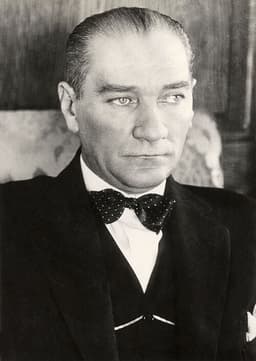
Mustafa Kemal Ataturk
Politician · Modern
80.0Total
Suleiman I
Emperor · Medieval
78.8Total
Basic Information
Born
1881
1494
Died
1938
1566
Era
Modern
Medieval
Nationality
Turkey
Ottoman Empire
Occupation
Politician
Emperor
Civilization
Middle Eastern
Middle Eastern
Score Comparison
Military (10%)
75.0
78.5
Political (20%)
85.0
82.0
Influence (20%)
75.0
85.0
Legacy (20%)
90.0
70.8
Leadership (15%)
80.0
81.7
Strategy (15%)
65.0
74.4
TOTAL
80.0
78.8
Mustafa Kemal Ataturk — Complete Timeline
1915 AD
Battle of GallipoliWar
As a colonel, Mustafa Kemal commanded Ottoman forces at Gallipoli, successfully repelling Allied landings. His leadership at critical points like Chunuk Bair made him a national hero and laid the foundation for his political career.
World War IOttoman EmpireMilitary Victory
Impact: regional
1919 AD
Turkish War of IndependenceWar
Kemal organized and led the Turkish National Movement against the Allied occupation of Anatolia and the Treaty of S
Independence WarNational MovementAnkara
Impact: nationalconstructive
1922 AD
Abolition of the SultanatePolitical Action◆ Major
The Grand National Assembly of Turkey, under Kemal's leadership, abolished the Ottoman Sultanate, ending 600 years of imperial rule. This severed the link with the old regime and paved the way for the proclamation of the Republic.
SultanateRepublicPolitical Reform
Impact: nationalprogressive
1923 AD
Proclamation of the Republic of TurkeyPolitical Action
Kemal declared Turkey a republic, becoming its first president. He moved the capital to Ankara and initiated a series of radical reforms to modernize and secularize the state, including the adoption of a new legal code and the Latin alphabet.
RepublicModernizationSecularism
Impact: globalprogressive
1925 AD
Adoption of the Hat LawReform◆ Major
Kemal introduced the Hat Law, banning the fez and encouraging Western-style hats. This was part of his broader cultural revolution to secularize and Westernize Turkish society, symbolizing the break with Ottoman traditions.
Cultural ReformSecularismWesternization
Impact: nationalprogressive
1934 AD
Granting of Women's SuffrageReform◆ Major
Kemal's government granted women the right to vote and stand for election in national elections, ahead of many European countries. This reform was part of his commitment to gender equality and modernization of Turkish society.
Women's RightsSuffrageModernization
Impact: nationalprogressive
Suleiman I — Complete Timeline
1522 AD
Siege of RhodesWar◆ Major
Suleiman I led a massive Ottoman army and fleet to besiege the island of Rhodes, held by the Knights Hospitaller. After a six-month siege, the knights surrendered and were allowed to leave. This victory secured Ottoman control over the eastern Mediterranean.
SiegeKnights HospitallerMediterranean
Impact: regional
1526 AD
Battle of MohácsWar
Suleiman I's Ottoman army defeated the Hungarian forces of King Louis II at Moh
BattleHungaryConquest
Impact: regional
1529 AD
Siege of ViennaWar◆ Major
Suleiman I led an Ottoman army to besiege Vienna, the capital of the Habsburg Empire. The siege failed due to supply problems and the onset of winter. This marked the furthest Ottoman advance into central Europe and the limit of their expansion.
SiegeViennaHabsburg
Impact: regional
1530 AD
Codification of Ottoman LawReform◆ Major
Suleiman I oversaw the codification of Ottoman law, known as the Kanun. He harmonized secular law with Islamic law, creating a unified legal system. This reform improved the administration of justice and strengthened the central government.
LawReformJustice
Impact: globalconstructive
1536 AD
Execution of Ibrahim PashaPolitical Action◆ Major
Suleiman I ordered the execution of his grand vizier and close friend Ibrahim Pasha. Ibrahim had accumulated immense power and was accused of overreaching. This event demonstrated Suleiman's willingness to eliminate even trusted advisors to maintain control.
ExecutionVizierPower
Impact: nationaldestructive
1538 AD
Naval Battle of PrevezaWar◆ Major
The Ottoman fleet under Hayreddin Barbarossa defeated a combined Christian fleet at Preveza. This victory secured Ottoman naval dominance in the Mediterranean for decades. It allowed the Ottomans to control trade routes and raid coastal areas.
Naval BattleBarbarossaMediterranean
Impact: regional
Expert Analysis
Origins
Mustafa Kemal Atatürk was born in 1881 in Salonika (then Ottoman Empire), into a modest family. His father was a former customs officer, and his mother a pious Muslim. He attended military schools, embracing secular and nationalist ideas. In contrast, Suleiman I was born in 1494 in Trabzon, the only son of Sultan Selim I. He received a princely education in Istanbul, studying history, science, and military tactics. Suleiman's lineage placed him directly in the Ottoman dynastic line, whereas Atatürk rose from relative obscurity.
Rise to Power
Atatürk's rise came through military prowess during the Gallipoli Campaign (1915), where he repelled Allied forces. After WWI, he led the Turkish National Movement against the partitioning of Anatolia, culminating in the Turkish War of Independence (1919-1923). He triumphed over Greek, Armenian, and French forces, abolishing the Sultanate in 1922 and proclaiming the Republic in 1923. Suleiman ascended the throne in 1520 upon his father's death, inheriting a vast empire. His early military successes, including the capture of Belgrade (1521) and Rhodes (1522), solidified his authority. The Battle of Mohács (1526) crushed Hungary, expanding Ottoman influence deep into Europe.
Leadership & Governance
Atatürk's leadership was transformative: he implemented radical reforms to create a secular, Westernized nation-state. He abolished the caliphate, adopted the Swiss civil code, Latin alphabet, and European dress. His governance emphasized nationalism, populism, and statism, centralizing power under his presidency. Suleiman's governance, by contrast, was traditional yet innovative. He codified Ottoman law (Kanun), balancing Islamic sharia with secular edicts. He fostered cultural flourishing, supporting architecture (Süleymaniye Mosque) and the arts. However, his execution of Grand Vizier Ibrahim Pasha (1536) revealed a ruthless, autocratic streak.
Triumph & Tragedy
Atatürk's greatest triumph was founding a viable, independent Turkey from the ruins of empire. His reforms, though controversial, modernized the country. Tragically, his death in 1938 from cirrhosis left a power vacuum, and his secular legacy faced challenges. Suleiman's triumphs included expanding the empire to its zenith, controlling the Mediterranean, and codifying law. His tragedy was the execution of his son Mustafa (1553) on suspicion of rebellion, plunging the dynasty into succession crises. The failed Siege of Vienna (1529) also marked a strategic limit.
Character & Destiny
Atatürk was a pragmatic visionary: disciplined, charismatic, and ruthless when necessary. His destiny was to forge a new identity for his people. Suleiman was a just but stern ruler, known as "the Lawgiver" and "the Magnificent." His destiny was to embody Ottoman greatness, but his later years were marred by court intrigue and familial strife.
Legacy
Atatürk's legacy endures as the father of modern Turkey; his principles (Kemalism) remain foundational. His military and political scores (M=75, P=85, I=75, L=90, D=80, S=65, T=80) reflect his strategic brilliance and reformist impact. Suleiman's legacy is the Ottoman Golden Age; his scores (M=78, P=82, I=85, L=71, D=82, S=74, T=79) highlight his military conquests and legal contributions. The 1.2-point gap favors Atatürk due to higher leadership (90 vs 71), underscoring his transformative governance.
Conclusion
While Suleiman the Magnificent epitomized Ottoman imperial power, Mustafa Kemal Atatürk's creation of a modern, secular republic from the empire's ashes represents a more profound and lasting shift. Atatürk's leadership score decisively tips the balance, making him the more influential figure in shaping Turkey's destiny.
Rankings
🥇
Mustafa Kemal AtaturkLeader
Mil: 75.0Pol: 85.0Inf: 75.0
80.0
🥈
Suleiman I
Mil: 78.5Pol: 82.0Inf: 85.0
78.8
+1.2 behind
How This Comparison Works
Algorithm
Each figure is scored on 6 dimensions (0—100 scale) based on structured historical data: Military (10%), Political (20%), Influence (20%), Legacy (20%), Leadership (15%), Strategy (15%). The weighted total produces the final ranking.
Data Sources
Scores are computed from structured sub-indicators in the database. Scale factors adjust for era (Ancient ×0.85, Modern ×1.0) and civilization size (Eastern ×1.05, Other ×0.80) to account for differences in population and military scale.
Maximum 3 Figures
Comparisons are limited to 2—3 figures to ensure readability and statistical meaningfulness.
Error Margins
±5 points per dimension — Sub-scores are derived from historical records with inherent uncertainty. Two figures within 5 points on a dimension should be considered roughly equivalent in that area.
Total Score Accuracy
±3 points overall — The weighted combination of 6 dimensions produces a total score with approximately ±3 points of uncertainty. Differences of less than 3 points are not statistically significant— the figures are effectively tied.
Known Limitations
- Historical records are incomplete and uneven across civilizations
- Figures from oral-tradition societies may be underrepresented
- Occupation labels can misclassify multi-role figures
- Scores measure capability and impact, not moral character
- Quantitative scoring is a comparison tool, not absolute truth
Capability Radar
Military (10%) — Battles & Warfare
Battles
85
95
Win Rate
90
92
Expansion
60
95
Political (20%) — Governance & Reform
Reform
98
90
Diplomacy
85
88
Economy
75
85
Influence (20%) — Cultural & Global Reach
Cultural
90
85
Global
80
85
Legacy (20%) — Historical Impact
Historical
95
88
Longevity
85
80
Leadership (15%) — Power & Stability
Tenure
85
95
Stability
70
80
Strategy (15%) — Tactics & Innovation
Strategy
85
90
Tactics
88
88
Reform
80
85
Similar Comparisons
Comments & Discussion
No comments yet. Be the first to share your thoughts!