Loading...
This comparison has not been analyzed yet.
One-time AI generation (~1 minute). Scores and timeline are already available below.
Mustafa Kemal Ataturk vs Sooronbay Jeenbekov
Mustafa Kemal Ataturk leads by 43.8 pts · 2 figures compared
…
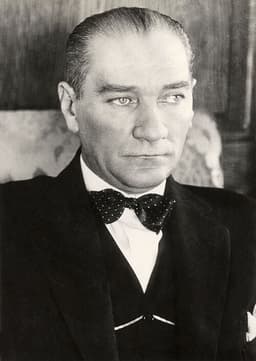
Mustafa Kemal Ataturk
Politician · Modern
80.0Total

Sooronbay Jeenbekov
Politician · Modern
36.2Total
Basic Information
Born
1881
1958
Died
1938
—
Era
Modern
Modern
Nationality
Turkey
Kyrgyzstan
Occupation
Politician
Politician
Civilization
Middle Eastern
Eastern
Score Comparison
Military (10%)
75.0
11.1
Political (20%)
85.0
27.9
Influence (20%)
75.0
47.1
Legacy (20%)
90.0
37.5
Leadership (15%)
80.0
41.5
Strategy (15%)
65.0
35.8
TOTAL
80.0
36.2
Mustafa Kemal Ataturk — Complete Timeline
1915 AD
Battle of GallipoliWar
As a colonel, Mustafa Kemal commanded Ottoman forces at Gallipoli, successfully repelling Allied landings. His leadership at critical points like Chunuk Bair made him a national hero and laid the foundation for his political career.
World War IOttoman EmpireMilitary Victory
Impact: regional
1919 AD
Turkish War of IndependenceWar
Kemal organized and led the Turkish National Movement against the Allied occupation of Anatolia and the Treaty of S
Independence WarNational MovementAnkara
Impact: nationalconstructive
1922 AD
Abolition of the SultanatePolitical Action◆ Major
The Grand National Assembly of Turkey, under Kemal's leadership, abolished the Ottoman Sultanate, ending 600 years of imperial rule. This severed the link with the old regime and paved the way for the proclamation of the Republic.
SultanateRepublicPolitical Reform
Impact: nationalprogressive
1923 AD
Proclamation of the Republic of TurkeyPolitical Action
Kemal declared Turkey a republic, becoming its first president. He moved the capital to Ankara and initiated a series of radical reforms to modernize and secularize the state, including the adoption of a new legal code and the Latin alphabet.
RepublicModernizationSecularism
Impact: globalprogressive
1925 AD
Adoption of the Hat LawReform◆ Major
Kemal introduced the Hat Law, banning the fez and encouraging Western-style hats. This was part of his broader cultural revolution to secularize and Westernize Turkish society, symbolizing the break with Ottoman traditions.
Cultural ReformSecularismWesternization
Impact: nationalprogressive
1934 AD
Granting of Women's SuffrageReform◆ Major
Kemal's government granted women the right to vote and stand for election in national elections, ahead of many European countries. This reform was part of his commitment to gender equality and modernization of Turkish society.
Women's RightsSuffrageModernization
Impact: nationalprogressive
Sooronbay Jeenbekov — Complete Timeline
2016 AD
Appointment as Prime MinisterPolitical Action
Jeenbekov was appointed Prime Minister of Kyrgyzstan by President Almazbek Atambayev. He focused on infrastructure development and anti-corruption measures, though his tenure was marked by tensions with the opposition and limited progress on reforms.
Prime MinisterInfrastructureKyrgyzstan
Impact: national
2017 AD
Election as President of KyrgyzstanPolitical Action◆ Major
Sooronbay Jeenbekov was elected President of Kyrgyzstan in a peaceful transfer of power, winning 54.7% of the vote. He succeeded Almazbek Atambayev, marking the first time in Kyrgyz history that one elected president handed power to another.
ElectionPeaceful TransitionKyrgyzstan
Impact: nationalconstructive
2020 AD
Resignation after October 2020 ProtestsPolitical Action◆ Major
Jeenbekov resigned as president following widespread protests triggered by disputed parliamentary elections. The protests turned violent, and Jeenbekov stepped down to avoid further bloodshed, handing power to an interim government led by Sadyr Japarov.
ResignationProtestsPolitical Crisis
Impact: nationaltragic
Disputed Parliamentary ElectionsPolitical Action◆ Major
Jeenbekov oversaw parliamentary elections that were widely criticized as fraudulent, with allegations of vote-buying and manipulation. The results triggered mass protests that ultimately led to his resignation, highlighting deep political instability in Kyrgyzstan.
ElectionFraudProtests
Impact: nationaldestructive
This comparison has not been analyzed yet.
One-time AI generation (~1 minute). Scores and timeline are already available below.
Rankings
🥇
Mustafa Kemal AtaturkLeader
Mil: 75.0Pol: 85.0Inf: 75.0
80.0
🥈
Sooronbay Jeenbekov
Mil: 11.1Pol: 27.9Inf: 47.1
36.2
+43.8 behind
How This Comparison Works
Algorithm
Each figure is scored on 6 dimensions (0—100 scale) based on structured historical data: Military (10%), Political (20%), Influence (20%), Legacy (20%), Leadership (15%), Strategy (15%). The weighted total produces the final ranking.
Data Sources
Scores are computed from structured sub-indicators in the database. Scale factors adjust for era (Ancient ×0.85, Modern ×1.0) and civilization size (Eastern ×1.05, Other ×0.80) to account for differences in population and military scale.
Maximum 3 Figures
Comparisons are limited to 2—3 figures to ensure readability and statistical meaningfulness.
Error Margins
±5 points per dimension — Sub-scores are derived from historical records with inherent uncertainty. Two figures within 5 points on a dimension should be considered roughly equivalent in that area.
Total Score Accuracy
±3 points overall — The weighted combination of 6 dimensions produces a total score with approximately ±3 points of uncertainty. Differences of less than 3 points are not statistically significant— the figures are effectively tied.
Known Limitations
- Historical records are incomplete and uneven across civilizations
- Figures from oral-tradition societies may be underrepresented
- Occupation labels can misclassify multi-role figures
- Scores measure capability and impact, not moral character
- Quantitative scoring is a comparison tool, not absolute truth
Capability Radar
Military (10%) — Battles & Warfare
Battles
85
16
Win Rate
90
18
Expansion
60
21
Political (20%) — Governance & Reform
Reform
98
15
Diplomacy
85
20
Economy
75
15
Influence (20%) — Cultural & Global Reach
Cultural
90
10
Global
80
10
Legacy (20%) — Historical Impact
Historical
95
15
Longevity
85
10
Leadership (15%) — Power & Stability
Tenure
85
20
Stability
70
10
Strategy (15%) — Tactics & Innovation
Strategy
85
23
Tactics
88
23
Reform
80
31
Similar Comparisons
Comments & Discussion
No comments yet. Be the first to share your thoughts!