Loading...
Mundzuk vs Napoleon Bonaparte
Napoleon Bonaparte leads by 15.7 pts · 2 figures compared
…
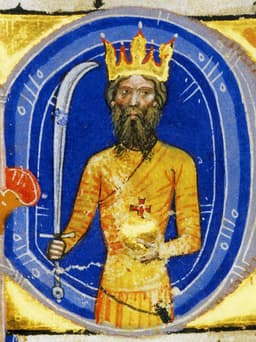
Mundzuk
Emperor · Ancient
55.2Total

Napoleon Bonaparte
General · Modern
70.9Total
Basic Information
Born
380
1769
Died
420
1821
Era
Ancient
Modern
Nationality
Hunnic Empire
France
Occupation
Emperor
General
Civilization
Western
Western
Score Comparison
Military (10%)
20.5
94.0
Political (20%)
68.0
72.0
Influence (20%)
56.2
40.0
Legacy (20%)
52.1
80.0
Leadership (15%)
77.6
78.0
Strategy (15%)
42.3
90.0
TOTAL
55.2
70.9
Mundzuk — Complete Timeline
400 AD
Father of Attila and BledaOther◆ Major
Mundzuk fathered Attila and Bleda, who would later become the most famous rulers of the Hunnic Empire. His paternity established the lineage that would lead to the Huns' greatest period of power and their campaigns against the Roman Empire.
HunsLineageAttilaBleda
Impact: regional
Hun noble statusOther
Mundzuk was a prominent Hun noble, likely a chieftain or king of a Hun tribe. His status allowed his sons to claim leadership of the Huns after his death, though he did not rule the entire Hun confederation himself.
HunsNobilityChieftain
420 AD
DeathOther
Mundzuk died around 420 AD, leaving his sons Attila and Bleda under the guardianship of his brother Rugila. His death set the stage for Rugila's unification of the Huns and the eventual rise of Attila and Bleda as co-rulers.
HunsDeathSuccession
Napoleon Bonaparte — Complete Timeline
1799 AD
Coup of 18 BrumaireOther◆ Major
Napoleon Bonaparte, with support from his brother Lucien and key political figures, overthrew the Directory in a bloodless coup. He established the Consulate with himself as First Consul, effectively becoming the ruler of France. This event ended the French Revolution's most unstable period.
French RevolutionCoupRise to Power
Impact: regional
1804 AD
Promulgation of the Napoleonic CodeOther◆ Major
Napoleon enacted the Civil Code of the French, known as the Napoleonic Code, a comprehensive set of laws that replaced the fragmented feudal legal systems. The code established legal equality, protected property rights, and secularized law. It became the basis for legal systems in many European and world countries.
Legal ReformNapoleonic CodeCivil Law
Impact: globalconstructive
1805 AD
Battle of AusterlitzWar◆ Major
Napoleon's Grande Arm
Napoleonic WarsBattleDecisive Victory
Impact: global
1812 AD
Invasion of RussiaWar◆ Major
Napoleon led the Grande Arm
Napoleonic WarsInvasionDisaster
Impact: globaldestructive
1815 AD
Battle of WaterlooWar◆ Major
Napoleon's French army was defeated by the combined forces of the Duke of Wellington's Anglo-Allied army and Gebhard Leberecht von Bl
Napoleonic WarsBattleFinal Defeat
Impact: globaldestructive
Expert Analysis
mundzuk-vs-napoleon-bonaparte
# The Father and the Emperor: How Mundzuk Shaped Attila While Napoleon Forged Himself
On a cold December morning in 1805, Napoleon Bonaparte stood atop the Pratzen Heights near Austerlitz, watching his Grand Army shatter the combined forces of Austria and Russia. Twenty-three years earlier, on the windswept steppes of Central Asia, a Hun noble named Mundzuk died in obscurity, leaving behind two young sons who would one day ride their horses across the ruins of Roman civilization. One man conquered an empire through his own genius; the other conquered nothing himself, yet fathered the man historians would call the Scourge of God. What makes a figure worthy of remembrance—achievement or ancestry? The answer lies in the stark contrast between these two men, separated by fourteen centuries yet bound by a single question: what does it mean to shape history?
Origins
Napoleon Buonaparte was born in 1769 on the Mediterranean island of Corsica, a land recently annexed by France. His family belonged to the minor nobility, but they were poor, proud, and fiercely Corsican. Young Napoleon spoke Italian before French, and his early letters seethed with resentment against the French occupation. Yet France was his ticket out of obscurity. At nine years old, he entered the military academy at Brienne-le-Château, where his classmates mocked his accent and his poverty. He responded by burying himself in books—military treatises, history, geography, and the works of Rousseau. While other boys played, Napoleon calculated the angles of cannon fire. His era was one of revolution, when old hierarchies crumbled and a man of talent could rise faster than ever before in European history.
Mundzuk, by contrast, lived in a world without written records, without schools, without any of the institutions that forged Napoleon. He was born around 380 AD, likely on the vast grasslands north of the Black Sea, where the Huns roamed with their horses and their herds. His people had no cities, no laws carved in stone, no concept of a nation-state. Power came from the sword, loyalty from kinship, and wealth from plunder. Mundzuk was a Hun noble—probably a chieftain or sub-king—but we know almost nothing of his life beyond his name and his sons. He did not attend an academy; he learned to ride before he could walk. He did not read military strategy; he absorbed it from the rhythm of the steppe, where survival meant knowing when to attack and when to vanish into the horizon.
Rise to Power
Napoleon’s ascent was a masterpiece of timing and talent. The French Revolution erupted in 1789, and by 1793, the young artillery officer found himself at the siege of Toulon, where the British held the port. Napoleon identified the key position—a fort called l’Éguillette—and bombarded the British fleet into retreat. At 24, he was promoted to brigadier general. In 1796, he took command of the starving, ragged Army of Italy and transformed it into a juggernaut, winning battle after battle against the Austrians. His secret was speed: he marched his men faster than anyone thought possible, kept his supply lines lean, and struck where the enemy least expected. By 1799, he had seized power in a coup d’état, naming himself First Consul. In 1804, he crowned himself Emperor of the French. The Corsican outsider had climbed to the summit of Europe.
Mundzuk never rose to power because he never sought it in the way Napoleon did. His authority came from birth, not ambition. As a Hun noble, he likely commanded a warband and participated in raids against the Roman Empire, but he never led a great campaign or carved out a kingdom. The key turning point of his life was not a battle but a birth: around 400 AD, his wife gave him two sons, Attila and Bleda. Mundzuk’s brother Rugila eventually became the dominant Hun ruler, and when Mundzuk died around 420, Rugila took the boys under his guardianship. Mundzuk’s path to influence was not a ladder he climbed but a seed he planted. His sons would inherit his noble status and, more importantly, his bloodline—the claim to leadership that would unite the Hun tribes.
Leadership & Governance
Napoleon governed with the same energy he brought to war. He reformed French law into the Napoleonic Code, a system that enshrined equality before the law, protected property rights, and secularized the state. He established the Bank of France to stabilize the currency, built lycées to educate the middle class, and negotiated the Concordat with the Pope to end a decade of religious conflict. His military genius was unmatched: at Austerlitz in 1805, he destroyed a larger Russian-Austrian army by feigning weakness on his right flank, then crushing the enemy center. His soldiers adored him because he shared their hardships and rewarded their courage. Yet his political wisdom had limits. He appointed his brothers to thrones across Europe, believing family loyalty would secure his empire. It did not. His brothers proved incompetent, and his enemies learned to outlast him.
Mundzuk left no laws, no institutions, no reforms. He was a tribal chieftain in a society where leadership meant leading by example in battle and distributing plunder to retain loyalty. We have no record of his military strategy, but his son Attila’s tactics suggest the Hunnic art of war: feigned retreats, lightning cavalry strikes, psychological terror, and ruthless negotiation. Mundzuk’s governance was personal, not bureaucratic. He ruled through kinship ties, gift-giving, and the threat of violence. He did not build cities or write codes. He kept his people fed, his enemies afraid, and his sons alive.
Triumph & Tragedy
Napoleon’s greatest moment came in 1805 at Austerlitz, where he achieved his most brilliant victory. His greatest tragedy followed a decade later: the invasion of Russia in 1812. He marched 600,000 men into the endless plains, won every battle, and captured Moscow—only to find the city burning and the Tsar refusing to surrender. The Russian winter destroyed his army. He returned to France with barely 100,000 men. His enemies, emboldened, formed a coalition that crushed him at Leipzig in 1813. Exiled to Elba, he escaped in 1815, rallied France, and met his final defeat at Waterloo. He died in 1821 on the remote island of Saint Helena, a prisoner of the British.
Mundzuk’s triumph was not his own. He died around 420, likely in obscurity, his body buried somewhere on the steppe. His tragedy was that he never saw what his sons would become. Attila and Bleda inherited his status and, under Rugila’s tutelage, learned to command. By 434, they ruled the Hunnic Empire together. Attila would go on to ravage the Balkans, extort gold from Constantinople, and invade Gaul. He died in 453 on his wedding night, likely from a hemorrhage. The empire he had built collapsed within a year. Mundzuk’s legacy was a brief, terrifying flame that burned out almost as quickly as it had ignited.
Character & Destiny
Napoleon was driven by an insatiable hunger for glory. “I live only for posterity,” he once said. He believed in his own destiny, in the power of will to reshape the world. His personality was a paradox: a brilliant administrator who could not delegate, a visionary who trusted no one, a liberator who became a tyrant. He wanted to unite Europe under French law and reason, but his ambition destroyed the very peace he claimed to seek. His decisions were shaped by his Corsican roots—the outsider’s need to prove himself, the exile’s longing for a homeland that never fully accepted him.
Mundzuk’s character is unknowable. We have no letters, no memoirs, no anecdotes. But we can infer something from his son. Attila was ruthless, cunning, and pragmatic—a man who used terror as a tool but also knew when to negotiate. He was not a mindless barbarian; he demanded Roman gold and Roman treaties. Mundzuk likely passed down the values of the steppe: loyalty to kin, suspicion of outsiders, and the understanding that power is fleeting. He did not dream of changing the world. He dreamed of surviving it.
Legacy
Napoleon’s legacy is written in stone and law. The Napoleonic Code still underpins the legal systems of France, Italy, Belgium, and dozens of other countries. He redrew the map of Europe, ended feudalism in the territories he conquered, and inspired nationalist movements that would reshape the continent. His military tactics are studied in war colleges to this day. He is remembered as both a genius and a tyrant, a liberator and a conqueror. His name means ambition, brilliance, and tragic overreach.
Mundzuk’s legacy is his son. Without Mundzuk, there would be no Attila—no Hunnic Empire, no Scourge of God, no legend of the barbarian who made Rome tremble. Yet Mundzuk himself is forgotten. His name appears in a few ancient chronicles, a footnote in the story of a greater man. He is remembered not for what he did, but for whom he fathered.
Conclusion
Napoleon and Mundzuk represent two poles of historical influence. Napoleon shaped history through his own actions—his laws, his battles, his reforms. Mundzuk shaped history through his offspring—his genes, his bloodline, his name. One is the archetype of the self-made man; the other is the archetype of the father who gives the world a destroyer. Both remind us that history is not made only by the great, but also by the forgotten. The emperor on his throne and the chieftain on his horse—one conquered an empire, the other conquered nothing. Yet without the father, the son could not have ridden. Without the son, the father would be dust. Which is more important? The question lingers, like a ghost on the steppe.
Rankings
🥇
Napoleon BonaparteLeader
Mil: 94.0Pol: 72.0Inf: 40.0
70.9
🥈
Mundzuk
Mil: 20.5Pol: 68.0Inf: 56.2
55.2
+15.7 behind
How This Comparison Works
Algorithm
Each figure is scored on 6 dimensions (0—100 scale) based on structured historical data: Military (10%), Political (20%), Influence (20%), Legacy (20%), Leadership (15%), Strategy (15%). The weighted total produces the final ranking.
Data Sources
Scores are computed from structured sub-indicators in the database. Scale factors adjust for era (Ancient ×0.85, Modern ×1.0) and civilization size (Eastern ×1.05, Other ×0.80) to account for differences in population and military scale.
Maximum 3 Figures
Comparisons are limited to 2—3 figures to ensure readability and statistical meaningfulness.
Error Margins
±5 points per dimension — Sub-scores are derived from historical records with inherent uncertainty. Two figures within 5 points on a dimension should be considered roughly equivalent in that area.
Total Score Accuracy
±3 points overall — The weighted combination of 6 dimensions produces a total score with approximately ±3 points of uncertainty. Differences of less than 3 points are not statistically significant— the figures are effectively tied.
Known Limitations
- Historical records are incomplete and uneven across civilizations
- Figures from oral-tradition societies may be underrepresented
- Occupation labels can misclassify multi-role figures
- Scores measure capability and impact, not moral character
- Quantitative scoring is a comparison tool, not absolute truth
Capability Radar
Military (10%) — Battles & Warfare
Battles
3
95
Win Rate
5
90
Expansion
12
95
Political (20%) — Governance & Reform
Reform
49
95
Diplomacy
52
80
Economy
52
85
Influence (20%) — Cultural & Global Reach
Cultural
67
85
Global
79
90
Legacy (20%) — Historical Impact
Historical
69
95
Longevity
71
90
Leadership (15%) — Power & Stability
Tenure
49
85
Stability
58
70
Strategy (15%) — Tactics & Innovation
Strategy
15
95
Tactics
14
98
Reform
22
92
Similar Comparisons
Comments & Discussion
HunFather6/17/2026
Mundzuk's real legacy isn't in battlefield glory—it's raw genetic imperialism. Napoleon won battles through superior tactics; Attila won through sheer terror and mobility that scared Rome into paying tribute. Mundzuk's bloodline created that terror machine. Without him, no "Scourge of God." Napoleon's father Carlo died young too, but Napoleon built his own legend from Corsican obscurity. Mundzuk gave history Attila's bow; Napoleon sharpened his own sword. Ancestry wins this one—reflexively.