Loading...
This comparison has not been analyzed yet.
One-time AI generation (~1 minute). Scores and timeline are already available below.
Muhammad Naji al-Otari vs Nursultan Nazarbayev
Nursultan Nazarbayev leads by 12.0 pts · 2 figures compared
…

Muhammad Naji al-Otari
Politician · Modern
45.2Total
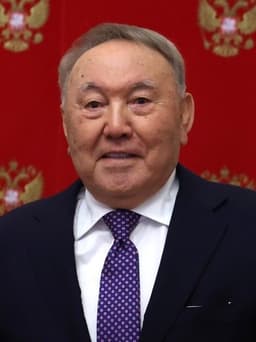
Nursultan Nazarbayev
Politician · Modern
57.2Total
Basic Information
Born
1944
1940
Died
—
—
Era
Modern
Modern
Nationality
Syria
Kazakhstan
Occupation
Politician
Politician
Civilization
Middle Eastern
Eastern
Score Comparison
Military (10%)
28.3
10.0
Political (20%)
39.4
78.0
Influence (20%)
51.8
62.0
Legacy (20%)
38.3
54.0
Leadership (15%)
53.2
78.0
Strategy (15%)
60.0
38.3
TOTAL
45.2
57.2
Muhammad Naji al-Otari — Complete Timeline
2003 AD
Appointed Prime Minister of SyriaPolitical Action◆ Major
Muhammad Naji al-Otari was appointed Prime Minister of Syria by President Bashar al-Assad on September 10, 2003, replacing Muhammad Mustafa Mero. He served for over seven years, overseeing economic reforms and maintaining the Ba'athist government's control. His tenure was marked by limited liberalization and continued authoritarian rule.
Syrian GovernmentBa'ath PartyPrime Minister
Impact: national
2011 AD
Resigned During Syrian UprisingPolitical Action◆ Major
On April 14, 2011, al-Otari resigned as Prime Minister along with his cabinet, following the outbreak of the Syrian uprising. The resignation was announced by state media as a response to the protests, but it was widely seen as a move by President Assad to reshuffle the government and offer concessions. He was replaced by Adel Safar.
Syrian UprisingGovernment ResignationAssad
Impact: national
Nursultan Nazarbayev — Complete Timeline
1991 AD
Became First President of KazakhstanPolitical Action◆ Major
Nursultan Nazarbayev was elected as the first president of independent Kazakhstan following the dissolution of the Soviet Union. He had previously served as the head of the Kazakh Soviet Socialist Republic. His presidency focused on nation-building, economic reform, and maintaining stability.
IndependenceNation-BuildingPost-Soviet Transition
Impact: nationalconstructive
1993 AD
Introduced Market ReformsReform◆ Major
Nazarbayev implemented a series of market-oriented economic reforms, including privatization of state enterprises and price liberalization. These reforms attracted foreign investment, particularly in the oil and gas sector, and helped stabilize the economy after the Soviet collapse.
Economic ReformPrivatizationForeign Investment
Impact: nationalconstructive
1997 AD
Moved Capital to AstanaPolitical Action◆ Major
Nazarbayev ordered the relocation of the capital from Almaty to the northern city of Akmola, renamed Astana (now Nur-Sultan). The move was intended to develop the underpopulated north and assert sovereignty over the region. The new capital was built with ambitious architecture and foreign investment.
Capital RelocationUrban DevelopmentNational Identity
Impact: nationalconstructive
2019 AD
Resigned as PresidentPolitical Action◆ Major
Nazarbayev unexpectedly resigned as President of Kazakhstan after nearly 30 years in power. He was succeeded by Kassym-Jomart Tokayev, a loyalist. Nazarbayev retained significant influence as head of the Security Council and as 'Elbasy' (Leader of the Nation), a title granted by parliament.
ResignationPower TransitionPolitical Legacy
Impact: national
2022 AD
Suppressed January 2022 ProtestsPolitical Action◆ Major
Following a violent uprising in January 2022, Nazarbayev was removed from his position as head of the Security Council. The protests, initially over fuel prices, turned into a broader challenge to the regime. Tokayev ordered a crackdown with CSTO support, and Nazarbayev's influence waned.
Protest SuppressionPower StruggleCSTO Intervention
Impact: nationaldestructive
This comparison has not been analyzed yet.
One-time AI generation (~1 minute). Scores and timeline are already available below.
Rankings
🥇
Nursultan NazarbayevLeader
Mil: 10.0Pol: 78.0Inf: 62.0
57.2
🥈
Muhammad Naji al-Otari
Mil: 28.3Pol: 39.4Inf: 51.8
45.2
+12.0 behind
How This Comparison Works
Algorithm
Each figure is scored on 6 dimensions (0—100 scale) based on structured historical data: Military (10%), Political (20%), Influence (20%), Legacy (20%), Leadership (15%), Strategy (15%). The weighted total produces the final ranking.
Data Sources
Scores are computed from structured sub-indicators in the database. Scale factors adjust for era (Ancient ×0.85, Modern ×1.0) and civilization size (Eastern ×1.05, Other ×0.80) to account for differences in population and military scale.
Maximum 3 Figures
Comparisons are limited to 2—3 figures to ensure readability and statistical meaningfulness.
Error Margins
±5 points per dimension — Sub-scores are derived from historical records with inherent uncertainty. Two figures within 5 points on a dimension should be considered roughly equivalent in that area.
Total Score Accuracy
±3 points overall — The weighted combination of 6 dimensions produces a total score with approximately ±3 points of uncertainty. Differences of less than 3 points are not statistically significant— the figures are effectively tied.
Known Limitations
- Historical records are incomplete and uneven across civilizations
- Figures from oral-tradition societies may be underrepresented
- Occupation labels can misclassify multi-role figures
- Scores measure capability and impact, not moral character
- Quantitative scoring is a comparison tool, not absolute truth
Capability Radar
Military (10%) — Battles & Warfare
Battles
40
0
Win Rate
45
0
Expansion
49
0
Political (20%) — Governance & Reform
Reform
20
75
Diplomacy
40
80
Economy
30
75
Influence (20%) — Cultural & Global Reach
Cultural
10
50
Global
10
60
Legacy (20%) — Historical Impact
Historical
10
60
Longevity
10
55
Leadership (15%) — Power & Stability
Tenure
60
90
Stability
40
70
Strategy (15%) — Tactics & Innovation
Strategy
50
0
Tactics
52
0
Reform
58
10
Similar Comparisons
Comments & Discussion
No comments yet. Be the first to share your thoughts!