Loading...
Mongkut vs Napoleon Bonaparte
Napoleon Bonaparte leads by 12.9 pts · 2 figures compared
…
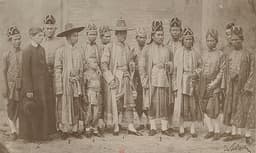
Mongkut
Emperor · Modern
58.0Total

Napoleon Bonaparte
General · Modern
70.9Total
Basic Information
Born
1804
1769
Died
1868
1821
Era
Modern
Modern
Nationality
Thailand
France
Occupation
Emperor
General
Civilization
Eastern
Western
Score Comparison
Military (10%)
21.2
94.0
Political (20%)
78.0
72.0
Influence (20%)
56.7
40.0
Legacy (20%)
58.0
80.0
Leadership (15%)
78.0
78.0
Strategy (15%)
38.3
90.0
TOTAL
58.0
70.9
Mongkut — Complete Timeline
1851 AD
Corresponded with Western leaders and scholarsCultural
Mongkut engaged in extensive correspondence with Western leaders, including President James Buchanan and Pope Pius IX, and with missionaries and scholars. He sought to learn about Western science, technology, and governance.
DiplomacyIntellectual ExchangeModernization
Impact: nationalconstructive
Reformed Buddhist monastic educationCultural
As a former monk, Mongkut reformed Buddhist monastic education by emphasizing Pali studies and scriptural accuracy. He founded the Dhammayuttika Nikaya order, which focused on strict adherence to Buddhist teachings.
BuddhismReligious ReformEducation
Impact: nationalconstructive
1855 AD
Hired Western advisors to modernize SiamReform
Mongkut employed Western advisors, including Anna Leonowens, to teach his children and assist in modernizing the court. He also hired European experts to help with military, legal, and administrative reforms.
AdvisorsModernizationEducation
Impact: nationalconstructive
Signed the Bowring Treaty with BritainPolitical Action◆ Major
King Mongkut signed the Bowring Treaty with Britain, opening Siam to free trade and granting extraterritorial rights to British subjects. This treaty ended Siam's isolation and set a precedent for relations with other Western powers.
TreatyTradeWestern Influence
Impact: regional
Napoleon Bonaparte — Complete Timeline
1799 AD
Coup of 18 BrumaireOther◆ Major
Napoleon Bonaparte, with support from his brother Lucien and key political figures, overthrew the Directory in a bloodless coup. He established the Consulate with himself as First Consul, effectively becoming the ruler of France. This event ended the French Revolution's most unstable period.
French RevolutionCoupRise to Power
Impact: regional
1804 AD
Promulgation of the Napoleonic CodeOther◆ Major
Napoleon enacted the Civil Code of the French, known as the Napoleonic Code, a comprehensive set of laws that replaced the fragmented feudal legal systems. The code established legal equality, protected property rights, and secularized law. It became the basis for legal systems in many European and world countries.
Legal ReformNapoleonic CodeCivil Law
Impact: globalconstructive
1805 AD
Battle of AusterlitzWar◆ Major
Napoleon's Grande Arm
Napoleonic WarsBattleDecisive Victory
Impact: global
1812 AD
Invasion of RussiaWar◆ Major
Napoleon led the Grande Arm
Napoleonic WarsInvasionDisaster
Impact: globaldestructive
1815 AD
Battle of WaterlooWar◆ Major
Napoleon's French army was defeated by the combined forces of the Duke of Wellington's Anglo-Allied army and Gebhard Leberecht von Bl
Napoleonic WarsBattleFinal Defeat
Impact: globaldestructive
Expert Analysis
mongkut-vs-napoleon-bonaparte
# The Emperor and the General: Two Paths to Power in an Age of Upheaval
In the summer of 1855, as King Mongkut of Siam affixed his royal seal to the Bowring Treaty, he opened his kingdom to British merchants, Western gunships, and the relentless tide of colonialism that had already swallowed India and Burma. Half a world away and forty years earlier, Napoleon Bonaparte had stood on the deck of a British warship, gazing at the remote island of St. Helena where he would spend his final years in exile. One man had conquered Europe and lost it all; the other had surrendered nothing and preserved his kingdom. Both faced the same fundamental challenge of modernity—how to survive in a world being remade by Western power—yet their answers could not have been more different.
Origins
Napoleon Bonaparte was born in 1769 on the island of Corsica, a place that had only recently become French. His family was minor nobility, but they were poor and resentful of French rule. This outsider status would shape him: he was ambitious, driven, and determined to prove himself. The French Revolution, which erupted when he was twenty, shattered the old order and created opportunities for talented men of modest birth. Napoleon seized them.
Mongkut, by contrast, was born into the heart of power. As a son of King Rama II of Siam, he entered a Buddhist monastery at age twenty, as was customary for Thai princes. But when his half-brother Nangklao ascended the throne, Mongkut remained a monk for twenty-seven years. During those decades of meditation and scripture study, he learned Latin, English, and astronomy from French missionaries. He studied Western science and corresponded with the Pope. While Napoleon was storming across Europe, Mongkut was quietly preparing for a different kind of conquest—one of the mind.
Rise to Power
Napoleon’s ascent was meteoric. In 1793, at age twenty-four, he drove British forces from the port of Toulon and was promoted to brigadier general. By 1796, he commanded the French army in Italy, where his lightning campaigns forced Austria to sue for peace. His political genius matched his military brilliance: in 1799, he staged a coup and named himself First Consul, then Emperor in 1804. He was thirty-five years old and master of Europe.
Mongkut’s path was far slower. When King Nangklao died in 1851, the forty-seven-year-old monk finally left his monastery to claim the throne. He had spent decades observing the world from a distance, watching as European powers carved up Asia. He understood something that few Asian rulers grasped: direct military confrontation with the West was suicide. The Opium Wars had just demonstrated what happened to those who resisted—China, the ancient Middle Kingdom, had been humiliated by British gunboats. Mongkut chose a different strategy.
Leadership & Governance
Napoleon governed through force and brilliance. His Napoleonic Code, enacted in 1804, standardized French law, abolished feudal privileges, and established merit-based advancement. It was a genuinely revolutionary achievement, spreading across Europe and influencing legal systems to this day. But his rule was also autocratic: he suppressed dissent, controlled the press, and crowned himself emperor with the Pope looking on. His military strategy was revolutionary—fast marches, massed artillery, and the concentration of overwhelming force at the decisive point. From Austerlitz in 1805 to Wagram in 1809, he seemed invincible.
Mongkut governed through patience and adaptation. He signed the Bowring Treaty in 1855, opening Siam to free trade and granting extraterritorial rights to British subjects—a concession that humiliated national pride but preserved sovereignty. He hired Western advisors, including Anna Leonowens, to teach his children English and modern science. He reformed Buddhist monastic education, emphasizing Pali studies and scriptural accuracy, blending tradition with reform. He corresponded with President James Buchanan and Pope Pius IX, treating Western leaders as equals rather than conquerors. His military score of 22.9 reflects his lack of battlefield ambition; his political score of 75.6 reflects his true genius.
Triumph & Tragedy
Napoleon’s greatest triumph was Austerlitz in 1805, where he destroyed the combined armies of Russia and Austria in a single day. His greatest tragedy was the invasion of Russia in 1812. He marched 600,000 men into the vast emptiness; fewer than 100,000 returned. He was exiled to Elba in 1814, escaped in 1815, raised another army, and was finally crushed at Waterloo. His political score of 75.0 and leadership score of 80.0 reflect a man who could inspire armies but could not build lasting institutions.
Mongkut’s greatest triumph was invisible: Siam survived. While Burma fell to the British, Vietnam to the French, and China to the opium traders, Siam remained independent. His tragedy was that he died in 1868, before seeing the full fruits of his strategy. He contracted malaria while observing a solar eclipse—a fitting end for a king who loved astronomy. His legacy score of 72.2 is modest by global standards, but for a small kingdom surrounded by colonial predators, it is remarkable.
Character & Destiny
Napoleon was restless, brilliant, and consumed by ambition. “Impossible is a word to be found only in the dictionary of fools,” he once said. He believed that destiny demanded he conquer, and he could not stop. His personality drove him to overreach—to invade Russia, to fight on two fronts, to refuse any compromise. The same energy that made him great also destroyed him.
Mongkut was patient, scholarly, and deeply pragmatic. He once wrote, “It is better to be a king who knows than a king who fights.” He understood that power in the modern world came not from armies but from knowledge, diplomacy, and the ability to adapt. His personality—formed by decades in a monastery—allowed him to wait, to learn, and to choose his battles wisely.
Legacy
Napoleon left behind a legend: the Napoleonic Code, the myth of the self-made emperor, the romantic image of the Corsican who conquered Europe. His total score of 82.4 places him among history’s titans. But he also left a warning: that pure ambition, unchecked by wisdom, ends in exile and ruin.
Mongkut left behind a kingdom. His total score of 63.8 is lower, but his achievement is more subtle. He proved that survival in a predatory world requires not just strength, but intelligence. His son, King Chulalongkorn, continued his reforms, and Siam—today’s Thailand—remains the only Southeast Asian nation never colonized.
Conclusion
We remember Napoleon because he changed the world through war. We should remember Mongkut because he understood that sometimes the greatest victory is the one that is never fought. In an age when Western empires crushed all who resisted, one monk-king chose a different path—and his kingdom survived to tell the tale.
Rankings
🥇
Napoleon BonaparteLeader
Mil: 94.0Pol: 72.0Inf: 40.0
70.9
🥈
Mongkut
Mil: 21.2Pol: 78.0Inf: 56.7
58.0
+12.9 behind
How This Comparison Works
Algorithm
Each figure is scored on 6 dimensions (0—100 scale) based on structured historical data: Military (10%), Political (20%), Influence (20%), Legacy (20%), Leadership (15%), Strategy (15%). The weighted total produces the final ranking.
Data Sources
Scores are computed from structured sub-indicators in the database. Scale factors adjust for era (Ancient ×0.85, Modern ×1.0) and civilization size (Eastern ×1.05, Other ×0.80) to account for differences in population and military scale.
Maximum 3 Figures
Comparisons are limited to 2—3 figures to ensure readability and statistical meaningfulness.
Error Margins
±5 points per dimension — Sub-scores are derived from historical records with inherent uncertainty. Two figures within 5 points on a dimension should be considered roughly equivalent in that area.
Total Score Accuracy
±3 points overall — The weighted combination of 6 dimensions produces a total score with approximately ±3 points of uncertainty. Differences of less than 3 points are not statistically significant— the figures are effectively tied.
Known Limitations
- Historical records are incomplete and uneven across civilizations
- Figures from oral-tradition societies may be underrepresented
- Occupation labels can misclassify multi-role figures
- Scores measure capability and impact, not moral character
- Quantitative scoring is a comparison tool, not absolute truth
Capability Radar
Military (10%) — Battles & Warfare
Battles
10
95
Win Rate
10
90
Expansion
10
95
Political (20%) — Governance & Reform
Reform
75
95
Diplomacy
85
80
Economy
70
85
Influence (20%) — Cultural & Global Reach
Cultural
55
85
Global
60
90
Legacy (20%) — Historical Impact
Historical
65
95
Longevity
60
90
Leadership (15%) — Power & Stability
Tenure
65
85
Stability
75
70
Strategy (15%) — Tactics & Innovation
Strategy
20
95
Tactics
15
98
Reform
30
92
Similar Comparisons
Comments & Discussion
MongkutMapper6/17/2026
Sure, Mongkut played defense like a chess grandmaster, but Napoleon wrote the rulebook on modern warfare. The Bowring Treaty wasn't genius—it was surrender with a smile. Siam survived because Britain found it more useful as a buffer than a colony. Meanwhile, Napoleon rewired Europe’s legal and political DNA with the Napoleonic Code. Mongkut's strategy works for a kingdom, but Bonaparte's ambition reshaped continents. Let's see Siam's legacy against the metric system, modern law codes, and the co
拿破仑炮手6/17/2026
说得好听是"开放",难听就是跪着签条约。蒙固王那套西化只是表面功夫,连个像样的军队都没练出来。拿破仑就算滑铁卢输了,他留下的行政制度、民法典、甚至欧洲地图的边界,哪个不是硬碰硬打出来的?暹罗活下来是运气好,夹在英法之间当缓冲区。真要论改变世界的能力,十个蒙固也抵不上半个拿破仑的军事天才和改革魄力。
ChakriCynic6/17/2026
The 'preservation' narrative ignores Siam's feudal stagnation. Mongkut traded sovereignty for survival, yes, but he also maintained an absolute monarchy that crushed dissent. Napoleon, flawed as he was, spread Enlightenment ideals across Europe—meritocracy, secular law, religious tolerance. Mongkut gave Bangkok a facelift while the countryside stayed enslaved to corvée labor. Which legacy actually moved history forward? The man who conquered and codified, or the king who played colonial politics
数据殖民6/17/2026
你们都在吹"保存国家"的神话,怎么不提暹罗的GDP在1880年就被菲律宾殖民政府超过了?开放贸易让英国鸦片倾销、华人控制经济命脉,这叫胜利?拿破仑至少整合了欧洲市场,缩短了内部贸易壁垒。蒙固的"巧外交"说白了就是慢性自杀,让泰国后来成了半殖民地经济,到现在曼谷和北部的贫富差距还摆在那。数据不会骗人:没有主权完整的现代化,光靠机灵话术活不过两百年。