Loading...
Mohammed bin Rashid Al Maktoum vs Napoleon Bonaparte
Napoleon Bonaparte leads by 13.3 pts · 2 figures compared
…
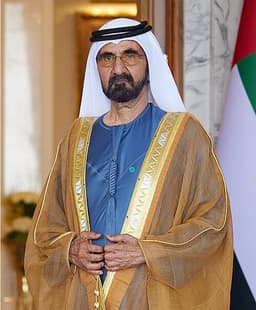
Mohammed bin Rashid Al Maktoum
Emperor · Modern
57.6Total

Napoleon Bonaparte
General · Modern
70.9Total
Basic Information
Born
1949
1769
Died
—
1821
Era
Modern
Modern
Nationality
UAE
France
Occupation
Emperor
General
Civilization
Middle Eastern
Western
Score Comparison
Military (10%)
45.7
94.0
Political (20%)
75.0
72.0
Influence (20%)
56.7
40.0
Legacy (20%)
49.2
80.0
Leadership (15%)
72.0
78.0
Strategy (15%)
45.0
90.0
TOTAL
57.6
70.9
Mohammed bin Rashid Al Maktoum — Complete Timeline
2006 AD
Establishment of Dubai World CentralReform◆ Major
Mohammed bin Rashid initiated the Dubai World Central project, a massive logistics and aviation hub centered around Al Maktoum International Airport. The project aimed to position Dubai as a global transport and trade nexus.
InfrastructureAviationLogistics
Impact: globalconstructive
Accession as Ruler of DubaiPolitical Action◆ Major
Mohammed bin Rashid Al Maktoum became the Ruler of Dubai on January 4, 2006, following the death of his brother, Maktoum bin Rashid Al Maktoum. He also became Vice President and Prime Minister of the UAE.
SuccessionMonarchyDubai
Impact: national
2009 AD
Dubai Financial Crisis and BailoutPolitical Action◆ Major
In 2009, Dubai faced a severe debt crisis when Dubai World, a state-owned conglomerate, announced a debt standstill. Mohammed bin Rashid secured a $10 billion bailout from Abu Dhabi, averting default but highlighting Dubai's over-leverage.
Financial CrisisDebtBailout
Impact: globaldestructive
2010 AD
Launch of Dubai's Vision 2021Reform◆ Major
Mohammed bin Rashid launched the UAE Vision 2021, a national development plan focusing on economic diversification, education, healthcare, and sustainability. The plan aimed to make the UAE one of the best countries in the world by its 50th anniversary.
DevelopmentVisionEconomy
Impact: nationalconstructive
2021 AD
Expo 2020 DubaiCultural◆ Major
Mohammed bin Rashid led Dubai's successful bid to host Expo 2020, which was postponed to 2021 due to the COVID-19 pandemic. The event attracted millions of visitors and showcased Dubai's innovation and global connectivity.
ExpoGlobal EventInnovation
Impact: globalconstructive
Napoleon Bonaparte — Complete Timeline
1799 AD
Coup of 18 BrumaireOther◆ Major
Napoleon Bonaparte, with support from his brother Lucien and key political figures, overthrew the Directory in a bloodless coup. He established the Consulate with himself as First Consul, effectively becoming the ruler of France. This event ended the French Revolution's most unstable period.
French RevolutionCoupRise to Power
Impact: regional
1804 AD
Promulgation of the Napoleonic CodeOther◆ Major
Napoleon enacted the Civil Code of the French, known as the Napoleonic Code, a comprehensive set of laws that replaced the fragmented feudal legal systems. The code established legal equality, protected property rights, and secularized law. It became the basis for legal systems in many European and world countries.
Legal ReformNapoleonic CodeCivil Law
Impact: globalconstructive
1805 AD
Battle of AusterlitzWar◆ Major
Napoleon's Grande Arm
Napoleonic WarsBattleDecisive Victory
Impact: global
1812 AD
Invasion of RussiaWar◆ Major
Napoleon led the Grande Arm
Napoleonic WarsInvasionDisaster
Impact: globaldestructive
1815 AD
Battle of WaterlooWar◆ Major
Napoleon's French army was defeated by the combined forces of the Duke of Wellington's Anglo-Allied army and Gebhard Leberecht von Bl
Napoleonic WarsBattleFinal Defeat
Impact: globaldestructive
Expert Analysis
mohammed-bin-rashid-al-maktoum-vs-napoleon-bonaparte
# The Emperor and the Builder: Two Visions of Power
On a June evening in 1815, Napoleon Bonaparte stood on a muddy field near Waterloo, watching his Imperial Guard—the finest soldiers in Europe—crumble before the British squares. Less than two centuries later, on a January morning in 2010, Mohammed bin Rashid Al Maktoum stood atop the world's tallest building, the Burj Khalifa, as fireworks cascaded over a city that had risen from desert sand. One man sought to conquer the world through force of arms; the other sought to build a world that would attract the conquerors of commerce. Both were rulers of their age, yet their paths could not have been more different. What drove these two men, and why did their legacies diverge so sharply?
Origins
Napoleon Bonaparte was born in 1769 on the island of Corsica, a land recently annexed by France. His family was minor nobility, but poor—his father was a lawyer who struggled to feed eight children. The young Napoleon was sent to military school in mainland France, where he was mocked for his Corsican accent and small stature. He devoured books on military history and the Enlightenment, absorbing the ideas of Rousseau and Voltaire even as he drilled with a musket. The French Revolution erupted when he was twenty, and it opened a door that would have remained shut under the old monarchy: a brilliant commoner could now rise to command.
Mohammed bin Rashid Al Maktoum was born in 1949 into a very different world—the ruling family of Dubai, a small trading port on the Arabian Gulf. His father, Rashid bin Saeed Al Maktoum, was the ruler who began Dubai's transformation from a pearl-diving village into a commercial hub. Young Mohammed was educated in Dubai and later in London, but his real education came from watching his father navigate the treacherous politics of the Middle East while building a modern state. Where Napoleon learned war, Mohammed learned negotiation and vision.
Rise to Power
Napoleon's ascent was meteoric. In 1793, at just twenty-four, he drove the British out of the port of Toulon, earning promotion to brigadier general. By 1796, he commanded the French army in Italy, where he won a series of stunning victories against the Austrians. His campaign in Egypt in 1798—though a military failure—made him a legend. When he returned to France in 1799, the government was weak, and he seized power in a coup. By 1804, he crowned himself Emperor of the French. The entire journey took just eleven years.
Mohammed's rise was more gradual and came by inheritance. When his brother Maktoum died in 2006, Mohammed became the ruler of Dubai. But he had already been the de facto leader for years, serving as Crown Prince and overseeing Dubai's explosive growth. His key turning point was not a battle but a vision: he saw that oil, which had made Dubai wealthy, would run out. He decided to transform the city into a global hub for tourism, finance, and logistics. Where Napoleon took power through force, Mohammed took power through foresight.
Leadership & Governance
Napoleon ruled through a combination of military genius and administrative brilliance. His military score of 94.0 reflects his unmatched ability to move armies, read terrain, and strike at the decisive moment. At Austerlitz in 1805, he destroyed a larger Russian and Austrian army by feigning weakness and then crushing their flank. He reformed French law with the Napoleonic Code, which established equality before the law and protected property rights—a legacy that still shapes legal systems across Europe and the world. Yet his political score of 75.0 shows his limitations: he centralized power, silenced dissent, and made himself the sole authority. His leadership score of 80.0 indicates he inspired loyalty but also fear.
Mohammed bin Rashid governs very differently. His military score of 32.0 is low because he has never fought a war—his power comes from economic development and political strategy. His political score of 74.7 is similar to Napoleon's, but his leadership score of 84.2 is higher. He leads by setting audacious goals—the Burj Khalifa, the Palm Islands, Expo 2020—and then inspiring his people to achieve them. He launched the UAE Vision 2021 to diversify the economy, and when Dubai faced a debt crisis in 2009, he negotiated a bailout from Abu Dhabi rather than fighting. His strategy score of 65.8 reflects a focus on long-term planning rather than battlefield tactics.
Triumph & Tragedy
Napoleon's greatest triumph was Austerlitz, where he achieved the perfect battle. His greatest tragedy was the invasion of Russia in 1812: he marched 600,000 men into the vastness of Russia and returned with fewer than 100,000. The disaster shattered his aura of invincibility. He was exiled to Elba in 1814, escaped in 1815, and was finally defeated at Waterloo. He died in 1821 on the remote island of Saint Helena, alone and bitter.
Mohammed bin Rashid's greatest triumph is Dubai itself—a city of 3.5 million people that barely existed fifty years ago. His greatest tragedy was the 2009 financial crisis, when Dubai World, the state-owned conglomerate, announced a debt standstill of $59 billion. The crisis exposed the fragility of his model: rapid growth fueled by borrowed money. But unlike Napoleon, Mohammed survived. He restructured the debt, tightened controls, and by 2021, Dubai hosted Expo 2020, a global celebration of resilience.
Character & Destiny
Napoleon was driven by an insatiable hunger for glory. "I am not a man," he once said, "I am a thing—an instrument of destiny." His personality—arrogant, brilliant, restless—pushed him to conquer but also to overreach. He could not stop. He invaded Russia because he could not tolerate a rival, and that decision destroyed him.
Mohammed bin Rashid is driven by a different hunger: the desire to build something that outlasts him. "The future belongs to those who can imagine it," he wrote in his book *My Vision*. His personality—pragmatic, ambitious, disciplined—has allowed him to take risks without destroying himself. He knows when to retreat, when to compromise. Napoleon never learned that lesson.
Legacy
Napoleon's legacy is written in blood and law. He is remembered as one of history's greatest generals, a reformer who spread the ideals of the French Revolution across Europe, and a tyrant who caused millions of deaths. His legacy score of 78.0 reflects this ambivalence.
Mohammed bin Rashid's legacy is written in steel and glass. He is remembered as the man who built a city from nothing, who proved that a small desert state could become a global power. His legacy score of 64.6 is lower, partly because his story is still unfolding. But his influence score of 74.8 is high—Dubai's model of development has inspired cities across the Middle East and Asia.
Conclusion
Napoleon and Mohammed bin Rashid both ruled with iron wills and grand visions. But Napoleon tried to conquer the world, while Mohammed bin Rashid tried to build one. Napoleon's empire collapsed with him; Mohammed bin Rashid's city continues to grow. Perhaps the deepest difference is this: Napoleon saw power as something to be seized, while Mohammed bin Rashid sees it as something to be created. One left a battlefield; the other left a skyline. In the end, the builder may have understood the human heart better than the conqueror.
Rankings
🥇
Napoleon BonaparteLeader
Mil: 94.0Pol: 72.0Inf: 40.0
70.9
🥈
Mohammed bin Rashid Al Maktoum
Mil: 45.7Pol: 75.0Inf: 56.7
57.6
+13.3 behind
How This Comparison Works
Algorithm
Each figure is scored on 6 dimensions (0—100 scale) based on structured historical data: Military (10%), Political (20%), Influence (20%), Legacy (20%), Leadership (15%), Strategy (15%). The weighted total produces the final ranking.
Data Sources
Scores are computed from structured sub-indicators in the database. Scale factors adjust for era (Ancient ×0.85, Modern ×1.0) and civilization size (Eastern ×1.05, Other ×0.80) to account for differences in population and military scale.
Maximum 3 Figures
Comparisons are limited to 2—3 figures to ensure readability and statistical meaningfulness.
Error Margins
±5 points per dimension — Sub-scores are derived from historical records with inherent uncertainty. Two figures within 5 points on a dimension should be considered roughly equivalent in that area.
Total Score Accuracy
±3 points overall — The weighted combination of 6 dimensions produces a total score with approximately ±3 points of uncertainty. Differences of less than 3 points are not statistically significant— the figures are effectively tied.
Known Limitations
- Historical records are incomplete and uneven across civilizations
- Figures from oral-tradition societies may be underrepresented
- Occupation labels can misclassify multi-role figures
- Scores measure capability and impact, not moral character
- Quantitative scoring is a comparison tool, not absolute truth
Capability Radar
Military (10%) — Battles & Warfare
Battles
24
95
Win Rate
29
90
Expansion
30
95
Political (20%) — Governance & Reform
Reform
85
95
Diplomacy
80
80
Economy
90
85
Influence (20%) — Cultural & Global Reach
Cultural
60
85
Global
65
90
Legacy (20%) — Historical Impact
Historical
55
95
Longevity
50
90
Leadership (15%) — Power & Stability
Tenure
75
85
Stability
75
70
Strategy (15%) — Tactics & Innovation
Strategy
32
95
Tactics
34
98
Reform
39
92
Similar Comparisons
Comments & Discussion
Duke of Data6/17/2026
Comparing a 19th-century emperor to a modern sheikh is like comparing a one-man band to a symphony orchestra. Napoleon lost 550,000 men in Russia alone; Sheikh Mo built 200 artificial islands with foreign labor. The real difference? Scale of damage vs. scale of construction. Call me when Bonaparte finishes a skyscraper. Until then, one man's empire is just another man's vanity project with higher body counts.
沙海筑梦人6/17/2026
拿破仑靠军靴踩出帝国,穆罕默德·本·拉希德靠蓝图堆出迪拜。前者有滑铁卢的泥泞,后者有哈利法塔的云端。你让拿皇活在今天,他会输给签证和海关;你让酋长回到1815,他会在早餐桌上买下整个欧洲。时代决定工具:火药还是石油,刺刀还是合同。不要问谁更伟大,问你的护照和钱包更信哪个。
Legionnaire's Ghost6/17/2026
I've read the Imperial Guard's memoirs—Napoleon slept two hours a night and marched beside them in the snow. Sheikh Mo's workers built the Burj in three-hour shifts under 50°C heat. The emperor won 50 battles but bankrupted France; the sheikh tripled Dubai's GDP. One burned through blood, the other through concrete. Both left monuments. I know which one I'd rather serve under—the one who gave me a salary, not a medal.