Loading...
Milos Obrenovic vs Qaplan I Giray
Milos Obrenovic leads by 10.6 pts · 2 figures compared
…
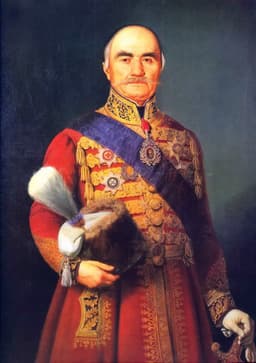
Milos Obrenovic
Emperor · Modern
52.7Total

Qaplan I Giray
Emperor · Modern
42.1Total
Basic Information
Born
1780
1678
Died
1860
1738
Era
Modern
Modern
Nationality
Serbia
Crimean Khanate
Occupation
Emperor
Emperor
Civilization
Western
Eastern
Score Comparison
Military (10%)
55.0
38.3
Political (20%)
68.0
32.2
Influence (20%)
53.3
47.9
Legacy (20%)
47.5
37.5
Leadership (15%)
53.2
55.3
Strategy (15%)
38.6
38.3
TOTAL
52.7
42.1
Milos Obrenovic — Complete Timeline
1815 AD
Led the Second Serbian UprisingWar
Miloš Obrenović led the Second Serbian Uprising against the Ottoman Empire. The uprising was more successful than the first, leading to negotiations with the Ottomans and the establishment of an autonomous Serbian principality under Ottoman suzerainty.
UprisingOttoman EmpireSerbian Autonomy
Impact: regionalconstructive
1817 AD
Recognized as Prince of SerbiaPolitical Action◆ Major
Miloš Obrenović was recognized as the hereditary Prince of Serbia by the Ottoman Empire, following the Second Serbian Uprising. This recognition established the Obrenović dynasty and granted Serbia a degree of autonomy.
RecognitionAutonomyDynasty Foundation
Impact: nationalconstructive
1839 AD
Abdicated the ThronePolitical Action◆ Major
Under pressure from opposition and the Ottoman Porte, Milo
AbdicationExileDynasty
Impact: national
1858 AD
Returned to Power as PrincePolitical Action◆ Major
Miloš Obrenović returned from exile and was reinstated as Prince of Serbia after the abdication of Alexander Karađorđević. He ruled until his death in 1860, consolidating the Obrenović dynasty's power.
Return to PowerDynasty RestorationSerbia
Impact: national
Qaplan I Giray — Complete Timeline
1711 AD
Battle of Pruth RiverWar◆ Major
Qaplan I Giray led Crimean forces in the Battle of Pruth River, supporting the Ottoman army against Russia. The battle resulted in a Russian defeat, forcing Peter the Great to cede Azov and dismantle fortifications.
BattleRusso-Turkish WarPruth River
Impact: regional
1728 AD
Suppression of the Kuban Nogai RevoltWar
Qaplan I Giray suppressed a revolt by the Kuban Nogai Horde, which had rebelled against Crimean authority. The revolt was crushed, and the Nogai leaders were executed, reaffirming Crimean control over the Kuban region.
RevoltNogai HordeKuban
destructive
1737 AD
Campaign against the AustriansWar◆ Major
Qaplan I Giray led Crimean forces in the Austro-Turkish War, fighting against Austrian troops in the Balkans. He was killed in action during the campaign, becoming one of the few Crimean khans to die in battle.
CampaignAustro-Turkish WarDeath
Impact: regionaltragic
Expert Analysis
Origins
Miloš Obrenović was born in 1780 in Srednja Dobrinja, Serbia, then part of the Ottoman Empire. He was of peasant origin, his father being a shepherd. Miloš had little formal education but gained experience as a livestock trader. He participated in the First Serbian Uprising (1804-1813) as a vojvoda (military commander). After the uprising's failure, he fled across the Danube but returned to lead the Second Serbian Uprising in 1815.
Qaplan I Giray was born around 1678 into the Giray dynasty, the ruling family of the Crimean Khanate. He was a son of Selim I Giray, a prominent khan. Qaplan received a traditional Tatar education in military arts and governance. He ascended to the throne in 1707, following a period of internal strife within the khanate.
Rise to Power
Miloš Obrenović's rise began with the Second Serbian Uprising in April 1815. Unlike the First Uprising, which was crushed by the Ottomans, Miloš employed a strategy of negotiation and limited warfare. He secured autonomy for Serbia through a series of agreements with the Ottoman Porte, culminating in the Hatt-i Sharif of 1830, which recognized him as hereditary Prince of Serbia. His political acumen scored 68.0, significantly higher than Qaplan's 32.2.
Qaplan I Giray became khan in 1707 after the death of his predecessor, but his rule was interrupted by depositions. He was reinstated in 1713. His rise was typical for Crimean khans, relying on Ottoman support and clan alliances. He participated in the Pruth River Campaign in 1711, where his Crimean forces contributed to the Russian defeat. His military score of 38.3 reflects limited strategic impact.
Leadership & Governance
Miloš Obrenović ruled Serbia as an autocrat, centralizing power and suppressing internal opposition. He implemented modernizing reforms, including a centralized administration, tax collection, and education system. However, his rule was marked by nepotism and corruption. He abdicated in 1839 under pressure but returned to power in 1858 after the overthrow of Alexander Karađorđević. His leadership score of 53.2 reflects his ability to maintain power despite challenges.
Qaplan I Giray's governance was typical for Crimean khans, focusing on military campaigns and managing nomadic tribes. He suppressed the Kuban Nogai Revolt in 1708, demonstrating his ability to enforce control. However, his political score of 32.2 indicates limited success in diplomacy or state-building. His leadership score of 55.3 is slightly higher than Miloš's due to his military command, but overall impact was lower.
Triumph & Tragedy
Miloš Obrenović's greatest triumph was securing Serbian autonomy and establishing the Obrenović dynasty. He successfully negotiated with the Ottomans and expanded Serbian territory. His tragedy was his authoritarian rule, which led to his abdication and exile. He died in 1860, having returned to power only two years earlier.
Qaplan I Giray's triumph was his role in the Pruth River Campaign, which resulted in a Russian defeat. He also suppressed the Nogai revolt. His tragedy was his death in 1739 during the Austro-Turkish War, killed in action while leading his troops. His legacy score of 37.5 reflects a lack of enduring achievements.
Character & Destiny
Miloš Obrenović was pragmatic and ruthless, using diplomacy and force to achieve his goals. His peasant background made him wary of the aristocracy, leading to a centralized rule. His character contributed to both his success and his downfall.
Qaplan I Giray was a traditional Tatar warrior, focused on military exploits. His adherence to the Ottoman alliance defined his reign. His death in battle was consistent with his martial values but limited his long-term influence.
Legacy
Miloš Obrenović's legacy is foundational for modern Serbia. He is remembered as the founder of the Obrenović dynasty, which ruled until 1903. His achievements in securing autonomy paved the way for full independence. His influence score of 53.3 reflects this impact.
Qaplan I Giray's legacy is minimal. The Crimean Khanate declined after his death, and he is remembered primarily as a minor khan. His legacy score of 37.5 is the lowest among the compared figures.
Conclusion
Miloš Obrenović had a greater impact than Qaplan I Giray. With a total score of 52.7 compared to Qaplan's 42.1, the gap of 10.6 points is significant. Miloš's political achievements and dynasty-building had lasting effects on Serbian history, while Qaplan's military efforts were largely ephemeral. Miloš's ability to navigate Ottoman politics and establish a semi-autonomous state outweighs Qaplan's battlefield contributions. Thus, Miloš Obrenović is the more consequential figure.
Rankings
🥇
Milos ObrenovicLeader
Mil: 55.0Pol: 68.0Inf: 53.3
52.7
🥈
Qaplan I Giray
Mil: 38.3Pol: 32.2Inf: 47.9
42.1
+10.6 behind
How This Comparison Works
Algorithm
Each figure is scored on 6 dimensions (0—100 scale) based on structured historical data: Military (10%), Political (20%), Influence (20%), Legacy (20%), Leadership (15%), Strategy (15%). The weighted total produces the final ranking.
Data Sources
Scores are computed from structured sub-indicators in the database. Scale factors adjust for era (Ancient ×0.85, Modern ×1.0) and civilization size (Eastern ×1.05, Other ×0.80) to account for differences in population and military scale.
Maximum 3 Figures
Comparisons are limited to 2—3 figures to ensure readability and statistical meaningfulness.
Error Margins
±5 points per dimension — Sub-scores are derived from historical records with inherent uncertainty. Two figures within 5 points on a dimension should be considered roughly equivalent in that area.
Total Score Accuracy
±3 points overall — The weighted combination of 6 dimensions produces a total score with approximately ±3 points of uncertainty. Differences of less than 3 points are not statistically significant— the figures are effectively tied.
Known Limitations
- Historical records are incomplete and uneven across civilizations
- Figures from oral-tradition societies may be underrepresented
- Occupation labels can misclassify multi-role figures
- Scores measure capability and impact, not moral character
- Quantitative scoring is a comparison tool, not absolute truth
Capability Radar
Military (10%) — Battles & Warfare
Battles
25
40
Win Rate
30
35
Expansion
35
25
Political (20%) — Governance & Reform
Reform
55
20
Diplomacy
50
25
Economy
45
20
Influence (20%) — Cultural & Global Reach
Cultural
30
15
Global
20
10
Legacy (20%) — Historical Impact
Historical
45
20
Longevity
40
15
Leadership (15%) — Power & Stability
Tenure
60
30
Stability
40
20
Strategy (15%) — Tactics & Innovation
Strategy
25
30
Tactics
20
30
Reform
30
20
Similar Comparisons
Comments & Discussion
No comments yet. Be the first to share your thoughts!