Loading...
Miguel Miramon vs Napoleon Bonaparte
Napoleon Bonaparte leads by 23.2 pts · 2 figures compared
…
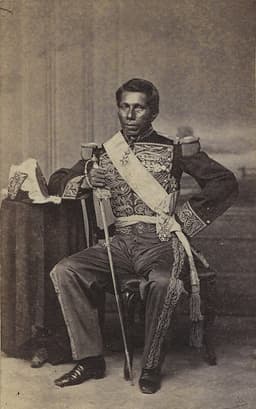
Miguel Miramon
General · Modern
47.7Total

Napoleon Bonaparte
General · Modern
70.9Total
Basic Information
Born
1831
1769
Died
1867
1821
Era
Modern
Modern
Nationality
Mexico
France
Occupation
General
General
Civilization
Western
Western
Score Comparison
Military (10%)
30.0
94.0
Political (20%)
39.4
72.0
Influence (20%)
51.8
40.0
Legacy (20%)
44.2
80.0
Leadership (15%)
58.8
78.0
Strategy (15%)
60.0
90.0
TOTAL
47.7
70.9
Miguel Miramon — Complete Timeline
1859 AD
Became President of MexicoPolitical Action◆ Major
Miramón became president of Mexico at age 28, the youngest in Mexican history. He led the conservative government during the War of the Reform, opposing the liberal forces of Benito Juárez.
PresidencyWar of the ReformConservative
Impact: national
1860 AD
Battle of CalpulalpanWar◆ Major
Miramón's conservative army was decisively defeated by liberal forces under Jesús González Ortega at the Battle of Calpulalpan. This defeat ended the War of the Reform and forced Miramón into exile.
War of the ReformBattleDefeat
Impact: nationaltragic
1863 AD
Returned to Mexico with French SupportWar
Miramón returned to Mexico during the French intervention, serving as a general for the imperial forces of Emperor Maximilian. He commanded troops in several battles against the republican forces.
French InterventionImperial ArmyMaximilian
Impact: national
1867 AD
Executed with MaximilianPolitical Action◆ Major
Miramón was captured by republican forces at the Siege of Querétaro. He was tried and executed by firing squad alongside Emperor Maximilian and General Tomás Mejía on the Cerro de las Campanas.
ExecutionQuerétaroMaximilian
Impact: nationaltragic
Napoleon Bonaparte — Complete Timeline
1799 AD
Coup of 18 BrumaireOther◆ Major
Napoleon Bonaparte, with support from his brother Lucien and key political figures, overthrew the Directory in a bloodless coup. He established the Consulate with himself as First Consul, effectively becoming the ruler of France. This event ended the French Revolution's most unstable period.
French RevolutionCoupRise to Power
Impact: regional
1804 AD
Promulgation of the Napoleonic CodeOther◆ Major
Napoleon enacted the Civil Code of the French, known as the Napoleonic Code, a comprehensive set of laws that replaced the fragmented feudal legal systems. The code established legal equality, protected property rights, and secularized law. It became the basis for legal systems in many European and world countries.
Legal ReformNapoleonic CodeCivil Law
Impact: globalconstructive
1805 AD
Battle of AusterlitzWar◆ Major
Napoleon's Grande Arm
Napoleonic WarsBattleDecisive Victory
Impact: global
1812 AD
Invasion of RussiaWar◆ Major
Napoleon led the Grande Arm
Napoleonic WarsInvasionDisaster
Impact: globaldestructive
1815 AD
Battle of WaterlooWar◆ Major
Napoleon's French army was defeated by the combined forces of the Duke of Wellington's Anglo-Allied army and Gebhard Leberecht von Bl
Napoleonic WarsBattleFinal Defeat
Impact: globaldestructive
Expert Analysis
miguel-miramon-vs-napoleon-bonaparte
# The Emperor and the Youngest President
On a June morning in 1867, on a hill outside Querétaro, three men knelt before a firing squad. One was an Austrian archduke who had briefly called himself Emperor of Mexico. Another was a thirty-six-year-old Mexican general who had once been his nation's youngest president. As the shots rang out, Miguel Miramón joined a long line of fallen leaders—but his story stands in stark contrast to that of another general who once dominated a continent, whose name remains synonymous with ambition and conquest.
Napoleon Bonaparte and Miguel Miramón both rose from modest beginnings to seize supreme power in their nations. Both were military men who believed destiny had chosen them. Yet one reshaped Europe and left a legal and political legacy that endures two centuries later, while the other ended his life as a traitor, remembered chiefly for his youth and his tragic end. The difference lies not merely in talent, but in the worlds they inhabited and the choices they made when history pressed hardest.
Origins
Napoleon was born in 1769 on Corsica, an island recently acquired by France. His family was minor nobility, but his education at French military academies placed him squarely in the currents of the Enlightenment. When revolution swept France in 1789, he was a young artillery officer with nothing to lose and everything to gain. The old aristocracy was collapsing, and talent—especially military talent—became the only currency that mattered.
Miguel Miramón was born in 1831 in Mexico City, into a conservative military family. His Mexico was not a rising empire but a wounded republic, torn between liberals who wanted to limit the Church's power and conservatives who saw tradition as the only shield against chaos. The United States had just taken half of Mexico's territory. The country was bankrupt, divided, and desperate for stability. Miramón entered the military academy at thirteen, graduating at seventeen—a boy in a man's world, but a boy with fierce ambition.
Rise to Power
Napoleon's ascent was meteoric but earned. At twenty-four, he drove the British from Toulon. At twenty-six, he crushed a royalist uprising in Paris with a "whiff of grapeshot." By thirty, he had conquered Italy and Egypt. Each victory was a stepping stone, and each was his own. He did not inherit power; he seized it, step by step, battle by battle. In 1799, he staged a coup and made himself First Consul. By 1804, he crowned himself Emperor in Notre Dame.
Miramón's rise was faster, and perhaps too easy. At twenty-eight, he became president of Mexico—the youngest in its history. But he did not win power through military brilliance or popular acclaim. He was the candidate of the conservative party, which controlled the capital. His rise reflected not his own genius but the weakness of his opponents and the desperation of his allies. He led a government that was never truly legitimate, never truly national. His authority rested on bayonets and clerical support, not on the consent of the governed.
Leadership & Governance
Napoleon governed as he conquered—with energy, vision, and ruthless efficiency. He reformed French law into the Napoleonic Code, which enshrined equality before the law, protected property rights, and secularized the state. He created a centralized bureaucracy, founded the Bank of France, and built roads and canals. He made peace with the Church while keeping it subordinate. His wars were costly, but his domestic achievements were real and lasting.
Miramón governed in a time of civil war. His presidency was consumed by the War of the Reform, a brutal conflict between liberals and conservatives. He had no time for lasting reforms, no space for building institutions. His government survived by borrowing from foreign lenders and relying on Church funds. When he finally faced the liberal army at Calpulalpan in 1860, his forces were crushed. He fled into exile, his presidency over at thirty.
Triumph & Tragedy
Napoleon's greatest moment was Austerlitz in 1805, where he destroyed the armies of Austria and Russia in a single day. His worst came at Waterloo in 1815, when the Duke of Wellington and the Prussian army ended his final gamble. But even in defeat, Napoleon retained a dignity that captivated Europe. He died in exile on Saint Helena, but his legend only grew.
Miramón's tragedy was more complete. After his defeat, he returned to Mexico not as a reformer or a patriot, but as a general for the French-installed Emperor Maximilian. He was fighting for a foreign ruler against his own countrymen. When the French withdrew, he was captured at Querétaro and executed by firing squad. He did not die for a cause he had built, but for one that had used him.
Character & Destiny
Napoleon was driven by an insatiable hunger for glory, but he was also a pragmatist. He knew when to compromise, when to reward talent, and when to crush opposition. His ambition was limitless, but his intelligence was equally vast. He understood that power required not just victory, but legitimacy.
Miramón was brave and loyal, but he lacked Napoleon's strategic vision and political instinct. He was a conservative in an age of change, a soldier in a war he could not win. He chose the losing side not once, but twice. His youth was not his curse—it was his inability to see beyond the certainties of his class and his Church.
Legacy
Napoleon's legacy is written in the law codes of Europe, the streets of Paris, and the memory of a continent. He is studied in every military academy, debated in every history seminar. His shadow is long.
Miramón is remembered, if at all, as a footnote—the youngest president, the executed traitor, the man who chose empire over republic. His scores in history's ledger are modest: military 53, political 48, influence 71. He was not a genius, but he was a man of his time, and his time destroyed him.
Conclusion
The difference between Napoleon and Miramón is not just talent or luck. It is the difference between a man who built a world and a man who tried to preserve one that was already dying. Napoleon rode the wave of revolution; Miramón stood against it. One created a legend; the other became a lesson. In the end, history rewards those who understand its direction—and punishes those who do not.
Rankings
🥇
Napoleon BonaparteLeader
Mil: 94.0Pol: 72.0Inf: 40.0
70.9
🥈
Miguel Miramon
Mil: 30.0Pol: 39.4Inf: 51.8
47.7
+23.2 behind
How This Comparison Works
Algorithm
Each figure is scored on 6 dimensions (0—100 scale) based on structured historical data: Military (10%), Political (20%), Influence (20%), Legacy (20%), Leadership (15%), Strategy (15%). The weighted total produces the final ranking.
Data Sources
Scores are computed from structured sub-indicators in the database. Scale factors adjust for era (Ancient ×0.85, Modern ×1.0) and civilization size (Eastern ×1.05, Other ×0.80) to account for differences in population and military scale.
Maximum 3 Figures
Comparisons are limited to 2—3 figures to ensure readability and statistical meaningfulness.
Error Margins
±5 points per dimension — Sub-scores are derived from historical records with inherent uncertainty. Two figures within 5 points on a dimension should be considered roughly equivalent in that area.
Total Score Accuracy
±3 points overall — The weighted combination of 6 dimensions produces a total score with approximately ±3 points of uncertainty. Differences of less than 3 points are not statistically significant— the figures are effectively tied.
Known Limitations
- Historical records are incomplete and uneven across civilizations
- Figures from oral-tradition societies may be underrepresented
- Occupation labels can misclassify multi-role figures
- Scores measure capability and impact, not moral character
- Quantitative scoring is a comparison tool, not absolute truth
Capability Radar
Military (10%) — Battles & Warfare
Battles
55
95
Win Rate
45
90
Expansion
20
95
Political (20%) — Governance & Reform
Reform
25
95
Diplomacy
30
80
Economy
20
85
Influence (20%) — Cultural & Global Reach
Cultural
25
85
Global
15
90
Legacy (20%) — Historical Impact
Historical
35
95
Longevity
20
90
Leadership (15%) — Power & Stability
Tenure
40
85
Stability
15
70
Strategy (15%) — Tactics & Innovation
Strategy
40
95
Tactics
50
98
Reform
30
92
Similar Comparisons
Comments & Discussion
CanonballCorsican6/17/2026
Comparing Miramón to Napoleon is like comparing a musket to a howitzer. Sure, both were young, ambitious soldiers who seized power, but Napoleon won Italy at 26 while Miramón lost Mexico City at 27. Napoleon fought across Europe with the Grande Armée; Miramón fought his own countrymen in a civil war. One created a code of laws, the other lost his head to firing squad. Context matters, but so does execution. Napoleon was a cannon; Miramón a spark that fizzled.
数据拆解师6/17/2026
说Miramón和拿破仑差不多?别开玩笑了。拿破仑征服了意大利、埃及,整个欧洲都在他脚下,而Miramón连墨西哥都没统一,1860年就被自由派打跑了。他当总统时才22岁,没错,但任期只有一年半,然后就被流放欧洲了。拿破仑当皇帝10年,改革法典、建立银行,影响到现在。Miramón最高成就就是死得年轻——36岁被处决,那不是英雄,是悲剧。
CodexConqueror6/17/2026
As a classicist, I see this as a clash of hubris against legacy. Napoleon codified the Civil Code, reshaping European law based on Roman principles. Miramón? He reversed Juárez's reforms, tried to return church lands, and allied with French invaders. One built an empire on meritocracy, the other on reactionary nostalgia. Napoleon's tomb sits under a golden dome; Miramón's grave is a footnote. The ancients would say: Fortuna favors the bold, but also the wise.
怀旧少年6/17/2026
我觉得大家太苛刻了。Miramón确实输了,但他29岁就做到总统,拿破仑23岁才是个准将。而且拿破仑有整个法兰西的资源和革命浪潮,Miramón面对的是内战、外国入侵、还有分裂的精英。他选择坚持保守派立场,不仅因为野心,也因为信仰。最后他拒绝逃跑,陪同皇帝马克西米利安一起死,那种忠诚和勇气,拿破仑可能羡慕。不是每个人都能当太阳王,但可以当一颗划过夜空的流星。
MarginWalker6/17/2026
Revisionist view: We're still measuring non-European leaders by Napoleon's yardstick, which itself is a colonial myth. Napoleon 'conquered' Europe with industrialized violence and left Paris-centered fame. Miramón fought in a post-colonial quagmire where no one had stable alliances. Napoleon's 'genius' is partly propaganda from a unified victor—Miramón's 'failure' is written by his liberal enemies. Put Napoleon in 1860s Mexico, and he'd be executed too. Context isn't an excuse, but it's a correc